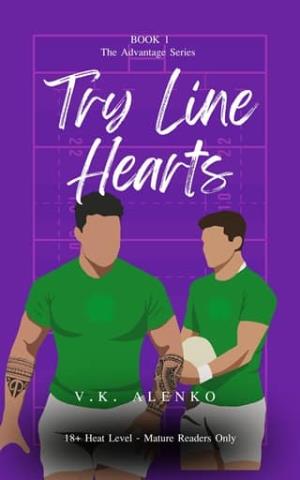
Try Line Hearts (Advantage #1)
Chapter One Collision Course
The Dublin morning had teeth; cold, wet ones—the kind that bit straight through Lucas Byrne’s Ireland team jacket and settled into his chest. He welcomed it because cold was simple. Cold didn’t ask questions.
He couldn’t afford questions. Not today.
He zipped the jacket higher, more out of habit than comfort. It didn’t matter; the wind always found him. It slipped through seams and collars, curled along his spine, reminded him—quietly, insistently—that control was never permanent. Only practiced.
First day of training camp.
First session as captain.
First look at the squad he’d be responsible for welding into something coherent—and marketable, and honorable, and uncontroversial.
Uncontroversial mattered more than people liked to admit.
Expectation pressed close, heavy and intimate, as the squad gathered on the pitch. Cameras would come later. Commentary later. Judgment later. For now, there was only grass underfoot and the weight of the armband snug against his bicep, a constant reminder that everything he did would be seen.
“Let’s warm it up, lads!”
Coach Carmody’s voice cracked across the pitch, whistle sharp enough to split stone. Players spilled onto the immaculate grass, boots churning frost into pale mist. Byrne jogged with them—not because he needed warming, but because captains didn’t stand still.
Captains set tempo, stayed visible and hid their doubts behind motion.
He scanned faces as they ran loops, cataloguing without effort. The returning lads were comforting in their predictability:
Rory Keane—lock and human battering ram, whose booming laugh could shake rafters and whose shoulders should have been regulated equipment.
Darren Morris—the wiry scrum-half whose mouth ran faster than his feet, sharp and relentless and always half a step from trouble.
Cillian Ward—a flanker built like a punishment, forever hovering between affectionate and homicidal.
Known quantities. Safe ones.
New faces blurred together—fresh haircuts, new boots, nerves masked as swagger. Manageable. All of it manageable.
Except one.
A problem.
Elijah Kaine—Eli to those who knew him.
Byrne clocked him mid-stride and felt something in his chest hitch, sharp and unwelcome.
Kaine ran with smooth, unhurried ease, every step balanced and sure, as if motion itself bent to accommodate him.
Nothing forced. Nothing showy. Just a body doing exactly what it had been engineered for.
Broad shoulders cutting clean lines through the air.
Lean muscle working without waste. Dark curls brushing his temples, already damp with mist.
Byrne tried not to look.
He failed within ten seconds.
Kaine was already a whisper around camp—speed, finishing ability, highlight reels from Super Rugby Pacific quietly circulating between phones and murmured conversations. The kind of signing that generated optimism. Headlines. Expectations.
Not just because he was good.
Because of how hard Ireland had gone after him.
Byrne had heard the story before he ever saw Kaine in the flesh—heard it in the quiet places where decisions were actually made.
In corridors after meetings. In low voices over coffee that had gone cold.
Ireland didn’t usually chase players like this.
They developed, they cultivated, they waited.
They didn’t cross hemispheres with intent unless the prize justified the risk.
And Elijah Kaine had justified it.
He was New Zealand-born. Māori. Raised in rugby the way some kids were raised in religion.
He’d come up through systems designed to feed the All Blacks, through academies that didn’t waste time on maybes.
By twenty-one, his name had already been floated—carefully, officially, dangerously close to inevitability.
The All Blacks had noticed him.
Which meant Ireland shouldn’t have stood a chance.
But they’d gone anyway.
Scouts flown out under the guise of “development conversations.” Analysts breaking down every meter he ran, every line he hit, every instinctive choice that couldn’t be coached.
Administrators sitting across from him in New Zealand hotel rooms, selling not just money but vision: leadership opportunities, a faster track to international caps, a team being rebuilt around pace and intelligence rather than tradition alone.
They’d made him an offer big enough to make people nervous.
Big enough that when the All Blacks’ interest became formal—quiet but real—Kaine had still paused.
Byrne remembered Carmody saying it once, shaking his head like he still couldn’t believe it. “We didn’t just recruit him. We won him.”
Won him away from the black jersey. From history. From gravity.
That alone would have been enough to make Byrne wary.
But standing here, watching Kaine move, he understood why Ireland had risked it.
Kaine didn’t play like someone grateful for an opportunity.
He played like someone who knew exactly what he was worth.
Like someone whose body trusted itself implicitly.
Tall—taller than most of the backs, long-limbed and broad through the shoulders, built with the kind of proportions that made defensive plans unravel.
Tattoos traced muscle and movement beneath his kit, ink that spoke of lineage and belonging, of something older than contracts and national anthems.
And he was—Byrne had to admit it, even as his jaw tightened—devastatingly attractive.
Not in a polished, sponsor-friendly way. In a way that felt grounded. Physical. Present. The kind of attractive that didn’t perform itself but existed whether it was noticed or not. The kind that made Byrne’s attention snag before his better judgment could intervene.
Byrne knew the danger immediately.
Not because Kaine was a problem player. Not because he threatened team balance or hierarchy.
Because Byrne felt the pull in his own body.
Because captains were supposed to manage risk, not become it.
Because Ireland hadn’t just brought in a winger—they’d brought in temptation wrapped in potential and set it loose under Byrne’s watch.
And Byrne—disciplined, devout, practiced at restraint—felt the unmistakable, unwanted truth settle into his chest:
This man was dangerous to him.
And the worst part was that he knew it the instant he saw him.
Byrne forced his gaze forward, jaw tightening until it ached. He hadn’t been shaken by a teammate on day one in a very long time—raw and stupid and still learning how quickly attention could turn into exposure.
Time to get himself under control.
Warm-ups bled into drills. Passing patterns. Rucks. Pace changes. Set-piece rehearsals. Byrne let the structure swallow him—catch, spin, call, direct. Numbers steadied him. Angles. Timing. Precision wrapped around him like armor.
Until Carmody’s whistle cut through the air.
“Right—tackle drills! Pair up!”
Byrne’s breath misted as he slowed. He looked automatically for Rory, his usual partner—predictable, steady, uncomplicated—
“Captain.”
The word landed low and warm against his spine.
Byrne turned.
Kaine stood a few paces away, grin easy, posture loose, eyes bright with something that felt dangerously like interest. His accent curled around the vowels—New Zealand by way of somewhere sunnier than Dublin had ever been.
“I hear you’re the one to beat,” Kaine said. “Thought I’d start at the top.”
Byrne swallowed.
“You don’t hold back,” Byrne said, keeping his voice level.
Kaine’s gaze flicked over him—not a stare, not anything anyone else would’ve clocked. Just a brief, assessing sweep: the armband snug against Byrne’s bicep, the set of his shoulders, the way he carried himself like space made room for him whether it wanted to or not. It lasted barely a second.
It was enough.
Kaine’s brows lifted, expression easy, curious. “Do you?”
Byrne felt it then—that familiar tightening, the one that came when someone saw more than they were meant to. He kept his face still. Captains didn’t react.
“Never,” he said.
The corner of Kaine’s mouth tilted, like he’d been expecting that answer. Like he’d hoped for it.
“Good,” Kaine said. The grin spread—not cocky, not sharp. Open. Unbothered. Infuriatingly warm. “Hate wasting time figuring people out.”
Byrne’s jaw tightened almost imperceptibly. “You’ll find we’re efficient.”
“I like efficiency,” Kaine replied, tone mild. “Means everyone shows their cards early.”
There it was.
Not flirtation—not something you could point at and name—but a shared understanding slipping between the words. Kaine wasn’t asking who Byrne was on paper. He was asking how hard he’d push back. How much he’d give when pressed.
Kaine took a step closer, rolling his shoulders loose, readying himself. His voice dropped just slightly—not quieter, just closer.
“Then tackle me like you mean it.”
It wasn’t sexual. Not technically. Kaine had no idea who he was talking to, not really.
But Byrne’s body didn’t care about technicalities.
Heat slid through him like recognition, sudden and disorienting, as if something ancient had woken up and stretched. His pulse jumped. His palms tingled inside his gloves. He hated himself for it immediately.
He nodded once, sharp. “Set.”
Kaine’s eyes held his for a beat longer than necessary—bright, intent, unreadable.
Then the whistle blew.
Kaine hit him like a dropped stone—low, explosive, technically perfect. The impact rattled Byrne’s teeth; his back smacked the turf hard enough to knock the breath from his lungs.
Not the hardest hit of his career.
But the most startling.
Kaine popped up effortlessly. “You alive down there?”
Byrne dragged in air and growled, “Again.”
They reset.
This time Byrne adjusted—stepped in earlier, closed the space before Kaine could gather himself, wrapped low and drove with his legs and the quiet fury of a man who refused to be surprised twice.
The hit landed clean.