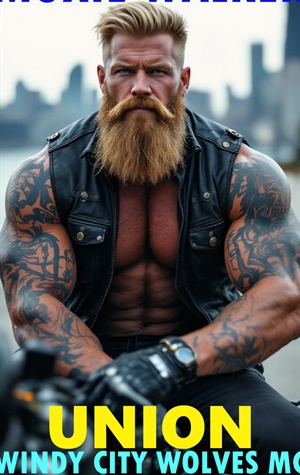
Union (Windy City Wolves MC #9)
Chapter 1
The body shop on Archer Avenue had been skimming from the Wolves for six months.
Union rolled his Harley to a stop across the street and killed the engine, studying the building with the same cold assessment he'd once given scab operations during union campaigns.
Corrugated steel walls. Three service bays with the doors down despite the afternoon heat.
A hand-painted sign reading MIKE'S AUTO BODY that looked like it hadn't been touched since the Reagan administration.
Lakeshore pulled up beside him, his Coast Guard build relaxed on his bike but his eyes already scanning exits. "Want me on the back?"
"Front's fine." Union swung off his Harley and rolled his shoulders, feeling the familiar tension settle into his frame. "This won't take long."
He walked toward the shop like a man walking onto a picket line—shoulders square, jaw set, no intention of leaving until the problem was solved. His grandfather had walked lines the same way. His father too, before the union went under and took everything with it.
Some things you carried in your blood.
The side door was unlocked. Union pushed through into the smell of Bondo and primer, his boots echoing on concrete as he moved past a half-stripped Camaro toward the office in the back.
Two mechanics looked up from their work—young guys, maybe twenty-five, with the soft hands of men who'd never done real labor.
"Shop's closed," the taller one said.
"Not to me."
Union kept walking. The office door was open, revealing a heavyset man in his fifties hunched over a desk covered in invoices and insurance paperwork. Mike Dunbar. Owner, operator, and the piece of shit who'd been fencing stolen Wolf property through insurance scams for the past six months.
Dunbar looked up and his face went pale. "I can explain—"
"No." Union stepped into the office. "You can't."
"Look, whatever you heard—" Dunbar was already standing, hands raised, backing toward the wall. "It was a misunderstanding. The bikes that came through here, I didn't know they were Wolf property. My guy said they were clean titles—"
"Your guy lied."
"Then it's his fault! I'll give you his name, his address, whatever you want—"
Union grabbed Dunbar by the collar and slammed him against the paint booth wall hard enough to rattle the spray guns on their hooks. The shop owner wheezed, his feet scrambling for purchase on the concrete floor.
"You fenced three Wolf bikes through your insurance contacts," Union said, his voice flat and direct. "You made twelve grand off property that belonged to my brothers. That's not a misunderstanding. That's theft from a collective."
"I'll pay it back—"
"Damn right you will."
Movement in his peripheral vision. The two mechanics had followed him, and the tall one was reaching for a tire iron on the workbench.
Lakeshore materialized behind them like lake fog rolling in.
He caught the tall one's wrist and twisted, dropping the kid to his knees with a sound like dry twigs snapping.
The other mechanic swung a socket wrench, and Lakeshore ducked it, drove an elbow into the man's solar plexus, and put him on the floor beside his friend.
Two seconds. Both down.
"Stay down," Lakeshore said quietly, and something in his voice made both men freeze.
Union turned back to Dunbar, who was staring at his employees with the expression of a man watching his exit strategy collapse.
"Here's how this works," Union said. "You owe the Wolves thirty-six thousand dollars. That's twelve grand times three, because a man who steals from workers pays triple."
"I don't have—"
"Then you'll find it." Union leaned closer, his scarred knuckles white against Dunbar's collar. "You've got two weeks. Miss the deadline, and we come back. Next time, we won't be having a conversation."
He released Dunbar and stepped back. The shop owner slumped against the wall, gasping, his hands shaking as they found his throat.
"And Mike?" Union waited until the man's terrified eyes met his. "If I hear about you fencing anyone else's property—bikes, cars, fucking lawnmowers—I'll shut this shop down permanently. You understand what permanently means?"
Dunbar nodded frantically.
"Good." Union turned and walked out through the service bay, Lakeshore falling into step beside him. The two mechanics were still on the floor, one clutching his wrist, the other curled around his stomach. Neither made any move to get up.
The afternoon sun hit Union's face as he stepped outside, and he breathed in the familiar South Side smell of exhaust and hot asphalt. Another problem handled. Another scab taught the cost of stealing from workers who stood together.
His grandfather would have approved.
They rode back to the compound through Bridgeport streets that Union knew like the back of his scarred hands.
Past the two-flats where three generations of his family had lived and worked and died.
Past the corner where his old man used to drink after the union closed.
Past all the ghosts of solidarity that Chicago had betrayed.
The meatpacking plant rose up ahead—two stories of brick and defiance, the Wolves' compound carved out of Back of the Yards history. Union pulled through the gates and parked his Harley in the row of chrome and steel that represented everything he believed in now.
A different kind of union. One that couldn't be broken by corporate money and political cowardice.
Lakeshore headed for the garage to check on a bike he'd been rebuilding, and Union made his way to the bar. The clubhouse was half-full with brothers drinking and bullshitting, the late afternoon light slanting through windows that hadn't been cleaned since the plant processed its last hog.
He grabbed a whiskey from the prospect behind the bar and settled onto a stool at the far end, away from the noise. His hand found his pocket automatically, fingers closing around the familiar weight of his grandfather's union pin.
He pulled it out and turned it between his fingers, studying the faded letters. LOCAL 743. CHICAGO.
Three generations of Grabowskis had carried this pin. His grandfather on the stockyard lines. His father at the trucking depot. Union had carried it through every picket action, every parking lot negotiation, every time he'd stood between workers and the forces trying to crush them.
Now he carried it into different fights. But the principle was the same.
"Body shop handled?" Razor's voice came from his left.
Union didn't look up from the pin. "Dunbar's got two weeks to pay triple what he stole. He'll find the money."
"And if he doesn't?"
"Then I'll find it for him." Union took a sip of whiskey. "One way or another."
Razor nodded and moved on, satisfied. That was the thing about the Wolves—they understood that some conversations didn't need explanation. You handled problems. You protected the collective. You made sure scabs learned that stealing from workers had consequences.
Union turned the pin between his fingers, feeling the worn edges smooth against his calloused skin.
His grandfather had died with this pin in his pocket and pride in his heart.
His father had died with this pin in his pocket and whiskey in his veins, everything he'd believed in stripped away by corporations and politicians who'd never worked a day in their lives.
Union intended to die with this pin in his pocket too. But he'd make damn sure the collective he'd found couldn't be broken the way the old one had been.
The bar filled up as evening came on, brothers drifting in from jobs and runs and whatever business kept the Wolves fed.
Someone put money in the jukebox and classic rock competed with the rumble of conversation.
Fang settled into his usual corner with a beer and a thousand-yard stare.
Stockyard started a poker game at the back table.
Union stayed at the bar, the worn metal of his grandfather's pin warm against his palm, thinking about picket lines and parking lot negotiations and the body shop owner who'd learned today what it meant to steal from men who stood together.
Chicago had killed the unions. Killed the stockyards. Killed three generations of solidarity and working-class pride.
But it hadn't killed the principle.
And as long as Union carried his grandfather's pin and rode with brothers who understood what it meant to hold a line, it never would.