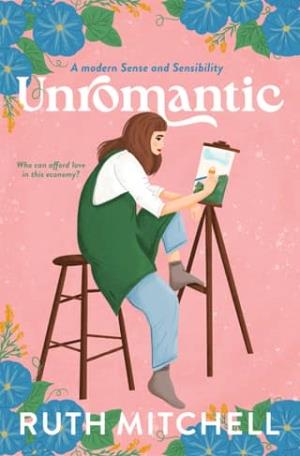
Unromantic (Modern Jane #4)
PROLOGUE
Dear, dear Norland! — Sense and Sensibility
Elinor
I breathe in the magic of Big Sur—sea mist scented with pine boughs, sage and a whiff of woodsmoke. The setting sun caresses steep slopes as they meet the cold blue of the Pacific. The glory of it all is impossible to capture.
Guests often ask if I’ve become jaded to the beauty of living here; I usually answer with a simple, “No, never.” I can’t put into words my deep affection for my home in the midst of the towering redwoods.
Only while painting do I begin to express those feelings.
I study the water scattered with gold flecks in the lowering sun.
How to replicate the ever-skittering light?
Should I use a buttery yellow, the palest of blues, or a pink-hued purple?
I pause before dabbing at my watercolors.
Birds chatter in the trees above, and in the distance, the surf murmurs and sighs.
“I’d buy that.” A voice interrupts my reverie. Startled, I brush an errant stroke on the canvas.
A man stands on the trail behind me. Backlit by the setting sun, he isn’t much more than a promising silhouette, with a voice pleasing enough to make me almost forgive him for intruding on my personal sanctuary. Few people know about this rocky outcropping only a short scramble off the main trail.
“It . . . it’s not for sale,” I stammer. The stranger steps closer.
“Everything’s for sale . . . for the right price.
” He pivots slightly, and with the change in lighting I can see that he has light brown hair—a shade my mom refers to as “old-money blond.” His eyes flick to mine briefly, and I feel a zing of interest. When encountering a man in the woods, I naturally put up my defenses, but something about this guy sets me at ease.
It’s as if my mind has automatically sorted him into the “friend” category.
Still, a girl alone in the woods can never be too careful.
I trust no one—not even my own instincts.
I reflexively tap the bear spray attached to my crossbody bag.
“It’s really not that good . . . it’s not even finished.”
“I disagree,” he says warmly. “I like it as it is—it speaks to me.”
I eye him suspiciously, noting his new boots, expensive hiking pants, and perfectly pressed shirt.
Each item appears fresh from the store, as if the tags have just been removed.
I can practically smell that new clothes scent.
This guy is definitely not an avid hiker, though his lean muscular build denotes a high level of fitness.
If I had to guess his sport, I’d pick tennis.
“We can agree to disagree,” I say in a friendly but not-too-friendly tone. As attractive as he might be, I need this tourist to move on.
“Hmmm . . .” His eyes dart between my painting and the spectacular view of the cliffs and the ocean.
“I’ll give you $500 for it.”
My guffaw startles a squirrel in a nearby live oak, setting off a high-pitched chatter of alarm.
“Is that too low?” he asks, running a hand through his hair. If possible, he is even more enticing with rumpled hair. “I’m sorry—I don’t normally buy the art.”
Buy the art—sounds like money. I steal another look and spy his vintage Rolex.
Yes, lots of money. Well then, he probably isn’t staying at Norland Park.
We do have our share of old money clients, but most of the uber-wealthy find the resort I manage too rustic.
He’s probably staying at the Post Ranch or another luxury boutique hotel in Carmel.
Maybe he’s just taking his new sports car for a scenic drive.
I wish he’d continue on his way. I don’t like how I am inhaling every detail about him .
. . stunning profile, strong jawline, good cheekbones, perfect nose.
I had no idea I held such strong opinions on noses until seeing this one—strong and straight with a slight bump.
“Was my offer too low? I hope I didn’t offend you.” An evening breeze ruffles his hair. “I can pay more.”
My mind whirls back to his earlier comment.
“Who normally buys your art?” I ask.
“My mom. She’s quite the collector.”
“Really?” I ask with genuine interest. There is no way I’m selling my amateur painting to this guy, especially now that I know his mom is an art collector.
However, my mom is a real artist with real talent, and though it has been years since she’s touched a canvas, she still has a few good paintings left to sell.
“Yes, she’s obsessed with art. I’ve never been as interested. But this painting . . . something about it . . .” He goes quiet as he studies my humble dabs. It really isn’t much more than a vague impression of the view, like a blurred reflection in rippling water.
“It’s not finished,” I point out.
“That’s what I like. It holds promise.” I look at the painting again and can almost see what he’s talking about. It isn’t half bad, but it isn’t half good either.
“What about $1,000?” he asks.
I laugh outright. “Ummm . . . you’re kidding, right?”
“Not one bit.”
“I can’t take your money. I’m not a real artist.”
“I don’t know what you mean by that. My mom always says, ‘Good art makes you feel something.’ This”—he points to my painting—“makes me feel something. I can’t name the emotion, but I know I want to buy it.”
“I’d be overcharging you.”
“I promise I can afford it.” He immediately backtracks. “Wait, that didn’t come out right.”
“You weren’t aiming for entitled and patronizing?
” I ask. Not my typical diplomatic self, but it’s been a long week, and I am so weary of wealthy customers throwing their money around .
. . like guests who demand I get air conditioning in their cabin, even though we make it clear in all our promotional materials that our cottages do not have AC.
We hardly need it here on the coast of Northern California; the daily high rarely exceeds room temperature, but some people believe they deserve perfect comfort at all times.
This sort of unrealistic expectation generally comes from our more affluent clients.
The working-class families in the campground never complain about the temperature—or call me at 2 a.m. demanding I bring them Fiji water.
It’s laughable how many guests have used the emergency phone number for their personal room service.
“No, no. I was aiming for snobby and pretentious,” he deadpans. “I find that’s always a crowd pleaser.” He flashes a sheepish smile. And so help me, I feel butterflies. I love a dry sense of humor . . . this could be a problem. I need to shut this down now.
Hoping to signal the end of our conversation, I start packing up my paints and then my easel.
He doesn’t take the hint and continues to gaze at the view as the clouds turn pink and the water silver.
I sigh. Well, if he isn’t going to leave, he might as well be helpful.
“Can you hold this?” I hand him the canvas. “Careful—the paint is still wet.”
“Of course.” He holds my painting gingerly as if I have given him something precious. He’s still admiring it when I finish packing my portable easel.
“You really like it?” I ask.
“I do. I don’t know why, but it moves me in a way I can’t explain.” He chuckles. “Sorry, that sounds a little woo-woo. My mom’s always saying stuff like that. . . . I never understood what she meant, but . . .”
I nod. That is exactly how I feel about this view . . . this place . . . my home. My painting is a poor imitation of this spot at the edge of the continent. Still, it gives me a small thrill to know that this stranger likes it too.
“Then it’s yours,” I say, continuing down the trail.
He trots after me. “Seriously? Thank you! How much do you want for it?”
“It’s a gift,” I holler over my shoulder. “Have a nice life!” I wave as I scurry down the trail.
“I can’t just take it—I should pay you!” He’s moving cautiously, carefully protecting the canvas while scrambling down the rocks, but I don’t bother to slow down for him.
I need to get away from this guy. He is too tempting, and I have no interest in being some guy’s vacation fling.
I pick up my pace as the trail levels out, becoming wider and smoother.
But the too-handsome stranger quickly gains on me.
I mentally move him from tennis player to long-distance runner.
“Wait!” he calls. “I need you to sign it.” I stop, and he catches up in a flash. “Someday when they’re auctioning your art at Christie’s,” he says, lightly panting, “I will want proof that I own one of your earliest works.”
“That is never going to happen. But fine.” I pull out a pen and sign it.
“E?” he says, examining my signature. “I was hoping for more . . . but I’ll take it.” He gives me a smile as dazzling as sunlight on the ocean. “I’m Edward.”
“Edward,” I repeat, hating how much I like the taste of his name. I start back down the trail.
“Hold on!” He calls after me. “What’s your name?”
I continue, trying to regain the blissful calm I had reached while painting outdoors—a futile task with this expensive tourist trailing behind. “Miss Mysterious E!” he calls after me. “Please have dinner with me.”
I stop in my tracks. Did he really just ask me out?
“Is that a yes?” Edward asks, sounding adorably hopeful.
I turn to face him but hesitate before answering.
I never date tourists. That’s my rule. I have too much on my plate, and I don’t have the bandwidth for a relationship, let alone heartbreak.
But this guy . . . he is so appealing—not the Rolex, but the mussed hair, the attentive eyes, the self-effacing humor and genuine smile . . .
But no, I made this rule for a reason, and I’m sticking to it.
“I don’t date tourists.”
“Seriously? That’s a devastatingly specific policy.”
“Sorry. I don’t have time to waste on relationships that can’t go anywhere.
And I never plan to leave Big Sur.” Truth be told, I’m so busy running Norland Park that I don’t have the time to date a local either.
But there are so few eligible men my age that it hasn’t really been a problem.
The steady supply of tourists is another story.
I can’t count the number of lonely, unwashed hikers who saunter through our camp after weeks of solo backpacking, sporting newly grown beards.
Most of them pursue my sister, but I’ve had to dodge my fair share of admirers.
I’ve just never met a tourist that interested me—except, perhaps, this one.
He is, I realize in an uncomfortable spasm of insight, exactly my type.
“That makes sense. But . . . I could visit—the city is not that far.”
So, he lives in San Francisco. That tracks. Everything about him signals that he belongs in the city. Reason enough for me to say no. But I hesitate. His smile alone is enough to make me reconsider my locals-only rule. Instead of dimples, he has these darling smile creases and crinkles by his eyes.
My mom and sister often joke about how dreadfully practical I am.
They tease that in place of a heart I have a spreadsheet.
I always laugh along—no need for them to know that I don’t avoid romance because of my stony heart.
I avoid relationships because I have a squishy, vulnerable heart that I must protect at all costs.
The whole family relies on me. I can’t risk any emotional setbacks.
Inherently risk-averse, I am not a thrill-seeker.
I have no interest in cliff jumping, motorcycles or sky diving.
And this Edward with his easygoing smile and squeaky new hiking boots—just a few hours with him and I’ll be free-falling.
“Sorry, that’s still a no.”
His face falls, but he rallies quickly.
“Well, at least I ended up with the painting. If you give me your name and number, I’ll Venmo you.”
“Nice try, Edward, but the painting’s a gift.”
“And I suppose I’ll have to be satisfied with that.”
We’ve reached a fork in the trail. I point to my path back to the resort. “This is me.”
He nods. “Thanks for the painting.”
“You really like it?” I ask. “Or was that just a pickup line?”
“I don’t do pick up lines,” he says bluntly. I can’t help but smile.
I’ve never had a guy ask me out so fast after meeting me. I can usually quell a man’s interest with a cold glance or an indifferent reply long before he thinks about asking me out. But Edward didn’t wait. His directness is surprisingly attractive.
But he’s still a tourist—here today, gone tomorrow. Nope, I am not up for that.
“I really like your painting. And I have this hunch that I’d really like you. Are you certain you don’t want to get dinner?” He must note my resistance crumbling. “I’ve heard there’s this place where they make the best garlic burgers.”
“Nope,” I shake my head sadly. “Can’t do it.” My mom makes the burgers he’s talking about at the park cafe. They’re famous for miles around.
“Okay, I can take a hint.” He appears absurdly disappointed, carefully holding my painting. He musters a half-smile. “I wish you nothing but the best, E.”
He puts out his hand for me to shake. I take it. The moment his skin touches mine my whole body buzzes with something unexpected. He must feel it too, because his eyes flicker with surprise. He lets go a little too quickly, gives a brief wave, and heads off, glancing back once before he disappears.
I stand for the longest time opening and closing the hand he shook, watching him disappear into the woods, already regretting turning him down.