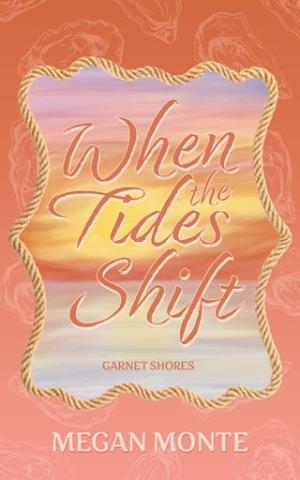
When the Tides Shift (Garnet Shores #1)
ELIZA
I’ve never been one to believe in signs.
Rainbows? Just pretty colors painted across the sky.
Ladybugs? They only land on you because they’re exhausted from flapping their wings a gazillion beats per second.
Finding a face-up penny means you’re one cent richer and zero-point-zero-two percent closer to buying a latte at an overpriced downtown café.
Good fortune doesn’t come from exhausted beetles or wallets with holes in them. It comes from hard work and strategic decisions.
So the fact that the downpour obscuring my car windows and flooding the gravel lot seems like a promising sign shows just how low I’ve stooped.
I’m so desperate for something good that my brain actually thinks the rain could be signaling a new beginning, washing away all the bullshit from the last two weeks that landed me in the nowhere-nothing coastal town of Garnet Shores.
Alright, maybe that isn’t a fair description. Garnet Shores, Rhode Island, is on maps. But the weather-beaten institution in front of my windshield is one of the only reasons it’s there.
Compared to Boston, it’s as exciting as a desert—the kind without stunning canyons and fun cacti that look like they’re waving hello. Maybe that’s unfair, too, but I grew up in a town as confining as it was uninspiring, and this one is even smaller.
It’s not that this town is ugly. Garnet Shores is actually rather cute, with its quiet rural homes, sliver of coastline, farm stands, and stretches of trees.
It’s quintessential coastal New England, without the preppy flair, lively atmosphere, or tourist energy I’ve experienced out on Cape Cod.
This is a place where you come to read a book on a quiet porch, migrate to the beach to continue reading said book, and—when you simply cannot digest another page—grab a drink at the sole bar that caters to all five square miles of this town.
It isn’t a place to make six figures, get promoted to Marketing VP, or network with entrepreneurs at happy hour.
Yeah, because all those things worked out so well for you.
Just like that, my chest tightens all over again.
I jerk my door open and shove myself into the rain. Promising-sign-from-the-universe or not, the downpour is relentless and distracting enough to stop my ribs from collapsing.
I’m tempted to dash across the gravel lot, but for some reason, running feels less professional than calmly allowing the rain to swallow me whole. So I keep my walk even as the smell of my new workplace cements itself in my head.
It kind of...stinks. Salty and briny with a hint of fish.
No surprise, given this gig is at an oyster farm, not a sterile office on the fortieth floor of a high-rise.
I’ll get used to the smell. I mean, I’ll have to. My contract is for twelve weeks, ending mid-August, and “adaptable” is on my resume. And while I might have exaggerated my skills a bit—because that’s what you do on resumes—I am good at making things work.
The closer I get to the office door, the more the building transforms from weather-beaten to charmingly rustic.
Wood-shingled, two stories high, and sprawling, it’s surprisingly well-kempt.
The shingles look freshly stained, pots of colorful flowers line the front porch, and I even see a few bird feeders.
A post pinned with multicolored wooden arrows—the kind you see in the Caribbean—offers helpful directions.
Order pickups are somewhere to the right, tours start by a little dock in the distance, and farm operations all point to the back of the building, which transitions from giant wood-shingled home to warehouse.
None of the arrows indicate the main office, but my welcome email told me it’s the yellow door under the porch.
“Gold’s Oysters” is spelled out above it in carefully arranged oyster shells, which should be tacky, but is actually kind of endearing.
The whole place looks like it was designed by a grandmother—not the moth-balls-and-prunes kind, but the crafty-crocheted-blankets-and-gardening kind. It’s surprising, because, if my research is correct, the whole Gold’s enterprise is managed by men.
Maybe men who crochet blankets and garden?
That would be a blessing. I’m at my wit’s end with the unfeeling, inconsiderate assholes I seem to attract like flies in the city.
Under the cover of the porch, I pull down my hood, check my hair for fly-aways, and peer through the office door’s window. I don’t see anyone, so I tentatively turn the knob, and come face-to-face with the tiniest office I have ever seen. Like, tinier than my city studio apartment.
There’s one big desk with a computer monitor, a cup of pens, and an empty chair behind it. On the wall hangs a giant map of what might be the oyster farm, next to a closed door in one corner. Two cushioned chairs line the windows beside me, and…that’s basically it.
Gold’s Oysters is in the midst of becoming one of the region’s top-tier oyster farms, distributing to Boston’s best seafood restaurants, and this is their front office setup.
There’s no one here to greet me. Not that I’m expecting a grand welcome party, but it’s my first day and I’m on time.
Eying the closed door beside the desk, I call out, “Hello?”
The only answer is the heavy patter of rain.
Taking another step forward, I try again, louder. “Anyone here?”
A muffled honk slices through the still air.
I jolt. “W-what?”
“Quack.”
This time, I jump, stumbling back against the doorframe.
Palming my heart before it jumps out of my throat, I wonder if I just hallucinated.
Because that sound was way too loud to come from behind the mysterious closed door, which means it came from inside the office.
But there’s no way, because it sounded like—
A duck waddles out from behind the desk, dark bill, brown feathers, and all. It stops when it turns the corner and stares at me with beady eyes.
“Quack.”
This quack sounds…impatient. Like it’s waiting for a reaction. But I can’t give one, because I’m still trying to process if I’m actually staring at a duck in the office. A real, live, enormous duck.
Five seconds later, it hasn’t disappeared, so I know this is real. And then I realize, oh my gosh, there’s a duck in the office. A wild animal.
Does it have rabies? It has to have rabies. Rabies makes animals do all kinds of abnormal behaviors, and a duck being in an office is definitely abnormal.
“Quack.”
I inch forward, one hand on the door handle in case it decides to charge me. There’s no drool coming from its mouth, which is maybe a good sign. With slow, careful movements, I extract my phone from my pocket and quickly search: How to tell if a duck has rabies.
The results have my hand dropping from the knob. Ducks cannot contract rabies. Rabies affects mammals.
I’m too relieved to be embarrassed I didn’t know this.
“Quack.”
This one’s disgruntled. Accusatory, like it knows I assumed it had a mind-addling virus.
I replace my phone and set my shoulders.
The little guy doesn’t have rabies, but he definitely shouldn’t be here.
There are wires and seat cushions for him to chew up and destroy.
Leaving him here while I find help will make me look like some incapable girl, and if corporate Boston taught me anything, it’s that first impressions are fast and final.
“Come here, ducky,” I croon in a high-pitched voice.
It blinks.
I crouch to its level. “Mr. Duck, let’s go please.”
Again, it doesn’t move.
Time to get resourceful.
I reach into my bag for the sandwich I packed for lunch. Peeling open the foil, I wave one end toward the duck. I’m aware this is a bird and not a dog, but given its size, it probably isn’t one to turn down food.
I’m right, because it happily waddles toward me.
I slowly open the door and inch outside, taking the sandwich with me. But the bird stops just before the threshold with another disgruntled, “Quack.”
“C’mon,” I groan, waving the sandwich.
It thinks about it, reaching forward cautiously with its head.
Come on. Come on. Come on.
I’m so zeroed in on whether its splayed webbed feet will take a step that I don’t notice how close the duck’s beak has gotten to the sandwich.
It lunges, and in the matter of a second, the entire turkey sandwich is out of my hand and in its mouth.
This is war.
“No, you did not!” I shout, lunging after the duck who’s a flurry of feathers as it escapes back into the office.
I’ve given high-stakes presentations in front of CEOs. Negotiated pay with a stick-up-her-ass HR executive. Navigated the subway alone at midnight. I’m not letting a cocky bird with way too much audacity litter this office with my sandwich bits and make me look like a fool on my first day of work.
There’s no time for an internet search on how to pick up a duck.
Two big steps get me right on top of it, where I reach down and scoop it up.
It squawks, a wing bashing me in the face as I stumble toward the door.
Something sharp scrapes down my stomach and I drop the bird, frantically palming my shirt for blood.
But the only evidence is a trail of loose threads in my sky-blue blouse.
This top was one of my favorite sale rack finds.
I turn, murder in my eyes. “You fluffy little piece of—"
“What in the hell are you doing?” The sharp exclamation comes from the open door behind me.
I pivot, wild eyes landing on the owner of the deep, angry voice.
His are just as infuriated as mine, two golden orbs glaring from a rugged, scruffy face that can’t be much older than mine. It’s all framed by messy dark hair, just long enough to curl against his forehead and ears.
I quickly scan his dark blue rain jacket and brown pants stained with black grease. When I zip back to his face, I spot a smear of that grease near the corner of his mouth, which is turned down in a scowl.
A scowl directed at me.
Seriously?
“Oh, I don’t know. Maybe I’m just trying to save this office from a wild bird,” I snark, because does this guy not have eyes?