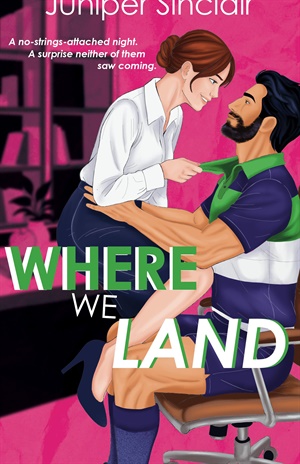
Where We Land
Chapter 1
“To the final interview,” Priya said, lifting her martini over the candle stub. “May Monday’s call include the words ‘generous’ and ‘effective immediately.’”
“You’re toasting a phone call that hasn’t happened yet.”
“I’m toasting what you’ve already survived. Five rounds, a case study they sprang on you, and a panel with a man who actually said ‘the cloud’ using air quotes.” She pointed her olive at me. “That woman has earned a drink. Be that woman.”
I was that woman. The final round had wrapped at four, and two hours later, Priya had commandeered the only open high-top on the Huxley rooftop.
It sat right against the railing, where the March wind rolled off Elliott Bay heavy with damp chill.
The propane heaters rattled overhead. Across the water, the Space Needle gleamed against the dark; behind us, downtown office towers stayed lit, floor after floor.
My whiskey rested on a coaster aligned squarely with the table edge. My nails were short, painted dark burgundy—my single indulgence in a wardrobe engineered to survive an audit. I’d hung my blazer over the back of the stool, and my hair had begun escaping its low chignon, one strand at a time.
Nothing counts until it’s in writing. You don’t celebrate an interview, you don’t spend a raise, you don’t book a flight. That wasn’t pessimism. It was common sense.
The panel had gone well. Priya wanted to dissect it anyway.
“What was Okafor after with that last question?” She leaned back, launching into an unmerciful, remarkably accurate impression of Diane. “She does that to every VP candidate. It’s like watching a nature documentary on apex predators.”
“She asked what I do when a plan falls apart halfway through.”
“And what did you say?”
“I change the plan.”
“And her?”
“She almost smiled.”
Priya whistled. On Diane Okafor’s scale, an almost-smile was a standing ovation with a bouquet of roses. She’d once described a CFO’s multi-year roadmap as “a promising first draft.”
My phone buzzed against the metal table. MOM, the screen announced. Greg was probably watching golf, and she’d already exhausted her conversational bandwidth with him.
“Katie.” My mother was using her celebration voice. “We’re so proud. Greg printed out the job description. He highlighted a few sections.”
“In multiple colors, or just yellow?”
“Katie...”
There was a laugh behind the warning, so I let it drop.
She asked about the flight case study, whether I’d eaten, and if people in Seattle were genuinely nice or just nice for corporate compliance.
I gave her what she needed while the candle flame shrank inside its glass.
Then, as usual, she jumped tracks without signaling.
“You know what I was thinking about today? My little planner. You got that from me. I had your entire life mapped out on that kitchen calendar: the dentist, piano recitals, everything. Even the thing with your father.” She paused.
When she started again, her voice had shifted into that familiar, softer register.
“He just wasn’t ready. I’ve told you before.
Some men don’t know how to handle surprises, that’s all.
And look at you now. Always with everything under control. ”
Heat crawled up my neck. I could control my voice, my words, and my expression, but my skin betrayed me in splotches of red.
I pressed the cold whiskey glass to the side of my neck.
I hated that the story still got to me; I hated arguing about it with her even more.
Years ago, my mother had decided on the version she could live with, and we never moved past it.
“It’s late back home, Mom.”
Unintentionally, I slipped into the tone I reserved for difficult vendors: polite, detached, final.
“Call me Monday when you get the news. I love you. Truly. Bye.”
I clicked my watch clasp open and shut. It was my grandmother’s gold watch and had survived forty years of marriage. She used to make that exact same motion whenever my grandfather let her win an argument. He did it often, and from what I remember, without suffering too much for it.
Priya watched me over the rim of her glass. She waited until I set the phone face down, aligning it with the coaster.
“How many glasses of Chardonnay is your mother in?”
“She meant well.”
“She always does.”
Priya waited for me to tell her what Linda had actually said. I nudged my phone a millimeter to the left. Priya understood the answer, polished off her martini, and stood up, trying to haul her coat on without dropping the olive.
“I’ve got a seven a.m. meeting tomorrow, a deck to finish, and a very serious relationship with the office espresso machine. Don’t stay out late, and don’t marry a stranger.”
She kissed the crown of my head and disappeared down the stairs.
* * *
The final whistle had blown across town an hour earlier, and downtown was still riding the win.
Fans poured onto the rooftop in waves, draped in blue and green scarves, chanting, “SEN-TI-NELS! SEN-TI-NELS!” Within minutes they’d claimed the entire railing.
Someone fired up a foghorn app on their phone and drew a cheer from half the patio.
A pack gathered around the fire pit, trading call-and-response chants with the bartenders. On the bar TV, the replay looped the final drive, each try bringing a fresh roar from the room. The stool across from me stayed empty. I set my phone to Do Not Disturb—my personal version of a wild night out.
Then I saw a man walk in.
The crowd at the bar parted for him. Two fans held up phones to snap photos over their own shoulders, and others stepped aside without being asked. He moved through the space as if he didn’t notice, or as if he were too used to it to react.
He had to be six-foot-three, with the kind of build you didn’t get from posing in front of a gym mirror: broad shoulders, heavy thighs, thick and well-proportioned.
The long-sleeved gray shirt fit closely enough to make that obvious.
His sun-bleached brown hair was a little too long, shaggy at the ends.
When he smiled at the bartender, he showed a capped incisor slightly more perfect than the rest of his teeth.
A pale scar cut through his left eyebrow, and his nose bent slightly to one side.
His features weren’t perfect. The marks made them more interesting.
He held a glass of sparkling water with a lime wedge. The tumbler looked small in his hands. A strip of athletic tape, peeling at the edges, was still wrapped around his wrist.
He looked at the empty high-top stool across from me, then glanced back at the crowd behind him.
“Is this taken, or are you saving it for someone more entertaining?”
“It’s open.” I moved my blazer aside so he wouldn’t have to sit on it. “The entertaining person position has also been vacant for about ten minutes.”
“Then consider this my application.”
He settled onto the stool; the table was small enough that our knees were nearly touching. Closer than strictly necessary, maybe, though neither of us corrected the distance.
A shout exploded from the railing:
“CAL-LA-HAN!”
The stranger raised his glass without turning around. The crowd answered with an even louder roar.
“They’re calling you,” I said.
“They do that sometimes.”
“Should I know why?”
He smiled for real. The scar on his eyebrow pinched, and I had to force myself to keep looking him in the eye.
“I love this city. Season opener tonight. We won.”
“You play for the Sentinels.”
“I do.”
“And what do you do, exactly?”
“Flanker. Number seven. I chase the ball and get stepped on. Professionally.”
He explained it like a guy talking about fixing pipes, then offered his hand.
“Cole. Cole Callahan.”
I shook it. His fingers wrapped around mine without squeezing. The contrast between the size of his hand and the gentleness of his grip traveled straight up my forearm before I could ignore it.
“Kate.”
“Just Kate?”
“For now.”
“For now,” he repeated, letting go slowly.
I looked at his glass.
“Water?”
“I run for eighty minutes most Saturdays. I try to stay on good terms with my kidneys.”
“Noted.”
He smiled again, as if that word had pleased him far more than was reasonable. He picked up the lime wedge, opened his mouth to say something, and thought better of it.
“I had a joke. I lost it.”
“A real tragedy.”
The silence stretched for a second. Neither of us scrambled to fill it. Then a boy appeared with an oversized scarf and a phone clutched in both hands, completely tongue-tied.
Cole took the phone, crouched down to eye level, and took the photo in under ten seconds. He did it so naturally that the kid never had time to feel awkward or small. Handing the phone back, those massive hands moved with that same deliberate care.
“Best night of my life!” the kid announced to the entire patio.
“Tell your dad the defensive calls were his fault,” Cole said.
The boy bolted toward the railing, eager to deliver the message.
“So, the flanker thing,” I said. “Explain it to someone who knows nothing about rugby.”
“I get in the way. The other team tries to organize, I get in the middle and make their choices harder. I don’t touch the ball that much, but I influence who ends up with it.”
“You’re a consultant.”
He pointed the lime wedge at me.
“I’ve never been insulted with such precision.”
“Do you bill by the hour?”
“By the eighty minutes. It’s a better model.”
The crowd roared at another replay. The table vibrated, nudging my glass off-center. I centered it back over the coaster.
“You line things up,” he observed.
I listened for criticism in his tone. There wasn’t any.
“Everyone has hobbies.”
“My preschool report said I didn’t respect play-zone boundaries.” He rotated the glass between his palms. “Some of us take longer to learn.”
The candle between us sputtered out, drowned in melted wax. Neither of us relit it. The amber glow from the propane heater caught the side of his face, catching the color in his eyes. Green, flecked with gray. He held my gaze without looking impatient.