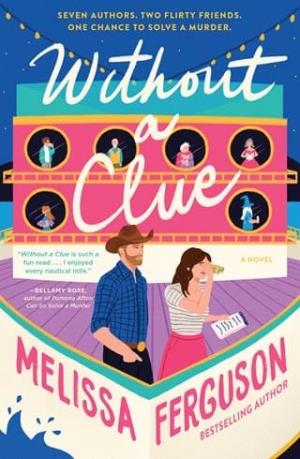
Without a Clue
Chapter 1
Did you know that jailbreaking your pent-up city toes from their Chelsea boots and surrendering your feet to the white-hot
sand of Miami in February is good for you? That standing right where the crest of bubbly waves gently hugs your ankles before
receding back into the blue-green ocean does wonders for your mental health?
But of course you do.
Just as you know, like everyone else on God’s green earth, that the torturous act of waking up in an obscure conference center in San
Diego at 3 a.m., missing your flight, rerouting your flying experience an extra ten hours through two more extremely stressful layovers (I don’t have time for details, but I’m now missing one shoelace and definitely have a welt blooming on my hip as
we speak), and becoming the ball in the great pinball machine of the United States is all worth it just to get to this moment?
But of course you do.
The beach is a miracle worker.
Any sane human knows that.
There are no words in the English language to properly describe the moment when you gulp in your first lungful of sea-salt air after months of particular grief and do precisely . . . nothing.
Nothing but stare out at the endless sea, listen as seagulls greet you gaily overhead, and feel the waves crash heedlessly
all around.
No phones.
No agendas.
No mind-spinning movement.
Nothing but letting the senses take over.
It’s worth it because of the ocean’s intangible something, that mysteriously magical something that beckons you and heals you and envelops your heart in a warm blanket embroidered with the word peace and makes everything you’ve suffered to get here—everything you’ve suffered the past six weeks—absolutely worth it because
of this moment.
Where the sea coos, I know you were a splinter away from breaking down into total madness, but shhh, child, you are here now. Rest and find peace
in my salty arms.
That is what I came for. (Well, that and the small fact I’m paid to for work.)
This is what I’m supposed to be feeling right now.
Peace.
And in fact, until twenty minutes ago, that was precisely what I was feeling.
And then he showed up.
With that THING.
And I’m not entirely sure of how it’s come to this point, how precisely point A led to point Z, but now here I stand, sensible twenty-seven-year-old Penelope Mae Dupont, with no criminal record or even so much as a speeding ticket, holding this stranger’s portable boom box high over my head in knee-deep water and waves tossing all around—all while threatening to hurl his precious music box into the sea.
I’ve gone, as it turns out, completely mad.
Which both is and isn’t surprising, given, as I said, I was only a splinter away before he came and ruined everything.
“Are you insane?” the man cries out, gesturing widely with his overtanned hands.
Then he utters some choice words.
And some more.
All of which I ignore.
A crowd is gathering.
But I, again in complete dissonance to my normal nature, don’t care.
“I definitely think you’ve got me there,” I cry back as the waves crash over my backside and send my green linen skirt twisting
and choking around my legs like I’m a seaweed-laden mermaid.
“Or who knows?” I toss out. “Maybe I’ve been insane all along.
Maybe I’ve been insane all these years giving myself over to absolute delusions of who I was and who he was and what in life I was really bargaining for and maybe now, right now, I’m finally waking up.
Who really, I wonder, has the authority to determine what makes us sane? ”
My philosophical question clearly sails above the man’s head.
After another cacophony of insults and a dozen commands, all of which I ignore, the man with the robust belly overtaking his
pineapple swim trunks finally has had enough.
He drops his beer can in the sand.
The beach chair quakes as he pulls himself to standing.
I am fairly certain I’ve never seen a person more directly angry with me in my life.
I waver for a moment, then hold the boom box higher.
To be clear, I did not wake up today with intentions to take on this one drunk man at two o’clock in the afternoon as representative of all that’s wrong with society.
I truly didn’t. I’m not one of those people who ambles around New York with a water bottle sticker declaring She Woke Up and Chose Violence.
My stickers revolve solely around literary puns, the saving of trees, and cats wearing funny hats.
But he was here.
Dropping his slew of items directly behind me with a whole stretch of Miami beach around us, just to make painfully loud and alluding comments about “the view.”
How beautifully green “the view” (a.k.a. my backside) was.
How perfectly round “the view” (a.k.a. my backside) was.
And I was fine at that point. I was still a reputable woman in society, capable of ignoring his idiocy.
I was still Penelope Mae Dupont, summa cum laude graduate of NYU in English literature, lover of old books that crack when
you open the spine and dogs that free-leash in Central Park at 8 a.m.
But then he cracked open what I guarantee was not the first beer of the day.
Made yet another leering remark.
And did the abominable. He turned on music.
Top-volume, angry, screeching, repulsive music that drowned out the beautiful keow of the seagulls, the laughter of children, the whistle of waves. A cacophony of
sounds obliterating all the things I traveled thousands of miles through emotional anguish and physical distress just to experience.
He ruined . . . my moment.
“It’s my music!” he demands.
“It’s our collective experience you are debasing!” I counter, pulling away one of the long locks of my wildly disobedient hair that was trying to blind me and make me eat it for lunch. I gesture at the growing crowd.
To be utterly honest, they weren’t exactly here before I made a scene.
Out of the corner of my eye, I see The Seven (minus Nash at the moment) in their little huddle, watching me. Suitcases are
at their feet. Massive sun hats and sunglasses cover their faces. Sunblock is smeared on Gordon’s nose like a vanilla Popsicle,
the cruise ship we are meant to be boarding in a matter of minutes flapping its flags far in the distance.
Jackie nods approvingly at my word choice.
Ricky appears to be making a note of the word in his phone.
Crystal, well . . . her gaze alternates between me, my opponent, and her phone as she taps madly (attempting to write my current
situation into a novel, no doubt).
“Put it away,” I say fiercely, pointing at her.
She gives me a caught-red-handed look and pockets her phone.
Pineapple Trunks takes a thunderous step my way.
“You give it back now,” he growls.
“Promise to turn it off,” I counter.
I’m five feet even and half of my height is covered in damp, dark brown hair. Thick and twisty hair that has tried to mummify
me in the salty wind. My long blunt bangs that reach to the top of my round glasses are plastered to my forehead, sticky and
no doubt incredibly unsightly in the humidity. Most days I look screamingly academic, running around in maroon sweaters and
juggling black folders full of Hugh’s pages, but right now I look more like a horrifying creature who has emerged from the
seaweed and is stealing people’s beach cargo.
Which is . . . some could say . . . fair.
Nonetheless.
I can still see nothing but that same old loyal expression of fondness in The Magnificent Seven’s—currently Six’s—eyes.
But then something distinctive changes in Pineapple Trunks’s look as he lets out another flash of outrage, and I cast a glance
at the tide and wonder just how seriously I can outswim him.
Neena jumps in.
No, that’s not correct.
Shimmies in.
“Okey dokey!” she cries out in a singsong voice, moving in between me and the man. “This has been a . . . well, a nice little
surprise in the day . . . but I think we’d best all settle down. Pip, honey, give the man his nice boom box.”
I open my mouth to protest, but she jumps in, adding, “And let me say, I’m so proud of you. This is great progress, and frankly, my dear, I’d love to sit this one out for as long as it takes. But the
boat has made that honking noise three times now, and I’m afraid if we let them go on any longer, they’ll leave us entirely.”
“They won’t leave us,” Hugh says. “We’re the ones putting on this cruise.”
“Never leave people believing they play second fiddle to you, Hugh,” she says, frowning at him. “It’s impolite.”
Hugh tucks in his lower lip, and Neena continues, “Anyway, I think it’s probably time we give this man back his property—no
matter how annoying he is or how many oxymorons he uses—”
“I’m not a moron!” Pineapple Trunks yells.
“Of course, dear,” she says, with a now let the grown-ups talk wave. “Or how generally wrong he seems to be in every way. It’s still his boom box, and we must give it back.”
“You heard her!” Pineapple Trunks pumps his fist in triumph and reiterates what she says very loudly, and much more forcefully,
in my direction.
Neena gives him a simpering smile and, to everyone’s surprise, pats his hand a few times. “I’ll take it from here.”
The man looks from his hand to her, this sixty-eight-year-old curvaceous woman in head-to-toe glittering purple.
And to everyone’s surprise, he sits down.
She turns to me.
“Come on,” she says then, beckoning me toward her like I’m some puppy being wooed from its cage. “Let’s go, sweetheart.”
“He’s just so insensitive,” I say.
“Very much so.”
“And the music was so abrasive.”
I take a tiny step forward.
The sparkling starfish clip in her hair glistens as she nods, and she reaches her hand out farther over the waves. “I heard
it all the way from the pier. A true blight to the human ear,” she agrees.
“And he was so . . . offensive.” I take another step forward, the boom box lowering slightly to my shoulder.
“I have no doubt. But we all make our own choices, don’t we? Some opt for a lifetime of meaninglessness. We can’t force someone
else to have a positive effect on the world.”
“Can’t we, though?” Hugh says casually. “With a little nudging?”
“Focus,” Neena says under her breath, smiling through gritted teeth.
I take a step forward.
Neena takes a small step forward to meet me. “The important thing is to focus on what kind of positive effect we can have.”
I nod, aware suddenly that the boom box feels heavy on my shoulder. The weight of this situation I put myself in is beginning
to settle on me, and the fire in me that started this whole mess is fizzling out.
“I want to have a positive effect,” I murmur and trudge through the waves.
My skirt is soaked.
My white blouse is dangerously close to getting soaked as well.
And my hair has twisted so far around me, I feel like a furry teddy bear.
I step onto shore.
“I know you do.” Neena clasps my shoulder with one hand in welcome home, soldier fashion and grabs hold of the boom box with the other. Swiftly she hands off the boom box to Hugh, who hands it to Ricky,
who hands it down the line to Gordon, Crystal, and finally Jackie, who hands it, with the kind of severe look only Jackie
and very, very angry librarians can give, to Pineapple Trunks.
He takes it.
People begin to clap.
“What a breakthrough. I’m very proud of you, Pip.” Neena engulfs my soaking wet, frizzy-hair-ensconced body in a hug (effectively soaking herself
entirely) that lasts several moments too long.
Eventually, the clapping dies down.
And Hugh clears his throat.
I look and see Pineapple Trunks with a screwy look on his face, the look of a drunk man trying desperately to use his remaining working neurons to deduce whether this was a situation in which to call the police.
The cruise ship gives another honk.
And I realize I’m already gearing up to make a statement, quietly hoping for a female officer who’s more likely to follow
the thread of how discussion of a perfectly beautiful view has led to this.
Neena swings her wide smile to the man. “You know what?” she announces. “You look like somebody who appreciates a good fruit
basket.”
Crystal rolls her eyes.
“Fruit baskets are not the answer to everything, Neena,” Jackie snaps.
They are, of course, to Neena, who firmly believes that a fruit basket is perfect in every situation from infant baptism to
petty crime.
“Forget the basket. Consider this your lucky day, sir,” Crystal, the youngest of 90 percent of the group by several decades,
says. “You get a heck of a story and a group picture! Free of charge. That’s worth a dozen fruit baskets and two dozen of
your archaic boom boxes.”
The man watches The Six begin nodding and mumbling in approval as though this is a most generous apology gift for an insane
woman who stood in the ocean holding his boom box hostage.
“Ship’s dropping ropes now,” Ricky says, squinting at the cruise ship in the distance. “I think they’re really going to leave.”
“They’re playing with us,” Hugh retorts. He kicks his suitcase, which topples into the sand. “And two can play that game.”
“Time for the photo op! Everybody in,” Crystal says, gathering the group together. Her eyes graze over the man dubiously. “Do your . . . swim trunks have a phone swimming there, or should we use one of ours?”
“All the sunblock’s covering my makeup,” Jackie protests, souring as she reaches into her handbag.
“Has anybody seen my hat?” Gordon says, twisting as he scans around him.
Pineapple Trunks notices, for the first time it seems, the crowd of bystanders with their phones all raised our direction.
“Who are you people?” he asks, as if we must be aliens freshly landed.
“Ah. The first intelligent question of the day.” Hugh steps out from the group, a head taller than the rest. He takes off
his hat. The sun glints on his silver and gray hair. His blue eyes twinkle. He looks distinguished and mysterious, even here
on this sandy port shore, just like his author photo on the back of every one of his mystery books lining the shelves at every
bookstore around the globe. “We’re The Seven.”
“The Magnificent Seven,” someone murmurs, phone raised.
“And that girl there,” Hugh says, pointing at me, “belongs with us.”