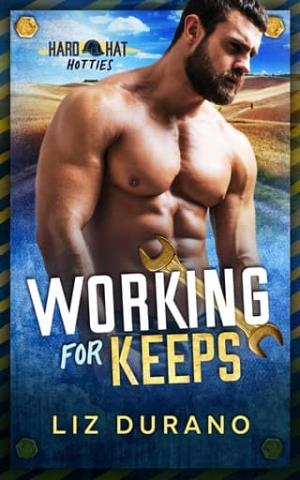
Working for Keeps (Hard Hat Hotties #13)
Chapter 1
One
Vera
The sign welcoming me to Forge Creek is exactly as rusted as I remember. The green paint peeling at the edges like burnt paper, revealing the oxidized iron beneath the surface.
Underneath the population count, someone has spray-painted a rough line, a minor act of small-town rebellion not scrubbed away in the three years I’ve been gone.
I grip the steering wheel of my rental car until my knuckles go white. The car smells like industrial cleaner and stale air freshener: a sterile scent that turns suffocating the moment I roll down the window.
The air rushes in cold enough to take the top off my lungs, laced with industrial oil and fresh-cut lumber and metal grit. It smells like hard work, like the kind of tired that lives in your shoulders.
It smells like Mick.
I swallow hard against the tightness in my throat as I wind down the pothole-riddled two-lane into the valley.
For three years, I’ve told myself that leaving was the right call.
In the glass-and-steel canyons of Chicago, surrounded by spreadsheets, performance metrics, and the relentless hum of the corporate climb, I found rewriting history easy.
I’d convinced myself that the Dear John letter I left on Mick’s kitchen table was an act of mercy.
We were young, trapped in a dying town, suffocating under a weight of expectations we couldn’t carry. I wanted a career; he wanted a life anchored to the soil and steel of his ancestors.
I saved us both, I’ve muttered on lonely nights in my high-rise apartment, watching city traffic crawl below. I gave him his freedom, and I took mine.
What I don’t let myself think about is that I didn’t only leave Mick. I left the one place that ever held all my pieces in the same room. My father carried me into this valley when I was four, a quiet Navy man home from Subic Bay with a half-Filipina daughter on his hip.
My mother got eleven Colorado winters before the cancer took her, my father a few years past that, and what was left was Nana Warden, the house she’d lived in for fifty years, and the two of us, my sister and me, raised on grief, casseroles, and an iron refusal to turn out soft.
I was the older one. I learned early that you earn your place by not needing one. I’ve been perfecting it ever since.
But as the skyline of Forge Creek comes into view, the lie crumbles. The files on my laptop may have given me the data saying Forge Creek was dying, but the valley coming at me through the windshield is a different number entirely.
I slow the sedan as the road constricts into a corridor of bright orange construction barrels.
To my left, the century-old brick skeleton of the old textile mill crawls with workers; half its facade has been sandblasted to a rich crimson, and a hand-painted sign for an artisan copper-works forge hangs over the archway.
I drive over the Black River Bridge, tires rumbling over a freshly laid seam of black asphalt. A yellow Public Works truck is parked at the berm as a crew in reflective vests reinforces the iron railings.
Well, whatever state Forge Creek is in, I tell myself I’m here to help it along.
I pull into the gravel lot of Halvorsen Works and park in a visitor space surrounded by mud-splattered four-wheel-drive pickups with toolboxes bolted to the beds. My silver rental is ridiculous here, and I can see that from inside it.
I sit longer than I mean to, staring at the weather-beaten brick facade of the plant.
Halvorsen Works has been the anchor of this valley for seventy years.
My father worked here. So did his father before him.
The plant makes heavy-duty industrial valves and custom steel stampings, unglamorous, essential components that keep the country running.
But Chicago Corporate doesn’t care about heritage. It cares about margins, and it cares that Halvorsen’s labor costs are dragging down quarterly projections, so it sent me down here as the corporate restructuring representative, which is a bloodless title designed to hide the ugly truth.
I’m the hatchet woman. I’m here to optimize, to streamline, to cut the fat.
And the fat, in corporate terms, always means people.
I never expected it to come to this. I’ve worked at Vantor Industries for nine years, six of them right here in town back when they had a remote office.
When they offered me the Chicago office three years ago, impressed by my work ethic, I said yes before the man finished the sentence and left Forge Creek without looking back.
Only now I’m back.
My reflection in the rearview mirror is pure corporate, as if I’d walked out of a company brochure. Dark hair pinned into a sleek bun, makeup flawless. And then there’s my battle gear: charcoal blazer, white silk blouse, slim trousers.
Only here, it makes me look like an executioner who bought her outfit on Michigan Avenue.
I can do this, I tell myself. It’s just an audit. I present the metrics and then I leave.
The admin office is what I expected. Low ceilings, fluorescent buzz, linoleum worn thin in the lanes between the desks. The receptionist doesn’t look up when the bell chimes.
“Can I help you?”
“Vera Warden. Vantor Industries, Chicago office. I’m here for the initial facility walkthrough.”
Her fingers stop over the keyboard. She looks up slowly, taking in the blazer, the hair, the briefcase. Whatever she was going to say next, she doesn’t say. News travels fast in a small town, and inside a factory it travels at light speed.
“Mr. Halvorsen says you’re clear for your floor assessment.” Her voice has gone clipped and hostile. “You’ll need a badge and safety glasses.”
She slides both across the counter. She doesn’t offer a hardhat.
“Thank you.” I clip the badge to my lapel, the plastic feeling heavy for its size.
I make my way to the end of the hall where reinforced steel doors separate the quiet of the admin wing from the heart of the plant. The moment I put my hand on the push-bar, the sound hits first, a wall of it, coming up through the soles of my shoes.
Thump-hiss. Thump-hiss.
The presses are the building’s pulse. Overhead fans cut the heavy air yet do nothing for the heat.
Floodlights buzz in the rafters and throw long shadows across a labyrinth of assembly lines and stacked pallets of iron castings.
The men move with a synchronized fluency no spreadsheet has ever captured: canvas, steel toes, grease-stained shirts, hands stained dark with oil that never fully washes out.
I open the efficiency log on my iPad.
Line Two is running eleven percent under its rated cycle, and I know it before I’ve finished the first column.
The bottleneck isn’t the press but the pallet handoff at the far end, and the fix is right there.
Six years I did this from a bedroom in this valley, and nobody in my division ran the models better.
Optimize. Find the redundancies. It’s what you’re paid to do.
But the stares press in. Welding masks come down, sparks dying to smoke as the suit invades their floor. Conversations stop, and the whispers that follow me are legible in every squared shoulder I pass.
I’m the enemy, the threat to their mortgages, their groceries, their kids’ shoes.
I keep my chin up and turn the corner past a hydraulic shear the size of an animal caught mid-bite.
Three men stand at the foreman’s desk over a blueprint. Two of them are silver under their hardhats.
The third is not.
He’s broader than I remember. A gray henley clings to his shoulders, damp, dusted with iron shavings. His forearms are corded from twelve years of the same eight hours. He wears no watch, no ring, nothing that could catch in the jaws of a machine.
Pinned over his heart is a silver union steward pin.
Mick Hayes.
The floor goes on roaring but I stop hearing it. And the moment he looks up, the universe shrinks to the concrete between us.
His eyes are the same dark blue I’ve been seeing in my sleep for three years, but there’s a hardness in them now. The reckless heat has been burned off and replaced with patience, which is worse.
He doesn’t flinch, doesn’t show a flicker of surprise, and takes a slow step back from the table to wipe his hands on a rag, every movement deliberate.
One of the older men mutters something and spits into a trash can.
I keep my chin up and follow the yellow line, heels clicking against concrete, my iPad held like armor against my chest.
Even in the drafty, ice-cold air of the plant floor, the heat radiating off him is an immediate, physical wall.
It cuts straight through the wool of my charcoal blazer and the thin silk of my blouse.
Every vibration of the heavy hydraulic press beneath my shoes suddenly matches the erratic thudding in my chest. The floor thumps; my pulse hits back twice as hard.
“Ms. Warden,” he says. “Welcome to Halvorsen Works. I hear you’re here to look at our efficiency.”
“Two weeks of it.” I bring the iPad up between us, which is the only shield I brought with me. “Time-motion on all three lines, then the workforce deployment model. I’ll want an hour with the steward before I put a single number in writing.”
“You know where to find him.”
Behind him the two older men have stopped pretending to read the blueprint.
“Let’s see what you’ve got,” I say, and I turn the corner past the tool crib and don’t let myself look back.