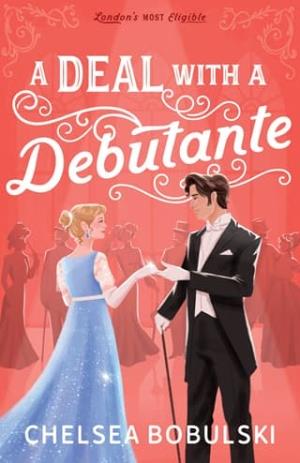
A Deal with a Debutante (London’s Most Eligible #1)
Chapter 1
Whitefawn Manor
Hampshire, England
Her mother had been thrilled to receive the invitation, although Miss Calliope Hart, currently eyeing the gentlemen of the ballroom through the leafy gaps of an overzealous fern, could not say the same.
She felt rather like a fattened pig at the county fair, with her mother attempting to sell her to the highest bidder; although the highest bidder in this case would not be the one with the most money, as the majority of marriageable bachelors in attendance were almost entirely broke (or, if not broke, still looking to add a considerable fortune to their depleted accounts).
No, Calliope’s future husband would not be carefully chosen by her mother among those gentlemen with the most wealth, as was typical among scheming, high-society mothers, but among those with the most prestigious titles and the largest, even if dilapidated, estates.
As an American heiress newly arrived from New York, Calliope was the one holding the money.
If she were there for any other reason, she would have been able to appreciate the architecture of the ballroom, delighting in the archways leading to the side galleries on the first- and second-floor mezzanines, which made her feel as though she were standing in the middle of a Roman plaza rather than in a country estate in the middle of Hampshire.
She would have breathed in the potted palms, snow-white roses, and gardenias perfuming the air with eager gratitude.
She would, right at this moment, be luxuriating in the warm amber glow of the chandeliers and in the way their light sparkled off the jewels decorating every woman’s neck, as well as the crystals embedded in their gowns, not to mention the artistic details of the Corinthian columns holding up an impressive dome ceiling delicately gilded to portray the night sky, with the North Star shining like a compass in its center.
It was an environment in which Calliope usually felt comfortable.
From a young age, she had practiced her dancing, etiquette, and conversational skills under the tutelage of skilled governesses, all so that she would be prepared for moments like these, when she would be standing in an opulent ballroom, wrapped in a gown of ice-blue silk specifically chosen to match the color of her eyes, and tapping her heel in time to the music as she waited for the right man to sweep her off her feet.
Except it turned out she hadn’t been properly groomed after all.
She would certainly pass muster in New York.
She had been named “the debutante of the Season,” in a society column last year.
But the rules were different in England.
It wasn’t that she was a complete heathen, but there was a proper way of doing something for every occasion, for every different type of person.
She would not address a duke in the same manner she would address an earl, and her curtsy, according to her new etiquette teacher, Madame Dupré, left much to be desired.
When Calliope informed her new teacher that she felt quite certain her curtsy was, at the very least, passable, Madame Dupré had replied, “Well, yes, dear, but you are an American.”
In the end, that was the only thing that mattered.
She was an American, and even though the majority of these men wanted—nay, needed—her for her money, they also looked down their long, aristocratic noses at her at every opportunity, and she simply could not imagine spending her life with anyone who saw her as a lesser person than himself.
Lord Wellesby, for instance—a viscount she’d had the displeasure of meeting at the Royal Opera House several weeks ago—was, at this very moment, circling the ballroom searching for her, his name the next on her dance card.
Calliope took a long, fortifying sip from her champagne flute as her mind flashed back to the night she’d met the viscount, a tall, rather thin gentleman only a year or two older than herself with gaunt cheeks and perpetually narrowed eyes, who appeared to garner his social currency from making others feel inferior to himself.
“Oh, wonderful,” he’d murmured to his sycophantic friends after introductions had been made, loud enough for Calliope to hear as she turned to follow her mother back to their opera box. “Another Robber Baron’s daughter has crossed the pond.”
The crowd surrounding him guffawed at the remark, as well as at the one that followed next, when Wellesby had compared her ilk to California’s gold-rush miners, wielding overly stuffed pocketbooks over pickaxes and seeking titles over treasures.
“Their manners are just as uncouth as their grimy-faced, shanty-residing countrymen,” he continued with a disdainful sneer, looking right at her as he said it (her mother had thankfully been engrossed in a separate conversation and had not heard him).
“I haven’t met one yet who knows how to properly address a peer of the realm, and none can hold an interesting conversation to save their lives. ”
Calliope had to bite her tongue to restrain herself from showing the viscount just how uncouth her manners could be, and now here he was again, hair shining beneath the chandelier light like an oil slick and jaw tight with annoyance, searching for her.
Well, Calliope had no intention of dancing with the viscount this night—or any other night for that matter—and so she was going to stay right here in her hiding spot behind the monstrously large fern.
Unfortunately for Calliope, her mother, Mrs. Mercy Bissette Hart, of the Maryland Bissettes, chose that precise moment to cluck her way around the corner with the other mother hens spending the evening cultivating their daughters’ prospects, and even if Calliope had possessed the ability to make herself invisible, she could not have done so quickly enough to escape her mother’s notice.
“Calliope?” Mrs. Hart, dressed in an emerald gown dripping with teardrop crystals that clinked together as she walked, stopped at the sight of her daughter. “What are you doing back here?”
Palms sweating, Calliope glanced past the fern and columns to the viscount edging ever closer.
“Um, I was”—she scrambled for something to say—“admiring this fern. An impressive specimen, is it not? Do you think the dowager countess found some unknown giant species in the rainforest and plucked it from the soil herself?”
The other ladies chuckled behind their fans, but Calliope’s mother’s lips drew tight.
She was not amused.
Closing the distance between them, Mrs. Hart pinched Calliope’s wrist between her thumb and forefinger, holding the dance card hanging from Calliope’s wrist to the light.
“It looks as though this dance belongs to Lord Wellesby.” Her mother’s gaze darted up to scan the ballroom. “And how fortuitous. There he is now.”
Calliope’s stomach dropped. “Mother, please, don’t, I beg of you—”
“Lord Wellesby!” Mrs. Hart trilled as she pulled Calliope away from the fern and directly into the viscount’s path. “I believe my daughter owes you this dance.”
Lord Wellesby’s returning smile reminded Calliope of a lion she’d observed once in the Central Park Menagerie, who had toyed with a mouse in his cage before swallowing it whole.
“Yes,” the viscount sneered, extending his hand. “She does.”
Perhaps it was the closeness of the viscount’s waistcoat against her chest that had Calliope feeling so flustered, preventing any hint of the summer breeze that had been trickling through the open windows and veranda doors from reaching them.
Or perhaps it was the fact that Lord Wellesby seemed incapable of going three seconds without saying something to offend her.
Either way, Calliope’s blood was boiling.
It had started innocuously enough. The dance was already half over by the time the viscount had led her to the center of the room, and Calliope consoled herself with the knowledge that she would not have to remain in the viscount’s arms for long.
Her hastily drawn battle plan had been to soldier her way through the remainder of the song by counting the steps in her head and dutifully nodding along to whatever topic of conversation her partner decided upon.
Her strategy went to shambles, however, when Lord Wellesby began by asking her if she even knew how to waltz.
Upon informing him, through gritted teeth, that she had been taught by a world-renowned dancing instructor at the age of eight, he murmured, “Really? I did not realize such European sophistication had traveled to the colonies. Tell me, do you dance it to the tune of Yankee Doodle?”
His lips quirked into a frustratingly pompous smirk. It was clear he was trying to get a rise out of her. His gaze flicked to a group of men at the side of the ballroom, watching with eager fascination and anticipatory grins. He’d probably promised his friends a show.
“Only when we are not dancing to ‘My Country, ’Tis of Thee,’ Your Lordship,” Calliope replied, unable to help herself.
An arrogant laugh escaped him. “Of course.”
Calliope opened her mouth, another retort on her lips, but then her gaze landed on her mother, watching them dance with such hope in her eyes that Calliope felt the least she could do was restrain her tongue for a few minutes more, for her mother’s sake.
But that was easier said than done. Yes, Calliope had been groomed for this life, and despite her contemptuous feelings toward their reason for being in England, she’d kept up with her studies at L’Académie Culturelle—Madame Dupré’s school for American girls trying to catch English husbands—if only so that she would not embarrass herself too often during their stay.
But Calliope had a wild streak inside of her that had been just as properly cultivated by her father and, later on, her best friends back home, which had the most annoying habit, at least in her mother’s opinion, of getting in the way of Calliope embodying the perfect high-society darling she had been groomed to be.