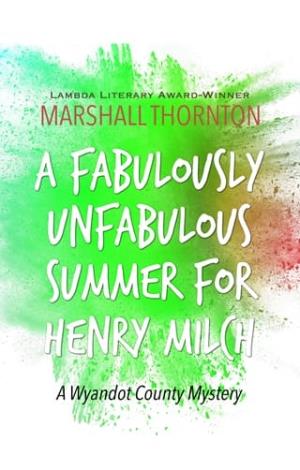
A Fabulously Unfabulous Summer for Henry Milch (The Wyandot County Mysteries #2)
Chapter 1
CHAPTER ONE
My Nana Cole claimed she couldn’t remember a blessed thing about the night she had the stroke.
I found that incredibly annoying since it meant, eventually, I’d have to come out to her all over again.
Okay, I want to be fair. I didn’t just tell her I was gay.
I sort of blamed her for all the violence in the world done against queer people and called her stupid. It might have been a little much.
No, thank you.
Of course, she could be lying. She probably was lying. Lying runs in our family like a bad overbite. Or, she might not be lying. Certainly if she did remember that night, it was hard to believe she wouldn’t blame the entire near-death experience on me.
Her stroke wasn’t my fault. But it was easy to imagine her deciding my being gay was such a horrible bit of news it had given her the stroke. I mean, there was my whole people-like-you are the scourge of the earth—
Well, enough about that. She recovered. Or mostly recovered.
She was in Midland Hospital for nearly three weeks before being transferred to Brookhaven Fields Rehabilitation Center, where she was asked to do all sorts of demanding things—like putting together the kind of fifty-piece puzzle you’d ask a five-year-old to complete or, and this was equally challenging, putting round and square pegs into the appropriate holes.
The first week or so, she had trouble speaking.
She slurred and drooled and chewed on her words as though they were Chiclets.
I really had no idea what she was saying most of the time.
But then her speech became clearer, and a month later it was very nearly what it had been.
She did still occasionally pause—as though she were trying hard not to stutter—and then skip forward quickly. Kind of like when a CD skips.
She was released from the rehab on the first Wednesday in June.
The sun was out in full force that day, and there were few clouds in the sky.
The temperature hovered just below seventy.
It was the kind of day we had often in Los Angeles, though rarely in Northern Lower Michigan, and it made me feel homesick.
To be honest, most things made me feel homesick.
Nana Cole had to sign a few forms and then an orderly, who was in his mid-thirties and Black—something which made him stand out like an over-bright neon sign in Wyandot County—pushed her in a wheelchair out to her Escalade which I’d left parked in front of the entrance.
Gently, he helped her climb into the passenger’s seat and told us to have a blessed day as he closed her door.
Walking around the SUV—only limping a little on the ankle I’d badly sprained six weeks before—I climbed into the driver’s seat.
When I was all the way in, Nana Cole said, “He was… nice.” There was a heavy dose of surprise in her voice.
“You mean even though he’s Black?”
“I didn’t say that.” She waited a moment then added, “But, yes. Even though he’s Black. When you see them on TV they’re so angry.”
“You shouldn’t believe everything you see on TV.”
“I meant… the news. The news is real.”
Having seen the news she watched, I didn’t entirely agree. I decided to leave that alone, though. I thought we should get all the way home before we had yet another argument.
As I pulled away, I turned on the local NPR station, which mainly played classical music.
It was the only station I could stand since the top forty stations were basically an episode of American Idol and there were zero stations playing club music.
A piece ended and the news came on. The big story of the day was that Martha Stewart had been indicted on nine counts of insider trading or some such.
Nana Cole grumbled and I thought for a moment she might have another stroke. She loved Martha Stewart. She had a subscription to Martha Stewart Living and faithfully watched her TV show. As the story ended, I resisted the temptation to say, ‘And that’s a good thing.’
The next story was about scientists genetically altering chickens to give them teeth.
“That’s horrible,” Nana Cole said.
“The chickens?” I asked, since she could have just been late reacting—
“Chickens are awful creatures. Teeth… would make them worse.”
“How would you know?”
“I used to raise chickens. When your mother was a girl.” She was silent a moment before she added, “The eggs were nice.”
Having had enough of the news, I reached over and pressed the tuning button until I found a country station.
“Oh, that’s George Strait,” she said, with a half-smile. It could have been George Bush for all I knew. I tried not to pay attention. I’d only put it on to be nice.
I suppose the drive from Bellflower to Masons Bay is scenic.
I mean, if you like trees and water and sky.
I wasn’t entirely sure how I felt about all that.
Everything had looked extremely dead when I’d arrived in February—which had matched my mood—and it continued to look dead right up until about Mother’s Day when the trees began aggressively sprouting leaves.
We had trees in Los Angeles, where I’d spent most of my life, but they never seemed to lose their leaves. They never looked dead. Or I didn’t remember them ever looking dead. One or the other.
I should probably explain myself. I went to a party at the beginning of February. A great party. Full of A-list gays. Or at least B-list. You know, industry types. I wanted to have a good time, so before I went I took a Vicodin I’d gotten from a girl at work when she wasn’t looking.
Later, at the party, someone offered me an Oxy. I think it was a 10, but I could be wrong. It might have been a 20, or even a 40. And I might have gotten one from someone else later, though it could have been something else entirely. That part’s very fuzzy.
The thing is, I don’t remember leaving the party or when I got home. Sometime in the early morning, my roommate, Vinnie, found me on the living room floor barely breathing. Or so he claims. Seriously, I love Vinnie to death, but he’s not the most truthful person in the world.
Anyway, 911 was called, and when my mother showed up at the hospital I was 5150’d (which, if you ask me, is a form of legal kidnapping). Three days later I had to decide between my grandmother or rehab. I chose my grandmother.
Possibly the wrong choice.
“Oh my God, what was that?” I nearly screamed, as we passed by some roadkill smushed in the center of the road. “Was that somebody’s cat?”
“Don’t be… stupid. It was a possum.”
“Ah, well, that’s better,” I said. I was getting used to constantly seeing deer and various other forest creatures dead by the side of the road. They were apparently not very bright when it came to crossing the street. But the idea of someone’s cat—
“Possums aren’t as gross as you think. They eat ticks. Bev told me.”
“Bev would know,” I said. She was my sometime boss at the Wyandot Conservancy. She tended to know a lot about the local flora and fauna. I guess I was supposed to feel bad about the dead possum, but I couldn’t muster the emotion.
“Cats are bad for the, uh, world. Nature.”
“Because they don’t eat ticks?”
“I don’t remember. I just remember Bev telling me… they’re bad. Barn cats. Not inside cats.”
Anyway, my grandmother’s farm was on West Shore Road right outside Masons Bay, a small—and I do mean small—town right below Michigan’s pinky, on the knuckle.
I say farm, but it really wasn’t anymore.
Not like it was. There were still two cherry orchards on either side of the long driveway, which she leased to her neighbor Jasper Kaine, who had a large orchard of his own, and with whom she split the profits.
The rest of the property, though, was given over to nothing more than a few vegetable gardens that would remain fallow that year.
She’d dropped hints about my doing the spring planting, but I chose not to hear them.
“Oh look, my lilacs,” Nana Cole said, meaning the three large pinkish blooming bushes by the house. Then she seemed to fold a bit. “I missed the tulips.”
There had been daffodils and then tulips while she was in the hospital and rehab. I suppose I could have been a better grandson and brought her some. Unfortunately, it hadn’t occurred to me. I suppose it should have.
“How do the cherries look this year?” she asked me.
“I dunno.”
“You didn’t go out to the orchard to look?”
“No. And I wouldn’t know what to look for if I did.”
“For one thing, whether there are a lot of them.”
Honestly, I didn’t know what would constitute a lot, so I didn’t say anything as we drove down the driveway to the two-story, white clapboard house with its large, stone porch—made of what I’d learned was called river rock.
Many of the older homes in Masons Bay used these rocks, which had been tumbled in nearby rivers until they were smooth and round.
Reaching Nana Cole’s house, there were four vehicles sitting there in the driveway. As I parked her Escalade, I noted that the cars belonged to Bev, Jan, Dorothy and Barbara. All friends of my nana’s. As soon as we parked, Reilly, her six-year-old yellow lab mix, came running.
“Why are they standing outside?” Nana Cole asked. “Why haven’t they gone inside?”
Except they couldn’t have because I’d taken to locking the doors. I said so and got a very dark look for my trouble.
“Why on earth… would you lock the door?”
“Because I nearly got killed just a few feet away.”
“That’s not going to happen twice,” she said, somewhat exasperated.
Rolling my eyes, I said, “I’ll grab your walker out of the back.”
I jumped out of the SUV and ran around to the rear. Reilly traced my every step, jumping up on me twice.
“Down boy,” I said, secretly pleased that he liked me so much. He had really become my dog in the last few months. I was trying to figure out how I could bring him back to L.A. with me when I left. Which I hoped would be as soon as my grandmother was able to live alone.