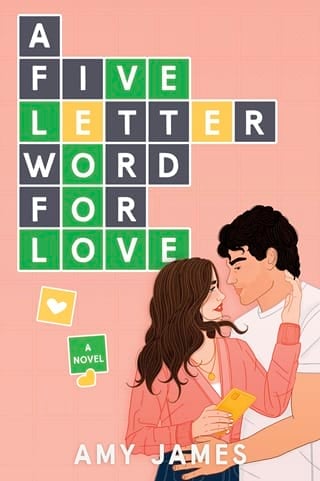
A Five-Letter Word for Love
1
Just between you and me, I’ve always found crossword puzzles condescending.
And yes, I know. Crossword puzzles are inanimate objects. They can’t be condescending or judgmental or smug.
But they totally are.
All those infuriating white boxes and pretentious clues, just laughing at you while you stare at them stupidly. Like, oh,
you don’t know who Deborah of The Innocents (96) is? And you don’t know a five-letter word for “simply be”? You poor, sad human. Do you even have a working brain?
I read somewhere that doing a crossword puzzle every day improves cognitive function and reduces brain shrinkage (which sounds
like a bad thing any way you look at it) so about a year ago, I downloaded the New York Times crossword app and decided to try it out. I got up at seven a.m., sat myself down by a sunny window (also proven to be good
for cognitive function), and was determined to make a go of it.
But... I couldn’t do it. I literally could not get a single answer. I kept clicking to the next clue, then the next, just
waiting for that “Aha!” moment when I’d finally get one.
Industrious animal in a classic fable. No idea.
Steppenwolf author. Nope.
Something that might be put on plastic bags. Immune system components. Unit in a duel.
No, nope, absolutely no sweet clue.
I called my father for advice, since I know he does the crossword every Sunday, and he said not to get frustrated and that
it gets easier the more you do it.
Which... how ?
It’s not like math. It’s not like you learn what two plus two is and then the next day you can still remember that it’s four.
It’s like learning that a brandy glass is called a snifter and then being asked the next day to fill in the last word of a
Benjamin Franklin quote. Surely one does not inform the other?
But it must, somehow, because millions of people do these things every day. Millions of people are strolling along knowing
a nine-letter word for “abruptly resign” and who the president of Finland is.
Honestly, it’s no wonder I can’t get a better job.
Anyway. I kept trying for about two weeks, waiting to get the hang of it (or for easier clues to show up) and for my morning
routine to transform into a blissful, fulfilling experience that improved my cognition and stopped my brain from shrinking.
But it never did. If anything, it felt like my brain was shrinking more , like it was contracting from stupidity or something.
I was just about to give up and revert to my old morning routine—scroll through cute animal videos on Instagram, realize I’m
wasting my life on my phone, frantically look up job postings, change the font on my résumé for the fortieth time as though
that might be the secret to getting an interview (“Helvetica? Let’s call her!”)—when I stumbled upon Wordle.
The instructions were simple enough for even my shrunken brain to grasp. You get six tries to guess a five-letter word. When you make a guess, the letters will turn gray, yellow, or green. Gray means that the letter isn’t in the word at all. Yellow means the letter is in the word, but you have it in the wrong place. Green means that it’s in the word and you have it in the right place.
It sounded doable, so I thought, what the hell, I’ll just give it a try. Surely it can’t be any harder than trying to figure
out a seven-letter word for “Off-the-books business, perhaps.”
So, I tried.
And I could do it.
It was easy enough that I didn’t want to smash my phone against my skull but hard enough that I had to work at it a little.
There were a few hiccups, like the first time I didn’t get a word and IDIOT popped up on my screen (I genuinely thought the
app was insulting me until I realized IDIOT was the five-letter answer), but after a while I got the hang of it. And it was
thrilling! That little surge of satisfaction when I figured it out quickly, the adrenaline rush when I got it right on the
last guess. I got a ten-day streak before KAYAK stumped me, then I made it twenty-nine days before I lost out to SQUAT. Then
suddenly, somehow, I had a forty-nine-day streak, and when I made it to fifty—BLUFF—I genuinely jumped up and down.
And okay, look, I can see you rolling your eyes. Thinking to yourself, what kind of loser gets so much excitement out of a
stupid app? Don’t you have anything meaningful in your life? You’re a twenty-seven-year-old woman, for goodness’ sake, don’t
you have a career to build or beloved children to adore?
And to that I say, go do a crossword, you pretentious cow. I think you’re the type of person who’ll enjoy it.
No, I’m kidding.
You’re entirely right.
The truth is, I don’t have a lot going on for me right now. I don’t have a career, just a low-paying job as a receptionist
at an auto shop and a bachelor’s degree in science that is entirely useless since I realized in my last year of university
that I actually want a career in the arts. And I don’t think I want any children, even if I had a boyfriend to make them with
or a salary to afford IVF or adoption.
So... yeah. It isn’t much, but I’ve got my Wordle. And I’m up to a three-hundred-day streak, now!
This morning, I put in DOUGH as my first guess (I was eating cookie dough for breakfast; don’t judge). The H was yellow (right
letter, wrong place), the rest of the letters were gray. Next, I tried PESKY (inspired by the housefly buzzing at my window),
which gave me a yellow P and a green Y. Then my mom called to have a chat before she and my dad go off on vacation to New
Zealand, so now I’m trying to finish the puzzle at work. Which might make me sound like an irresponsible employee, until I
tell you a little more about my job.
First of all, before you ask, no, I don’t have any particular interest in cars. I applied for this job for one reason and
one reason only: it was near a cute house that had crazy low rent. See, in my last year of university, when I realized I wanted
to work in a creative field like film or art, it was too late to go back and change my major. But I figured, hey, a bachelor’s
of science is still a degree . I could still apply for low-paying entry positions or internships in creative fields. Surely my passion and enthusiasm would
make up for my lack of a BA.
(Spoiler alert: they didn’t.)
The trouble was, for every job or internship I applied for, I was competing with equally passionate, enthusiastic people who had figured out what they wanted to do in the womb, like you’re supposed to, and who not only had proper arts degrees but who had already done all these impressive, artsy things. Like when I applied for a job at an art gallery in Toronto that went to a girl who had won a National Geographic youth photography award. Or when I applied for an internship at a Vancouver film studio that went to a twenty-one-year-old who had directed an award-winning short film. And honestly, I don’t blame them for not choosing me. I wouldn’t have chosen me either. But it felt like I was trapped in a catch-22. I couldn’t get a job without any experience, and I couldn’t get any experience without getting a job.
To make some money in the meantime, I applied for a few entry-level jobs for people with a bachelor’s in chemistry (my actual
degree), but there I ran into the opposite problem. I had the degree and decent grades but absolutely zero passion or enthusiasm.
I didn’t want to be an agricultural chemist or a toxicologist or a water chemist (whatever that is), and I just couldn’t fake
it well enough to get past an interview.
So, after about a hundred rejections (and eighteen months of living with my parents in their tiny condo in Halifax), I made a new plan. I was going to go back to school and do a proper, creative degree. But I already had a twenty-six-thousand-dollar student loan from my bachelor’s in chemistry, and no clue which arts degree I wanted to do. I wanted to choose the right thing this time, and every time I thought I knew for sure—Writing for Film and TV, yes!—I’d get prickles of doubt when I actually started the application. Was this what I was really passionate about, or did it just sound cool? What if I dug myself twenty-six thousand dollars deeper into my student debt hole and wound up with nothing to show
for it?
I waffled and I stressed, and all the while my loan payments piled up and my living situation grew a little more strained.
Not that I don’t get along well with my parents or anything, but it was pretty tight quarters, and I just felt so pathetic
every time I’d run into an old friend and they’d ask, “Where you living these days?”
So, when my mother’s friend told me her sister was looking for someone to rent their house in Waldon, Prince Edward Island,
for practically nothing, I jumped onto my computer to find jobs nearby. And there were exactly two: line cook at a local restaurant
and receptionist at an auto shop called Martin Auto.
I applied for both. After a ten-minute phone interview with the auto shop owner, Fred Martin, during which he asked me zero
questions and complained at length about his old receptionist leaving without any warning, I got the job.
(It’s probably lucky for the people of Waldon that the restaurant never called.)
I work at the shop from nine to five, Monday through Friday. I could try to describe what the shop looks like for you, but
that feels like a waste of both our time. Hop in your car and drive to the nearest auto shop. That. It looks exactly like
that.
Martin Auto has two mechanics—Dave, who’s old and car-obsessed, and John, who’s young and car-obsessed—and only schedules about ten appointments a day. The owner, Fred, doesn’t actually work in the shop anymore, so I’ve seen him maybe three times since I started. I answer the phone, check people in and pro cess their payments, tidy up the break room, and empty the garbage cans. And... that’s about it.
There are definitely good things about it. It pays just enough for me to chip away at my student loan, and it’s not very busy,
which gives me plenty of time to do Wordle and research arts degrees. And the town of Waldon is actually pretty lovely, with
brightly colored buildings scattered around a small fishing harbor, red sandstone cliffs to the east, and a long stretch of
farmland to the west. The air always smells like the sea, and in spring and fall, I wake up to the sound of lobster boats
whirring in the harbor. If I was someone who wanted a small-town life, I might be perfectly happy here.
Hang on a minute.
Happy .
H, P, Y.
Of course! I smack my forehead with the heel of my hand and swipe open Wordle. I type in HAPPY and voilà. The letters turn
green, one after another. My streak’s up to three hundred and one days!
As I do a little celebration dance in my chair, the shop doorbell jingles and an elderly woman with curly white hair steps
inside. She’s wearing a heavy coat even though it’s pretty warm out for May, and she looks vaguely familiar, although that
isn’t saying much. Waldon is such a small town that basically everyone looks vaguely familiar.
“Morning,” I say cheerfully. “Do you have an appointment?” I glance down at the schedule and wonder if she’s “Maud Williams,
tire change, 9:30 a.m.”
She looks a bit nervous. “No, there’s something wrong with my car. It’s making this awful sound.”
“Oh no.” I pull a sympathetic face. “Have you brought your car to us before? What’s your name?”
“Ethel Cox.”
I type her name into the awful, ancient program they use to keep track of customers and open her file. “You were here last
month.” I squint at the scanned receipt, struggling to make out a word of Dave’s writing. “Your car was acting up then, too,
wasn’t it?” I squint harder. “For a—a squelching noise, it says?”
“A squeaking,” Ethel corrects.
“And did they fix it?” I ask uncertainly. I can see that Dave charged her forty dollars last time, but I can’t see exactly
why.
“No, they couldn’t find anything wrong! Then the squeaking stopped, just like that. I thought it must have fixed itself, but
now there’s a new sound.” Ethel’s brow creases. “Could someone look at it today? I’ve got bridge in Charlottetown at three.”
She looks really stressed, poor thing. “It’s a pretty light day,” I tell her. “Let me go see if they can squeeze you in.”
She brightens. “Oh, thank you.”
I smile at her and then retreat into the garage to find Dave. He’s got a car up on the lift that belongs to one of the local
lawyers. It’s an old Porsche that’s apparently really rare or interesting or something. Dave and John both went nuts over
it when she brought it in.
“Morning, Emily,” Dave says. He’s a tall white guy in his late fifties, with graying hair, broad shoulders, and large, calloused hands. He’s divorced, with two adult children named Analyn and Jenny. Or at least, that’s what I’ve managed to glean from his Facebook page. He’s not big on personal talk, Dave.
“Morning,” I reply. “Do you have time for a fit-in today? There’s a woman here whose car is making a weird sound.”
“Not today,” Dave says. “John might.”
I turn away with an inward sigh. Great.
It’s not that I don’t like John, it’s just—
Actually, no. That’s exactly it. I don’t like John.
His full name is John Smith (because his parents knew how boring he was going to grow up to be, I guess) and he’s around my
age. He’s sort of good-looking, in a can’t-be-bothered-shaving, too-cool-to-care-about-how-I-dress kind of way, and I’ll admit,
when I first met him, I kind of thought we might hit it off. I put extra time into my hair and makeup the first few weeks
I worked here and tried to think of clever conversation to make.
But the thing is, John doesn’t care about clever conversation. Or conversation in general, really. Like, there was this one
time I walked into the break room and heard him speaking Spanish on the phone. So when he hung up, I said, all bright and
interested, “I didn’t know you spoke Spanish!”
And he said, “Yup,” and started scrolling on his phone.
I waited for him to elaborate, but when it became clear that was never going to happen, I asked, “Did you learn as a kid or
an adult?”
I was planning to tell him about this interesting study I’d read about how age impacts your ability to learn new languages.
Without looking up from his phone, he said, “My mom’s Dominican.”
I already knew that because of the time John was away for a few days and Dave told me he was visiting his grandparents in the Dominican Republic, but I nodded like it was news to me. “That’s cool. I wish I was bilingual. I’m trying to learn French, but it’s super hard. I should’ve done French immersion in school.”
To which he responded with a nod. No actual words, no “mm” of acknowledgment, just a slow nod, like what you do when someone
is being really annoying and you’re trying to get them to take the hint.
I should’ve just given up then, but at the time I thought he was cute enough to bother trying once more. So I asked, “What
language do you think in?”
He stared at me. “What?”
“I just... wondered what language you thought in,” I said. “Like, if you learn two languages in childhood, do you think
in both of them, or just one? Or does it depend on the situation?”
He stared at me again—slightly incredulously, I might add—and then shrugged. “Dunno.”
At which point I really did give up.
And look, I’m not saying it was a particularly genius conversation starter on my part, but at least I was trying to fill the silence. John has never once tried to initiate conversation with me, unless it’s, like, to ask me what time a
customer is coming in.
When he does talk—which is rare—all he talks about is cars. Even when he and Dave and I happen to be in the break room at
the same time, all he talks about is the cars they’re working on, or this race car he and his friend are fixing up to take
to the local track. And he never even tries to include me in the conversation, like he just assumes I couldn’t possibly be
interested.
Which... okay, I guess I’m not. But it’s still rude, and feels sort of sexist.
He’s also a jerk to customers, which is why I wish I didn’t have to ask him about this fit-in.
“What kind of noise?” he asks unhelpfully, when I tell him about Ethel’s car.
“She didn’t say,” I answer politely. I’m always polite to John. When you only have two coworkers, you can’t afford to be snarky
to one of them. I don’t think John has any idea I don’t like him (or that he’d care if he did).
He sighs. “She out front?”
“Mm-hmm.” Where else would she be?
I follow him back out to reception, where Ethel is sitting in one of the plastic waiting room chairs.
“This is John,” I tell her, since John never introduces himself to people. “He might be able to squeeze you in, but he was
wondering—”
“What kind of noise is it?” John interrupts. “Do you hear it all the time?”
“Oh, well, I don’t know,” Ethel says, looking flustered. “It started last week.”
John frowns. “So do you hear it all the time? And is it a grinding or rattling or what?”
I have to stop myself from rolling my eyes. This is what I mean. It’s not like he yells at customers or swears at them or anything, but he’s so curt and impatient. Like he expects a seventy-five-year-old woman to walk in and say, “Why, good morning, young man. I’m afraid I’ve just heard a distinct ticking noise from the exhaust manifold, so I’ve popped in to see if the gasket needs to be replaced. I would do it myself, but silly me, I seem to have misplaced my torque wrench!”
Honestly.
“It’s sort of a rattling,” Ethel says. “You know, I had a Honda for years and it never gave me any problems, but then I got
in an accident last year and I had to buy an old Toyota because the Honda dealership closed down—”
She launches into a story about her late husband, who didn’t get along with the owner of the Toyota dealership, and how she
can see why, because her new car isn’t half as reliable as her old one. I can feel John growing irritated beside me. And okay,
yes, this story is going on a bit long, but she’s a nice old woman. There’s no need for him to frown at her like that.
“I’ll take a look,” he says pessimistically, when she finally peters off. “Are your keys in the car?”
“No, I’ve got them here.” Ethel rummages through her purse. “Will it take very long? I’ve got bridge at three.”
“Depends what’s wrong,” John says, then heads off without offering any more information. I scowl at his back.
“Would you like me to call you a taxi so you can wait at home?” I ask Ethel.
“Oh, no, dear. I’ll just wait here, if that’s all right?” She eyes the tiny space. It’s basically just my desk and four ugly
plastic chairs. “I don’t want to be a bother.”
I smile at her, feeling a spark of warmth in the center of my chest. “It isn’t a bother at all.”