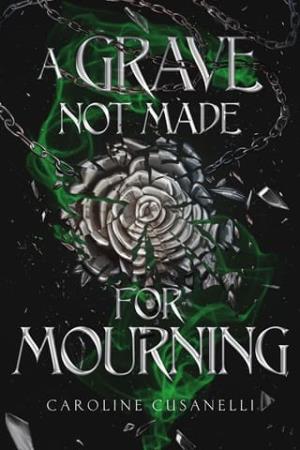
A Grave Not Made For Mourning (The Fated Blood Trilogy #1.5)
Chapter 1 Before This War Is Over, I’d Like to Ask
Before This War Is Over,
I’d Like to Ask
T
he room is silent, but I hear everything.
Boredom rattles behind me like a restless foot hitting a desk leg.
Over and over. Banging into my mind until I can’t forget the sound.
Shame slams into me from across the classroom—it’s not mine, but it roots itself in my chest like it grew there.
I suck in my stomach, hold my breath, make myself smaller, all for her. I do what she wants.
What she does.
Where does her feeling end, and my body begin?
The professor’s irritation hammers behind my eyes. Calista’s rage clings to my skin, settling beneath me like I belong to her. Lately, she feels like this all the time. There’s a party in the woods tonight, meant to celebrate her engagement.
One that I know was never her choice.
My teeth grind together until I’m scared they’ll shatter right out of my mouth. I want to slap the desk, throw my chair—anything to give this rage a place to go.
I want to scream. But it wouldn’t be my voice.
It would be theirs.
Instead, I grip the arms of my chair, my nails digging into the cushion until I hear it rip.
The sound seems to echo through the classroom, as if this space is sacred. Holy. Even if it’s far from so.
“Wendy,” Calista hisses.
I look up.
The professor’s face is stone. His bald head is shining. “Ms. Estridon, do you intend to participate?”
If I could explain, I would.
I am a body of water, contaminated by all that touches me.
“What was the question?” I ask, trying to separate myself from Calista’s constant anger.
He sighs. “If your personality shapes your actions—and that personality is largely a product of your genetics and life experiences, both of which are mostly beyond your control—can you truly be said to have free will?”
He paces once, slowly.
“Now, let’s complicate it,” he says. “Add the gods. Systems above you, shaping you. Does that give you more freedom—or take it away?”
The question makes sense. It just doesn’t leave room for mercy. I didn’t ask for this power or choose to feel everyone inside my skin. It’s the magic that isolates me. The thing that forces distance while I beg for connection.
I’d prefer free will to be a sham because I don’t feel I have any in the first place.
“I’d have to ponder,” I answer.
“That is the point of this class, Ms. Estridon.” His tone is curt.
I sink into my seat, wishing I could disappear.
Some of my classmates scoff, and it gets stuck in my throat. Some lean in, making it impossible for me to relax.
But one person stands out from the rest. Someone with an answer they aren’t ready to share; but I can feel its weight, the steadiness behind the unease. The conviction they feel for the topic.
I reach for it.
For Azaire. His emotions don’t spike or sting—they root, like a tree that stands no matter the storm. And when I lean toward him, it’s not just for relief; it’s instinct. Like moss stretching toward a crack in the cave ceiling, desperate for light.
His calm doesn’t make my palms sweat and my eyes twitch. It simply settles.
“Then no,” I answer, my heart pounding like I’m prey and not a person. “If I am composed of things beyond my control, then there is no free will.”
“And of the gods?” the professor goads.
“I’ve yet to decide.”
If the gods are cruel, or just careless.
If life is punishment disguised as choice.
If the gods shaped me, then they gave me this power. They either wanted me to struggle or suffer. Or maybe they weren’t paying attention at all.
But either way, they must not have liked what they made.
“It’s not a decision,” he says. “It’s a belief. What do you believe?”
My arms shake, both from the opinions of others and my own unraveling. “I believe it’s possible.”
“What is possible, Ms. Estridon?”
“That they shape us.”
“And what does that mean?”
“That… we aren’t free?”
The room stings—relief, dread, judgment. Everyone’s hiding behind their own answers, either thankful they’re not in my position or worried they’ll be next. It sets off a sequence of contradictions in my bones. Every limb reaches in a different direction, stretching me apart thoroughly.
I don’t know what I am.
“You made your choice today, did you not?” the professor asks. “You chose to sit in this class, whether you knew you’d enjoy it or hate it. Why? Why do you make the choices that you do? What has shaped you?”
Shaped me? Like I’m clay in a mold.
I am.
“I’m here because I have to be,” I say, choosing logic over emotion. “I’m enrolled.”
“You don’t have to do anything. That’s a belief.”
My torso tightens, unable to take in air. Calista’s emotion grows heavier—not because she cares about the topic. Only because she can’t let go of her future.
“There’s no free will. Is that what you wish for me to say?” I ask.
“I only wish for the truth.” The professor’s voice is steady. But not steady enough to calm me.
The truth has never been on my side. Nothing has. Not this room of onlookers—critiquing, watching, but never feeling. Not like I do.
I fail to distinguish my feelings and choices from other peoples’. What is truth, in that case?
Finally, I mutter, “I don’t know what that is.”
“Then that’s your first belief, Ms. Estridon. That your truth is unknowable. And that’s a prison you built for yourself.”
?
A cup falls from my shaking fingers.
No, not my shaking fingers.
Yes, my shaking fingers.
The glass shatters at my feet.
My fingers are shaking—but it isn’t my overwhelm.
I watch myself in the mirror, green eyes glowing from the spikes of emotion around me—the other girls in the suite.
It’s our newest suitemate that has me acting up.
Has my magic acting up. I’ve grown used to Calista and Aralia, like background noise I can tune out unless something major is happening.
Most of the time, I manipulate their emotions just enough to soften the edges.
Aralia’s always carried a quiet disappointment in the world, a hint of rebellion, but lately there’s something different—curiosity.
And I think I know why. Her new roommate, Desdemona, is a bundle of nerves.
Incessant, almost whining—for as much as pure emotion can.
I’ve never believed that people can’t sense emotions, at least to some degree. So I’m guessing Aralia’s sensing hers.
Calista is, as always, annoyed. She doesn’t want to go tonight and celebrate her forced marriage to Lucian, though she knows the power of appearance.
I’m surprised she’s in our suite, rather than getting ready with her friends. I think of walking to her room, asking her to do my eyeliner or offering her a skirt to wear. I wish I could. But that bridge sank long ago.
Instead, I do my own eyeliner and wear the skirt I used to lend her.
It was nice that she would ask. She’s a princess—she could get any skirt she wanted. She may seem harsh, but a hard shell often protects a soft interior.
And I know hers.
By the time I make it to the door, ready to leave, I flinch. Unable to open it.
“Wendy,” the voice in my mind says, his voice soft, delicate.
Disappointed.
“I know,” I respond to the boy. That’s what I call him. That’s all he is.
The boy in my head.
“Come to me.”
I do as he says, closing my eyes and entering the world of my mind. The four walls of my room slip away, and I fall into the woods—right beyond where the party will be.
He lies next to me in the grass.
“This is where you want to meet?” I ask him, staring into his big green eyes.
He didn’t always have them. In the beginning, he was nothing but a wisp of smoke, the shadow of a person. With the years, he’s taken shape, nearly growing into something real.
“You should go tonight,” he answers—though, not much of an answer, admittedly.
“I don’t want to.” I flip onto my back, looking up at the stars and away from him, but waiting to be convinced.
“You do.”
I’ve yet to name him. To the both of us, he’s “the boy.” On some days—like this one—that lack of a title makes him feel less tangible.
“If you didn’t, we wouldn’t be meeting here,” he finishes.
Where the party is steps away.
“That was your doing.”
“My doing is yours,” he answers. “You can do more than watch from the outside. That’s what Ma would say.”
I sit up, dusting imaginary dirt from my leather pants and staring into the distant trees. “When you say things like that, you make it clear that you are me.”
“You don’t want me to be you?”
“I don’t,” I say, raising my voice the way I only can in my head. There’s freedom in yelling.
I can’t remember the last time I truly did.
“I disagree.”
I glare at him. “How can you disagree if you’re me?”
The boy cradles my cheeks, his palms resting beneath my chin as he lifts my face. “Go. You cause yourself more pain by fearing it.”
?
I sit on the outskirts of the festivities, watching the dancing grass and bugs, feeling the sloppy students and singing stars. My classmates stand around fires with bottles of alcohol. Some dance.
It isn’t long before I turn away, shunning the crowd I never joined, and walk further into the woods. I’m desperate to escape the echoing words in my mind that are not mine—despite that being the very thing I have to endure to find human connection.
It seems an impossible task. That’s what I came for, and I’m already running away. I’m already weak.
There was no reason to believe anything would be different this time, but sometimes loneliness makes you do irrational things.
As I escape the crowd, my fists clench, as if holding onto something that isn’t here—desperation. My feet wobble, and I almost stumble into a tree—alcohol. Someone not far from here is angry, a second is drunk, and the last is full of fear.
If this is what happens with three people, how can I face the hundreds by the bonfires?
Nearly the entire student body is out here.