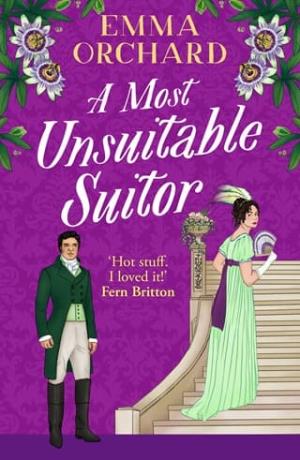
A Most Unsuitable Suitor
Prologue
Max Severin stood at the edge of the crowded ballroom, watching the colourful throng of dancers, men in evening black, ladies showing all the colours of the rainbow, and wondering what the point of it all was.
Well, he knew that, because he was almost six and twenty, not a green boy.
It was the marriage mart. Society existed to perpetuate itself, and it did that by ensuring that suitable young ladies met suitable gentlemen – they didn’t have to be young, the men, though the ladies emphatically did – and married them, and in due time produced more suitable young ladies and gentlemen.
That was what it was for, and to question it was foolish.
It would be like asking what cats were for, which any nodcock knew: to catch mice, look superior, and make more cats.
The members of the haut ton had other people to catch their mice for them, which left them with plenty of time to concentrate on the rest. Looking superior apparently came naturally; everything else took a little more effort.
The dancing, the flirting, the subtle or not-so-subtle manoeuvring – the making of good matches.
His friend Tom Ivory had told him that a Wednesday night at Almack’s Assembly Rooms was worse.
More boring, with worse food, worse music, and even more naked desperation.
He didn’t know; he’d never been offered vouchers that would permit him to go there.
It wasn’t a place one chose; one was chosen, and Max hadn’t been.
Perhaps some of the fearsome lady patronesses who decided such things might have condescended to admit him, but not all of them, clearly.
He wasn’t special in that respect; far from it.
London, of course, was full of people from every nation under the sun, and as far as he could tell always had been.
You could call yourself a Londoner wherever you came from.
How many languages were spoken in the world?
He had no idea – it wasn’t the sort of thing they’d taught at Oxford – but surely most of them could be heard in this great city of nigh on a million people.
He wasn’t even the only well set-up black man in London, he didn’t suppose – he was confident there’d be traders, merchants, probably for all he knew Yoruba princes and haughty, gold-rich aristocrats from Berber lands, or further afield.
But he wasn’t a prince or a tribal lord; he wasn’t even the son of an Englishman and an African woman.
That was not uncommon; the other way round was entirely unthinkable, of course.
Nobody knew what he was, not even his friends, and he intended to keep it that way.
But he wouldn’t hide himself, all the same.
And maybe that was why he was here. To make them see him.
To force the so-called elite of society to acknowledge that people like him existed, however little they liked it.
He certainly wasn’t present tonight and on all the other nights because he wanted to involve himself in marital entanglements, apart possibly from the kind that meant sleeping with other men’s wives, supposing those ladies were willing.
He imagined, cynically, that some of these people – debutantes, and their noble parents too – might be quite prepared to overlook his dubious origins if it meant getting their hands on his heavy purse.
They’d hold their noses and swallow him like bitter medicine, if they were impoverished enough and saw no better alternative.
But they wouldn’t get the chance, because marriage was the very last thing on his mind.
That being so, he didn’t dance. He came to parties like this with his friends, Tom and Gil, and lounged about, perhaps played a little at the card tables, drank a glass of warm champagne, surveyed the scene and listened to the latest gossip, then left for more congenial entertainments.
Safer ones. Because he knew the rules. To take the floor, as a single man of his age, was to signal publicly that one was available as a life’s partner too.
He wasn’t, so he didn’t raise expectations he had no intention of fulfilling.
It was true that there might be a perverse sort of a pleasure in asking a particularly disdainful young lady to dance.
If she refused him, she wouldn’t be able to accept anyone else for the rest of the evening; she would be obliged to stand and watch and waste her precious time.
She’d know that, and so would probably therefore accept him, just for a single set, however much she might inwardly hate the idea.
But no – that would be self-destructive and also unnecessarily cruel; he had not the least desire for an unwilling companion, even for ten minutes.
And the girls here were at the bottom of the heap, despite appearances, in some ways not entirely unlike him, or even worse off, because they could never have financial independence.
They too could not choose, but only wait to be chosen, even the loveliest of them.
The only power they had was the power to say yes or no, and take the consequences, in life as in the ballroom.
Max had been watching the dance with more attention than his casual, relaxed pose might have led anyone to imagine.
His handsome face was impassive, even a little bored, as was fashionable, and his unusual eyes, somewhere between amber and hazel, did not betray a flicker of emotion.
But he’d been observing one person all the while; his intent gaze had never left her as she moved through the steps, partnered with another man.
She wasn’t an especially good dancer, or an especially bad one, neither graceful nor clumsy but somewhere in between, but that didn’t matter a jot to him.
He didn’t usually regret his decision, taken a few years ago, not to fully participate in events like this; to be a mere observer, a cynical onlooker, and never to flirt directly with danger. But that, of course, had been before he’d laid eyes on Miss Allegra Constantine.