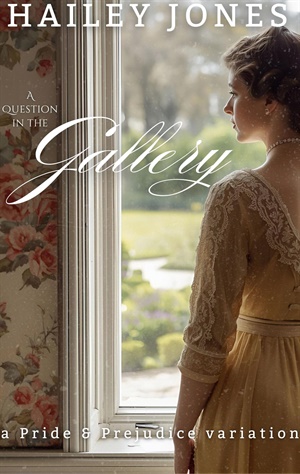
A Question in the Gallery (The Pemberley Collection #11)
Chapter 1
Elizabeth followed Mrs. Reynolds through the rooms of Pemberley with her aunt and uncle, answering when spoken to, praising what deserved praise, and keeping her eyes from lingering too long upon anything that might betray the uneasy movement of her thoughts.
When they entered the gallery, the light softened, falling from the high windows in pale, slanting bars, touching gilt frames and darkened varnish, and making the painted faces seem almost alive in their stillness.
Elizabeth moved beside Mrs. Gardiner, attending as well as she could to Mrs. Reynolds’s explanations, until her gaze was arrested by a smaller portrait near the end of the room.
She stopped, and her breath caught painfully.
The face was familiar at once: the handsome features, the open countenance, the easy sweetness of expression that had once appeared to her the very sign of candour. Her fingers tightened around her reticule before she knew they had moved, and the name escaped her in a low, startled voice.
“Mr. Wickham.”
Mrs. Gardiner turned immediately. “My dear?”
Elizabeth’s cheeks warmed. She had not meant to speak aloud, much less with such feeling, and the stillness of the gallery seemed to gather round her embarrassment. Mrs. Reynolds had turned too, her expression attentive but not impertinent.
“You know the young gentleman, ma’am?” she asked.
Elizabeth lowered her eyes for a moment. To confess acquaintance with Mr. Wickham here, in this house, after all she had lately learned, seemed almost to confess the whole history of her folly.
“I did,” she said, and her voice was quieter than she wished. “Or believed I did.”
Mrs. Gardiner’s look sharpened with concern, but Mr. Gardiner, with his usual good breeding, stepped nearer the portrait and spared her a question.
“He was connected with the family, I suppose?”
“Yes, sir,” Mrs. Reynolds replied. “His father was steward here many years, and much valued by my late master.”
Elizabeth looked again at the painted face, and a small chill moved over her arms. How readily she had trusted that look; how willingly she had allowed every agreeable smile to stand in the place of proof.
“He is handsome,” Mrs. Gardiner observed.
“Very much so, ma’am,” said Mrs. Reynolds. “And he was a pleasing child, by all accounts. He was much noticed in the family.”
There was nothing severe in the housekeeper’s tone, but Elizabeth heard restraint in it, and restraint now seemed more significant than blame.
Her heart beat fast and low, uncomfortably near her ribs, and the question that rose in her mind seemed at first too strange, too intimate, too impertinent for speech.
Yet it pressed on her with such force that silence became impossible.
“Mrs. Reynolds,” she said, turning a little from the portrait, “may I ask whether he was ever truly loved at Pemberley?”
Her aunt glanced at her in surprise. Mr. Gardiner’s brows lifted slightly. Mrs. Reynolds regarded her for a moment, not with suspicion, but with a sober kindness that made Elizabeth feel still more exposed.
“Yes, ma’am,” she said. “He was.”
Elizabeth’s throat tightened.
“My late master had a generous heart,” Mrs. Reynolds continued.
“There were few under his care whom he did not consider in some measure his own charge. Tenants, servants, dependents, old families upon the estate—he thought of them all. Mr. Wickham’s father served him faithfully, and the son was a lively, engaging boy.
There were circumstances, too, which made assistance useful... ”
She trailed off for a moment, but then added delicately, “Not want, exactly, but where money is not always governed with prudence, even a respectable situation may fail to provide all that might be desired.”
Elizabeth understood enough, and more than enough.
The words were too tasteful to accuse, yet they opened a new chamber in her mind.
Mr. Wickham had not been merely pitied; he had been provided for.
He had not been cast off by cold pride; he had been received, educated, and loved by a family whose kindness he had taught her to despise.
“My late master saw him educated,” Mrs. Reynolds continued. “He intended him for a gentleman. No one can say he was neglected at Pemberley.”
The heat in Elizabeth’s face deepened until even her ears seemed to burn.
Her gloves felt close and airless; beneath them, her palms were damp.
She thought of Mr. Darcy’s letter folded among her things, of the pain she had read there without wishing, at first, to honour it.
She had been so eager to laugh at him, so ready to condemn, so proud of her quick discernment.
“And the present Mr. Darcy?” Mr. Gardiner asked, after a short pause. “Does he resemble his father in the management of the estate?”
Mrs. Reynolds’s countenance warmed at once.
“In every way that matters, sir,” she said, “He is exact, fair, and kind. There is not a tenant or servant who would not speak well of him. Some gentlemen are liberal when they are observed; my master is considerate when no one sees it.”
Elizabeth could not look at her aunt. The gallery blurred a little before her, not with tears exactly, but with the strain of keeping them back.
Mr. Darcy—proud, disagreeable Mr. Darcy—had been known here by justice, steadiness, and kindness, while she, who had valued herself upon understanding character, had seen only what wounded her vanity.
Mrs. Gardiner came softly to her side. “Lizzy, are you well?”
Elizabeth forced a small smile, though it trembled before she could command it. “Perfectly well.”
She walked on before more could be asked, her steps measured, her pulse unsettled, and the painted faces watching from the walls as if Pemberley itself had become a witness against her.