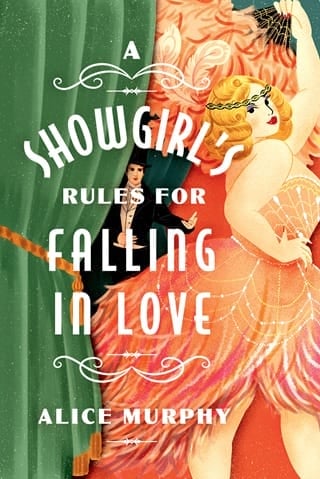
A Showgirl’s Rules for Falling in Love
Present Day
PART ONE
THE MOTH AND THE FLAME
Armitage Gallier [email protected]
Miss Blair,
Hello. I understand that you are the author of The Secret History of Vaudeville newsletter recently featured in NPR’s “Jazz Night in America” program. I have a research inquiry with which I believe you are best suited to assist me. Please reply with your availability at your earliest possible convenience. I am happy to meet with you in your office at the Manhattan Historical Preservation Society, or at another location of your choosing.
Warm Regards,
Armitage Gallier
Phoebe Blair [email protected]
Hi there!
Thanks for reaching out! So nice to hear from readers—there aren’t a lot of you out there, lol! “Featured on NPR” is a very nice way of saying, “referenced in passing by a random guest on a story barely anyone heard,” but I’ll take the compliment. Maybe even put it on my business card!
My “office” is more of a desk in TMHPS’ basement, but if you can stand the schlep downtown, it’s probably the best place to meet. That way, if you need any documents pulled from our archive, I can grab them for you then and you won’t need to make a special trip!
I’m in the office from 8 to 4, Monday to Friday. No need to make an appointment—I’ll be there, and probably bored!
Looking forward to it!
Phoebe
P.S.—I can go ahead and start pulling documents for you now if you tell me the subject of your inquiry!
Armitage Gallier [email protected]
Miss Blair,
Thank you for your prompt reply. I will visit your office this week.
No need to preemptively pull documents.
Warm Regards,
Armitage Gallier
Present Day
M ARSHMALLOW FLUFF. I T ALL STARTED WITH MARSHMALLOW FLUFF.
I mean, it literally all started with a three-email exchange with a man I’d never met. But that was just preamble.
In my heart, it started with marshmallow fluff.
You see, at the Manhattan Historical Preservation Society where I worked, archivists weren’t supposed to have food while on duty. But on the day Armitage Gallier finally materialized in my basement office, I was on my period, going through a brutal ghosting situation, realized that my favorite jeans didn’t fit anymore, had my coffee stolen from the pick-up bar at Starbucks and—
Anyway, there I was, sitting under my desk, eating marshmallow fluff by the spoonful like a very cool, very put together, adulting adult. I didn’t even consider the possibility that Armitage’s “I will visit your office this week” meant “I will visit your office when it’s least convenient and most embarrassing.” But then, the door opened.
Shit, I thought. Probably my boss .
So I tossed my snack/the incriminating evidence, scrambled back to my seat, and tried to do my best to look as not-guilty as possible.
“Oh, shit.”
This time, I didn’t just think that. I said it out loud. Because the guy standing across from me wasn’t my pinch-faced boss ( Sorry, Mr. Kaczmarek ), but … someone else.
Someone unbelievably handsome. Like, I thought he was a hallucination conjured by a bored and lonely mind handsome.
But no, he was real, and he was looking down his long, perfect nose at me.
Civilians never came to the archives. Researchers occasionally did, and the rumor was that Marty Scorsese visited when he was researching Gangs of New York (nice guy, apparently), but in all the time I’d worked there (six months), I’d only saved my isolated brain from going totally The Shining on everyone’s ass by reading way too many books, writing a Substack that no one cared about, and developing deep and abiding parasocial relationships with the hosts of my favorite podcasts and YouTube channels.
So yeah. Seeing anyone in the archives would have shocked me. But then I remembered the email. Of course, this surprisingly young, surprisingly handsome gentleman caller with the surprisingly muscular forearms had to be my pen pal. Armitage Gallier, the scion of the massive Gallier Entertainment and Telecom company.
The shock was enough to make me forget I had marshmallow fluff on my face.
“Uh, hi,” I said. Be professional. “Welcome to the Manhattan Historical Preservation Society. Can I help you?”
“I have an appointment with Phoebe Blair,” he said, his deep voice gliding over my name like a sharp blade over fresh ice. He looked hesitant, almost as uncertain and surprised as I felt. “Might that be you?”
“… Yes?”
“You don’t sound certain.”
When I saw that email from one of the biggest companies in the world, I thought you’d be some stuffy loser. And I mean, you may be kind of a stuffy loser, but you’re also a hot, stuffy loser I’d definitely try to take home if I found you at a FiDi bar on some random Tuesday. So yeah. You’ve thrown me off my game.
“Are you Armitage Gallier, then?” I asked, ignoring his question so I didn’t say something entirely regrettable.
“That’s me. Thanks for taking the time.”
“Thanks for donating the entire Eastern wing of the museum.”
Oof. Wrong thing to say. And in case it’s not already obvious, I was always doing that, saying the wrong thing.
I tried again. “Sorry. I’m not used to having people down here. Especially not—” Especially not guys with eyes green as Prospect Park. Especially not rich donors. Especially especially not rich donors with stunning green eyes looking at me like I’m important. “I guess I’m just a little out of practice in the human interaction department. Not many people come down to the basement for conversation. Can I start again? Hi. Yes, my name is Phoebe Blair. Nice to meet you, Armitage Gallier. Welcome to the Manhattan Historical Preservation Society. Can I help you?”
His Ivy League good looks only got better when he was trying not to smile.
“Yes, I think you can. I hope you can, anyway.”
“I’ll do my best. I’ve been dying to know what you’re looking for. Your last email was so mysterious.”
“Do you recognize this woman?”
From his pocket, he withdrew a plastic baggie containing a yellowing 4 × 6 piece of cardstock. Instead of handing it over, he held it out at a distance for my inspection, as if it were too precious to pass along to a stranger. The overhead lights glared off the plastic, so I blinked.
I readjusted my glasses. Then, blinked again. This time, it had nothing to do with the glare.
“Where did you find this? Looks original.”
“I believe it is. Would you mind signing a nondisclosure agreement before we proceed?”
Boy. If I had a nickel for every time a guy asked me that …
An hour later, once I clocked out of work, I broke the number one rule of New York City singlehood. I went to a second location with a guy I’d just met.
A total rookie move. I didn’t know anything about this dude except, well, that he was Armitage Gallier of the Galliers. Yes, I had googled him after I’d gotten his emails—I am a professional researcher, after all—but basically all I had learned was that he was super rich. In fact, the kind of super rich guy I typically hated, who seemed to spend a lot of time dressed up at galas and soirees with very thin models. Now, here I was in his car. He’d given me very little information about this assignment, and his dark eyes did totally unprofessional things to me. The whole situation had all the makings of a Lifetime original movie—the slightly sexy but potentially murder-y kind.
But when a strange guy with more money than God hands you an original 1896 Evelyn Cross Spring Will Come girlie card and asks you to go somewhere with him, you’ve just gotta say yes. What other choice do you have?
Near the turn of the century, Evelyn Cross was one of vaudeville’s hottest commodities, a genuine star forged by the strange, American art form. A plus-size performer with scintillating yet tasteful song-and-dance numbers, she toured the United States and Europe, becoming a huge box-office draw all on her own. She counted Harry Houdini and Ethel Barrymore amongst her friends. Later, a group called Billy Watson’s Beef Trust would co-opt her iconic style, billing themselves as a troupe of beautiful dancers each over two hundred pounds, and going on a hot streak of popularity spanning nearly thirty years. Before there could be Judy Garland, Fanny Brice, Sophie Tucker, or even Miss Piggy, there was first Evelyn Cross.
Just as legendary as the woman herself was her disappearance from vaudeville in 1897. Her abrupt departure from the stage was a mystery no historian had yet been able to solve. So even without the good-looking millionaire of it all, seeing a mint-condition girlie card of Evelyn would have been enough to make me drop everything and follow Armitage Gallier anywhere.
To take matters a step further, I was a plus-size woman myself. And not one of those hot, striking plus-size women who knew how to dress themselves to show off every curve. I was a jeans and oversized sweater, half-jar of marshmallow fluff for a stress snack, insecure mess of a plus-sized woman. Evelyn Cross, with her bold, unflinching performance style and reputation for sexual conquest, had always been a particular fixation of mine. An image of the woman I could have been if I had even a fraction of her courage and self-confidence.
Back in high school, I’d been basically every fat-girl stereotype rolled into one. And when a boy pulled a mean prank on me involving prom, a date, and me showing up to the first without the latter, I’d fallen into an eating disorder spiral. I visited the pro-ana Tumblrs, I pinned thinspo to my locker, and I drank Diet Coke and chewed Tic Tacs for at least two meals a day.
For a while there, I wasn’t sure I’d live to see graduation. But I didn’t care about graduation. All I wanted was to disappear.
But then, while researching for a final paper in my US history class, I’d come across some photos buried deep in a local archive. These weren’t the glossy pictures from documentaries or history books, and they certainly weren’t glamorized stills from one of those classic MGM musicals. They were snapshots from a local theater, where Evelyn Cross had once passed through town to rapturous notices.
She was a woman who looked like me.
After a lifetime of idolizing Kiera Knightley thinness and Nicole Kidman’s consumption-starved body in historical costume dramas, it was a revelation. Contrary to what galleries and textbooks and pop culture would have you believe, fatness wasn’t some new concept. And people before me had lived and loved and been celebrated in bodies like mine.
I went to my counselor that afternoon and told her about my eating disorder. She got me the help I needed. I lived to graduation and beyond. All because of a few pictures pulled from the library. Proof that history was more than I’d been told. Proof that I could have a life and love without changing who I was.
That’s what made me passionate about historical research in the first place: the idea that people have been erased from our history … and I had the power to bring them back.
And, by doing so, I got to make people feel less alone. I had the power to give other people the same revelation I was once given all those years ago.
Evelyn Cross was a chapter in that lineage. She was big, unapologetic, and a star. She wasn’t the first buxom beauty, and by God, she wouldn’t be the last. But she was remarkable. An undeniable inspiration.
She gave me hope. Reassurance. Encouragement that, one day, I could be like her, too. Not just a fat girl who’d survived an eating disorder, but a full-fledged person —one who believed in myself, loved myself, and reached out for more.
That’s why this opportunity to research her for Armitage Gallier was personal, right from the start.
What I didn’t know then, as Armitage’s driver inched his Continental GT through Manhattan traffic, was that it was personal to him, too.
“It’s not a big thing, really,” he said in the quiet, rushed way people used only when they said really big things. His eyes darted this way and that, as if he expected mal-intentioned eavesdroppers under the car’s seats or inside my six-year-old iPhone. “It’s just that my dad is retiring to the South of France soon, and he’s deciding how to split up the family properties before he goes. We opened up the old estate on Fifth Avenue—it’s basically gone unused since the ’50s—and when I went up to the attic, I found some old junk that I want more information about. Like I said, not a big thing.”
Old junk, huh? Fucking rich people.
“Really?” I teased. “The South of France? I thought you billionaires were all retiring to space these days.”
A tiny sigh. “I sounded like a total prick just then, didn’t I?”
“Don’t worry. I’m not sure guys like you can help it.”
Our eyes locked. A look passed between us that I’d only seen in movies—at first defiant, then soft and vulnerable, then bashful at what we’d both just revealed with nothing more than a glance.
He let out a small laugh, took a handkerchief out of his pocket— rich people —and lifted it to wipe that forgotten streak of marshmallow fluff from my face.
I shivered and did a thing I never should have done. I decided I liked him.
“Believe it or not,” he said, “I’m a little out of practice in the human interaction department, too.”
From the outside, the mansion on Fifth Avenue looked as if it’d been plucked from one of my photographs back in the archive. A copy-pasted sliver of our collective history, the sight of which made me giddy with nerd excitement.
Once inside, that excitement only increased. If there was an opposite of the Tenement Museum, this house was it. Nothing against the Tenement Museum, obviously—but I have always had a weakness for glam, and this was a perfectly preserved nineteenth-century mansion, complete with original furniture and what appeared to be a functioning gramophone.
Near the end of our tour, he tried to breeze us through the parlor, but an oil painting above the mantel caught my eye. I stopped on a rug older than most universities in this country and stared.
It looked like any other turn-of-the-century painting at first glance, John Singer Sargent in style and abruptness. A stern man in a suit standing behind a seated, button-nosed woman attired in her finest gown and jewels. He was surprisingly handsome, and she slender and lovely. Confident brushstrokes. Strong use of shadow.
I noticed the family resemblance between the two painted figures and the live one waiting in the doorway for me. Over a century had likely passed since the portrait had been made, and still, the genes ran strong. Armitage shared the man’s strong jaw. His ears peeked out a little too far from his head, just like the woman’s.
But there was something else that caught my eye.
“That’s Thomas Gallier, isn’t it?” I asked.
Everyone who knew anything about the history of New York, or vaudeville, or the history of power in the United States, knew about Thomas Gallier. I recognized his picture from the hundreds of photographs and articles about him I’d thoughtlessly catalogued at the archive.
“Yes, and that’s his wife. Constance.”
“They look …” How to say this without being rude? “I mean, they look—”
“Like royalty? We have a copy of this painting in our offices in London. My mother loves the image they project, makes us put them up everywhere. People always assume they’re old royals.”
“I was going to say miserable. They look miserable.”
Armitage shifted, but that tiny light in his eyes telegraphed amusement instead of annoyance or discomfort. “Maybe we should go back to the tour. We’re getting ahead of ourselves.”
“What does that mean?”
Armitage glanced up at the couple hanging in their place of honor. “It means that Thomas Gallier might not have been in love with his wife. And after finding this in his personal effects …” He waved the Spring Will Come card. “I think he might have been in love with this woman instead. I want to know if I’m right, and I’m hoping you can help me uncover their story.”
So there you have it. What constitutes the rest of this book is the story of the man in that painting and the woman on that card. Through fictionalized history, drawn from almost a full year of research and accounts of my own life while investigating and writing this book, A Showgirl’s Rules for Falling in Love will finally and definitively reveal what happened between Thomas Gallier and Evelyn Cross. I have tried to hew as close to reality as possible—both Evelyn’s and mine—and so this book features historical figures, events, locations, celebrities, newspapers, fads, and contexts that will be familiar to the reader. Each part is named for a song Evelyn Cross once sang onstage.
But, to begin. A disclaimer.
A warning, really.
If you’re a true historian, you’ll know what it’s like to get swept up in your research, to the point that its characters become more than figures on the pages of old letters and newspapers, to the point that you wake up thinking about them and go to sleep dreaming of them. The point where their story becomes your entire life. And when that happens, sometimes the truth—the kind of truth I learned about in graduate school, the truth of facts and dates and figures and absolutes—that kind of truth isn’t enough to truly capture the past, in all its richness and emotion.
So with that in mind: What follows here isn’t a true story.
Not really. Not entirely.
I just wish it was.
1897
MANHATTAN