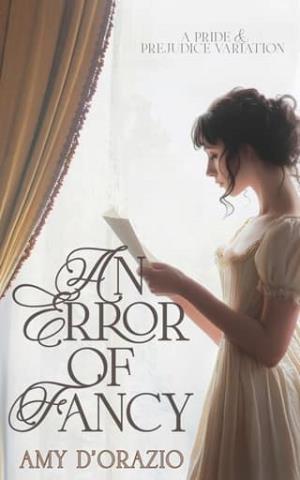
An Error of Fancy (Happily Ever After with Mr Darcy)
Chapter 1
ONE
NEWS FROM LONDON
…I know you have worried for me, have prayed for me, have feared the worst. Would that I could write to you now and inform you that such sentiments have been in vain!
Alas, I cannot. You can have no idea of how terrified I am. Never could I have imagined… But never mind that. It is far too late to lament what might have been.
I beg you would help me, dear Lizzy, though little I deserve it. You mentioned that Mr Darcy is in Kent, and I pray you would speak to him, beg his assistance, for I cannot find hide nor hair of his friend in London.
The letter had arrived that morning, and Elizabeth, as capable of performing the condemning math as any woman, had delayed in reading it.
Somehow, she had just known that the innocuous folded pages bore a great weight, and the last thing any of them needed was the curious eyes of Mr and Mrs Collins.
She had waited until she could be alone, until the path through Rosings Park had curved away from sight of both the parsonage windows and the great house, and then she had broken the seal with fingers that were already cold and trembling, praying all the while for good news.
She had read it twice. Then she had stood very still among the early spring hedgerows with the paper shaking in her hand, fully comprehending that the world she had walked out into this morning was not the same world she was standing in now.
Elizabeth folded the letter and pushed it back inside her pelisse, against her heart, which seemed to be beating too hard and too slowly at the same time.
What will we do? What will become of us?
The notion Jane had that Mr Darcy might help was preposterous. Had Jane forgotten it was Mr Darcy who played a chief part in Mr Bingley’s defection last November? No, it was to them, or more specifically, to her to think of something to do. What that something might be, she could not imagine.
Standing stock-still in the middle of a park would do nothing for anyone, and thus did she begin eventually to walk again.
The beauty of the verdure, or the wildflowers, and the flowering hedges that would ordinarily have delighted her, failed her in this ramble.
Jane, Jane, Jane was a constant refrain through her mind along with the anticipation of dark days ahead.
What could she do? What could anyone do?
Write to Mr Bingley, she decided. Save for the fact she had no idea what was his direction.
Where did a man like Mr Bingley live? Did he live with the Hursts?
Jane had gone to see Mrs Hurst and Miss Bingley in Grosvenor Square, but it had been made clear to her that Mr Bingley did not live there, nor was he expected there.
I could send a letter to Miss Bingley to give to her brother. Despite everything, she gave a snort of a laugh at that. That letter would be tossed in the fire so quickly, it was not worth considering, an effort not worth the time, the paper, or the ink.
Could some other man, any other man, be prevailed upon to marry Jane?
Would her uncle know someone? Neither Mr Gardiner nor Mrs Gardiner knew the burgeoning tragedy which resided beneath their roof, at least insofar as she knew.
They would have to know soon if they were to provide any aid to her poor dear sister.
Who could have thought Mr Bingley such a scoundrel! He had seduced her and then left her, having got what he wished for. Had he given any thought to her since then? Or had he been merrily gadding about London while Jane fretted and waited and pondered the ruination of her life?
Elizabeth did not hear Colonel Fitzwilliam until he was almost beside her. “Miss Bennet!”
“Oh!” Her hand, the hand that had held the damning page, flew to her chest. She hastily forced a smile to her lips. “Forgive me, sir, I did not hear your approach.”
“You are abroad very early. I had thought to have the park to myself this morning. I make a circuit of the grounds each year at this visit, a kind of personal ritual, though I confess,” he said with a chuckle, “the grounds have not materially changed since last April. May I join you?”
The last was said with no real anticipation of her refusal.
He fell into step beside her with the easy good humour that was natural to him, glancing at her sideways with a look that registered something—her pallor, perhaps, or the rigidity of her posture—but did not quite settle into concern.
That was good, she supposed. Heaven forfend she give any of this away by her looks.
“I hope you have not had any unpleasant news?”
A sudden picture came into her mind. Colonel Fitzwilliam in his red coat, mounted on some great beast of a horse with sword brandished, finding Bingley and making him marry Jane.
It was a silly notion, but she needed help. Was Colonel Fitzwilliam a man to be trusted with this, a ruining secret?
“I have, in fact,” she said tentatively. “A…friend finds herself in dire straits.”
“Ah, well. I am sorry to hear it. In my experience, these things do tend to work themselves out, but what a friend she has in you to stroll about the park pale and anxious on her behalf!” He grinned at her. “I do hope she does not have a cold. These spring colds linger abominably.”
“No,” said Elizabeth with a searching look in his direction. “She does not have a cold.”
The colonel strolled along, as jovial as ever, no real concern on his countenance.
“Anne, as you might have noticed, has been indoors a fortnight with a complaint of the chest. My aunt is in high anxiety about it, though between ourselves the anxiety does not visibly diminish her wish for cards and company at the dinner table.”
He chuckled again.
Well, what did you think? He barely knows you. Why should he become the family saviour? Faintly, Elizabeth said, “I pray she is well again soon.”
“As do I, although we may need to leave before we know the truth of it. I was speaking with Darcy only this morning about our return to London—he is eager to quit Kent, I think, though he will not say so directly. My cousin is not a man who says things directly when he can say them obliquely, as I am sure you have observed.”
He looked over at her then, and she offered a nod. “Mr Darcy, um, wields a great deal of influence over his friends, it seems. Even you.”
“I am at his disposal when we travel, of course. He arranges the business just as he chooses.”
“I do not believe I know anybody who seems more to enjoy the power of doing what he likes than Mr Darcy does.”
“He likes to have his own way very well,” replied Colonel Fitzwilliam. “But so we all do. It is only that he has better means of having it than many others.”
“I cannot disagree with you,” she admitted.
“But Darcy is an excellent friend. Truly, no one else is so good to those whom he really loves.”
Thankfully, Elizabeth refrained from scoffing at that. Instead she said, very mildly, “I have heard differing accounts on that score, but you know him far better than I do, of course.”
“Differing accounts? What do you mean?”
She supposed it must have been the roiling turmoil within her that made her say, recklessly, “I have made an acquaintance of one of Mr Darcy’s boyhood friends who gives a far less favourable account of his treatment.”
The effect of her statement on the colonel was surprising.
All lines of geniality were erased, and the colonel looked hard and angry.
It was then she saw the soldier in him, compared to the man about town she had known to this point.
“I hope,” said the colonel stiffly, “that you do not refer to George Wickham.”
“In fact, I do.”
The colonel stopped walking and turned to her.
“Pray, Miss Bennet, do me the honour of trusting absolutely nothing that scoundrel has to say. I cannot offer details of the circumstances, but upon my word as a gentleman, I assure you that Wickham has received far, far more than was his due from Darcy. Far more than was deserved, earned, or warranted, in my opinion. And he repaid that largesse with a betrayal of the worst kind, and still worse, must do as he can to blacken Darcy’s name. ”
“I suppose I do not know—”
“No, no, of course you do not know. Darcy does not speak of his history with Wickham, and Wickham spreads his lies to anyone who would listen. Only believe me when I say to you this: do not trust him. He has all the appearance of goodness, it is true, but that is all that it is—an appearance. I beg you to believe me, even if I have not given you any facts to support these assertions.”
“Of course,” Elizabeth replied, thinking that it hardly signified. When the truth was known, their family would be reviled by all, including Mr Wickham.
They began again to walk.
“No one could wish for a better friend than Darcy,” the colonel said warmly. “He is forever doing all he can to help those who need it. Why, even on our way here, he spoke to me of a great service he had just performed for a friend.”
Elizabeth gave him a sidelong glance which he did not perceive.
“I believe, although he did not say so directly, that it was in aid of his friend Bingley, whom I believe you to be acquainted with.”
Elizabeth made a noise of agreement.
“It is a circumstance which Darcy, of course, would not wish to be generally known, because if it were to get round to the lady’s family, it would be an unpleasant thing.”
Perhaps more than you know, she thought, but said merely, “You may depend upon my not mentioning it.”
“I have not much reason for supposing it to be Bingley save for the fact of knowing Darcy was with him all of the autumn and that Bingley is the sort of young man to get himself into these kinds of scrapes.”
“What kinds of scrapes do you mean?”
“The sort of scrapes that entrap a gentleman into the inconveniences of a most imprudent marriage.”
Yes, why be entrapped into a marriage when one can be roaming about having all the privileges of a husband with none of the responsibilities, she thought. Aloud, she said, “Did Mr Darcy give you his reasons for this interference?”
“I understood that there were some very strong objections against the lady.”
Are goodness and kindness objectionable? She said, merely, “And what arts did he use to separate them?”
“He did not talk to me of his own arts,” said Colonel Fitzwilliam, his face restored to its customary amiable appearance. “He only told me what I have now told you.”
Elizabeth could not think of a thing to say in reply.
Far from indignation, she was benumbed. Would Mr Bingley have married Jane if Mr Darcy had not interfered?
When Jane had told her what happened the night of the Netherfield ball, she told her that she had thought them engaged.
She had understood the words he had said to her that night as promises and proposals, assurances of a future in which a little indiscretion would not signify. They had even spoken of a wedding date!
Anxiety was beginning to overwhelm her. “Colonel Fitzwilliam.” Elizabeth heard the tightness in her own voice and could not entirely smooth it out. “Forgive me. I am afraid I have a headache.”
It was true enough. A pain was beginning behind her eyes that she suspected had less to do with the spring air than with the effort of keeping herself composed. “I believe I must return to the parsonage.”
“Of course. Shall I escort you back?”
His expression was genuinely sympathetic, but already his eye had drifted ahead along the path, towards the long view of the park that was evidently the object of his morning expedition.
“No, no,” she said. “I am perfectly capable of going on my own, and it is a very short distance if I take that path to the side.” She gestured towards a small cut between the trees.
He smiled and nodded. “Very good, then. I do hope your friend recovers from her cold.”
Would that it was a cold, she thought tiredly and excused herself from his society. He whistled a little as he walked away, looking contented, his step jaunty.
I am a fool. How could I have imagined him to be interested enough in my concerns to help poor, poor Jane?
If nothing else, she knew now for a certainty that this sin might be added to the others she held already against Mr Darcy.
She was reminded then of Mr Wickham. She might not have thought him so bad if Mr Darcy had told her of it, but the colonel’s vehement response had given her some pause.
She had already begun to wonder if Mr Wickham’s charm was but a patina over something less delightful, but if the colonel was even half-accurate, Mr Wickham was very dreadful indeed and had lied about his dealings with Mr Darcy.
So perhaps in that, Mr Darcy may be exonerated, she decided. Not that it signified in the least. For as much as he had scorned her family before, once he knew how low the Bennets had sunk, his disgust would know no bounds.