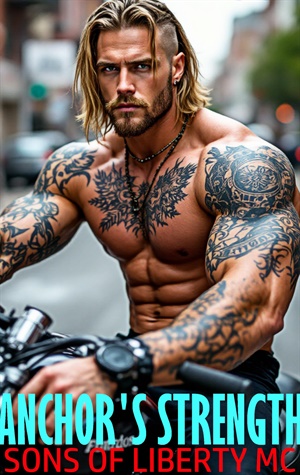
Anchor's Strength (Sons Of Liberty MC #21)
Chapter 1
The container swung overhead like a thirty-ton guillotine blade, and Anchor watched it come down with the patience of a man who'd stopped flinching at heavy loads years ago.
"Steady," he called up to the crane operator. "Six inches left. There."
Steel kissed concrete with barely a whisper. Clean drop. The kind of work that separated men who knew the docks from men who died on them.
February wind cut across the Delaware River waterfront, carrying diesel fumes and the salt-rot smell of the channel.
Anchor pulled his collar up against the cold and moved to the next position, boots steady on wet concrete, the Sons of Liberty patch on his back drawing looks from the regular dockworkers who knew better than to ask questions.
The port moved around him in its ancient rhythm—forklifts growling across loading bays, men shouting over the crash and grind of commerce, ships waiting patient in the channel like massive gray animals.
Legitimate work, mostly. The Sons used the waterfront to move supplies and maintain connections that kept their Philly operations running smooth.
Anchor knew every inch of it. Which pallets held what. Which inspectors looked the other way. Which cargo needed to disappear before manifest counts happened.
Third generation, bred into the bone.
"Yo, Anchor." Eddie Rosetti, the shift foreman, appeared at his elbow with a clipboard. Fifty-three years old, worked these docks since he was eighteen, one of the few who remembered Anchor's father. "Got a problem with container seven-seven-four. Seal's broken."
Anchor took the clipboard, scanned the manifest. Medical supplies, supposedly. Bound for a warehouse in Northeast Philly that didn't exist on any official map.
"I'll handle it."
He crossed the loading bay with the deliberate calm that defined everything he did. Rushing got people killed—dropped containers, crushed limbs, the kind of accidents that ended careers and lives. The river taught patience or it taught nothing at all.
Container 774 sat at the end of row six, its seal hanging loose like someone had gotten curious. Anchor checked the surrounding area—no witnesses except a young dockworker pretending to inventory nearby pallets while sneaking glances at the cut on Anchor's back.
Kid named Tomas. Maybe twenty-four. Soft hands that said college, not chain hooks.
"Something you need?" Anchor asked without turning around.
Tomas startled. "No, I just—how do you make it look so easy? The load work, I mean. You move like you've been doing this forever."
"Because I have." Anchor inspected the broken seal, noted the precise cuts that meant this wasn't accident—someone had wanted a look inside. "My grandfather worked these docks. My father too."
"That's cool, man. Like a legacy thing."
Anchor didn't answer. Legacy wasn't the word he'd use. More like an anchor chain wrapped around his throat, dragging him toward the same end his father found at the bottom of a bottle when the automation started eating jobs.
He pulled out his phone, texted Turnpike: 774 compromised. Need eyes on Northeast warehouse.
The response came in seconds: Handled.
That was what brotherhood meant. Problems solved with a text. No questions, no hesitation.
Anchor finished his inspection, marked the container for secondary processing, and moved on.
The morning wore into afternoon, gray February light never quite breaking through the cloud cover.
Ships came and went in the channel. He loaded, unloaded, moved through the waterfront with the ease of a man who'd grown up treating these docks as home.
By three o'clock, his shoulders ached in the way that meant honest labor. The kind of tired his body understood, welcomed even. Muscle memory and patient work, the same rhythm his father had known before everything fell apart.
He clocked out, grabbed his gear from the locker room, and headed for the parking lot where his Harley waited. Black Low Rider, first real purchase after he'd prospected into the Sons. The engine caught on the first kick, V-twin rumble settling into his chest like a second heartbeat.
Anchor pulled out his phone before riding out.
One missed call, one voicemail.
Colleen Brannigan's voice filled his ear, sharp and businesslike with the hint of dark humor underneath: "Anchor.
Confirming your appointment tomorrow, two o'clock.
We're finishing the memorial piece. I've got the final design ready—your father's name is going to look like it was always supposed to be there.
Don't be late. I've got a three-month waitlist and you're lucky I like you. "
He felt his mouth curve. Three years of ink sessions with Colleen had built something that wasn't quite friendship—she didn't do friendship, and neither did he—but close to it.
Understanding, maybe. The kind of connection that happened when someone put their art on your skin and you let them see the grief behind why you wanted it there.
His father's name. Michael Carlyle Sr. The man who couldn't adapt when the work changed, who drowned in bottles instead of fighting back, who left behind a widow and a son and a row house that the bank took six months later.
Anchor was getting his father's name tattooed across his chest because some debts couldn't be paid any other way. And Colleen understood that without him having to explain it. Her hands were steady, her work was art, and she didn't ask questions that made him want to hit something.
He texted back: Confirmed. 2pm.
Then he kicked the Harley into gear and rode out.
The route from the port to the Sons compound cut through the heart of Philadelphia's working-class soul—past row house neighborhoods with American flags on every porch, corner bars where men had been drinking the same beers for fifty years, streets where the Eagles were religion and loyalty was the only currency that mattered.
Anchor's city. His territory. The ground the Sons had bled to protect from outside crews, cartels, and anyone else who thought they could carve up Philly without paying the price.
He pulled into the compound lot as the sun started its descent toward the Schuylkill River. The converted brewery rose three stories of brick and defiance, bikes lined up in the secure lot like a chrome army waiting for orders.
Gallows nodded from the doorway. The Sergeant at Arms didn't waste words—never had, probably never would. His face showed nothing, but his eyes tracked everything.
"Church in an hour," Gallows said.
Anchor killed his engine. "What's the situation?"
"Patriot's got intel on some loan shark making moves in Fishtown. Operating in our territory without tribute."
Fishtown. That was where Colleen's shop sat—narrow storefront on a block the Sons had protected for years. Independence Ink, she called it. Said the name was about building something that belonged to her, something no one could take away.
"Got a name?" Anchor asked.
"Warren Driscoll. Been squeezing small businesses for protection money. Word is he's getting bold."
Anchor swung off his bike, rolling his shoulders to work out the dock work tension. "How bold?"
"Bold enough that Patriot's taking it to the table." Gallows's expression stayed flat, but his tone said everything. "Might need your waterfront connections. See what's coming through the port that shouldn't be."
"I'll make calls."
He headed inside, grabbed a beer from the bar, and settled into a corner booth to wait for church. The clubhouse smelled like motor oil and spilled beer and the particular musk of men who solved problems with violence. Home, in every way that mattered.
An hour until the meeting. Then he'd find out what Warren Driscoll had been doing in Sons territory.
Then tomorrow, two o'clock, he'd sit in Colleen's chair while she finished putting his father's name on his chest.
Anchor tipped his beer back, watching the other brothers filter in for church.
He didn't know yet that the loan shark squeezing Fishtown had already made his move on the tattoo shop.
Didn't know that the woman with steady hands and sharp humor was about to become the center of his war.
All he knew was the river taught patience—and somewhere in Fishtown, his patience was about to run out.