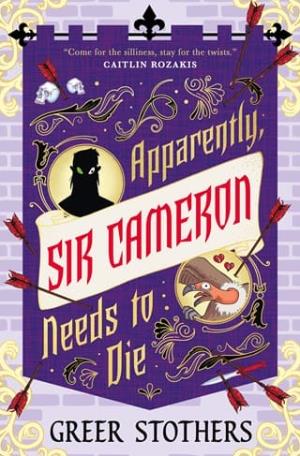
Apparently, Sir Cameron Needs to Die
Prologue
In Which the Mad Sorcerer Merulo Announces His Nefarious Intentions to the World, Expecting Some Nonspecific Mixture of Fear and Awe, but Is Instead Ridiculed for His Clothing, Which He Chose on the Basis of Wanting to Look Intimidating and Is Thus Rather Sensitive About.
The man in black waited in line.
He did not look happy to be waiting in line. But then again, few people did.
Chancellor Felix Noor found his eyes drawn to the man, time and again, as he performed his own duties. His clothing is just awful, he thought, straightening his own ermine-lined sleeves. Though what’s worse—to be awful, or to be dull?
A seemingly endless crowd waited in the audience chamber, their murmurs overlapping in a background babble.
Their modes of dress varied, but none belonged to the noble lineages of New Albion, represented by the banners that hung from the walls: the eagle of Nasr, the salamander of Falade, the lion of Vaillancourt, and so on.
Nobody, then, worth paying much attention to.
The chancellor sighed and threw back his wine.
When he slammed the goblet down against the arm of his chair, the serf at the front of the queue hopped, turned several shades paler, and choked on his tongue.
The chancellor’s knights urged him forward, but the serf failed to recover, and his speech stumbled.
This brought Chancellor Felix Noor no amusement; it made the process drag on intolerably. Still, he couldn’t shun his duties. Not with the Church watching.
The man in black was next. He’d jumped the queue somehow, the family of farmers behind him appearing oddly frozen. Without waiting for a summons, he marched forward, his pinched, weaselly face jutting forward with unearned haughtiness.
Chancellor Felix Noor leaned in for a better look.
The man’s black robe blended with his dark, limp hair to give the impression of a cowl.
Perhaps it was a purposeful perversion of an Elder’s white gown—the chancellor glanced at the Church representative seated to his right, curious to see her reaction.
Elder Beth was busy with a drinks order. A stooge hovered, bent nearly double to better hear the woman, peppering every pause with compliments as to her taste.
“I am the sorcerer Mer—” the man began, his voice raised imperiously over the merchants, farmers, and freshly washed peasantry who waited to be seen behind him.
“Hold on.” Chancellor Noor raised a hand heavy with rings. “Elder Beth. Do you have any thoughts on his robe?”
Elder Beth frowned, clearly annoyed by the interruption. “The shade is unpleasant. What does black symbolize—death and wickedness? And that cut—does he pretend to be a monk?”
The man glared up at the Elder with undisguised hatred. He was lanky and tall, but he stood some feet beneath them, a dais keeping the chancellor and his guest clear of the masses.
“I don’t pretend to be anything. I am the sorcerer Merulo, and I have come to announce my intentions!”
At his proclamation, a hush fell over the crowd. Chancellor Noor thumped his goblet meaningfully against the arm of his chair. In answer, the knights guarding the dais ceased their yawning and scratching of armoured asses, and stiffened, ready to advance.
“Insolent creature. What are your intentions?” The Elder’s words rang clear and strong across the audience chamber.
“I will, eugh—” The man’s voice broke, and he cleared his throat, blinking. His eyes matched his attire, chips of flint in a ghoulishly pale face. “I will kill your God,” he continued, clearly trying to match the Elder’s volume and charisma, “and destroy the world’s magic!”
Laughter came from the queue, some of it nervous, some genuine.
The chancellor hid a smirk behind a broad hand.
“Now, most people come to me about property lines, or conning merchants. He’s obviously insane,” he added to the Elder, who’d leaned so far forward in her carved seat that it threatened to topple.
She looked like a dog pulling at an invisible chain.
“Shall we take pity on his lack of faculties?”
“Doing so would be an insult to Order itself,” she growled. Then, louder: “God is everlasting. We shall give you ample time to reconnect with Him through prayer. Escort this man to a holding chamber!”
The chancellor bristled at her giving orders to his men, but such was the way of the Church.
To contest its representatives’ will would be akin to blasphemy.
Wearily, he swung his attention back to the supplicant—and exhaled sharply.
The man glowered up at them without fear, his thin lips pulled back in a flash of teeth.
Of course, the poor idiot lacked all sense. Still . . .
“He did claim to be a sorcerer.” The chancellor glanced sideways at the Elder, fingering an opal in his ring. Projecting his voice, he called: “Hold up, hold up. You can arrest this man in just a moment.”
His knights paused, all but rattling in their armour at the conflicting commands.
Elder Beth’s eyes bulged. “You—”
“I only mean to better evaluate this threat to the Church. Say, sorcerer, do you know any spells?”
“Do I—” the sorcerer spluttered. “Do I know any spells? I am the great sorcerer Merulo—”
“So you’ve said.”
“My magic could have you weeping on your knees!”
“Oh?” said the chancellor, not hiding his yawn. “Could it?”
A poisonous look crept over the man’s face. “Would you like a sample?”
“That’s more like it.” The chancellor sat up and beamed at the Elder, who had turned an interesting shade of maroon. “Shall we see a spell, Elder?”
Before she could respond, several figures stepped forward from the queue, their motions stuttering and faces blank.
The knights paused—they had clearly readied themselves for a day of sweating monotony—but the figures showed no such hesitation.
Accelerating to a run, they crashed into the line of knights, mouths gaping into splinter-lined cavities.
All illusion vanished as they fought. It wasn’t men the knights grappled with, but sickly, twisted trees, given a freakish semblance of life.
The Elder rose, whipping out a wand of carved ivory.
She spat an incantation at the sorcerer, and gleaming ice swords condensed out of the air, leaving the chamber dry and staticky.
They encircled the black-robed man, stabbing inward—only to shatter into a cloud of refracting droplets at a single barked word.
“Damn.” The chancellor sat back. “He’s good, eh?”
The sorcerer’s next word sent the Elder sailing backward in a billow of white cloth, like a giant swatted dove, to crash against the tapestry-draped rear wall. The chancellor winced in sympathy, but made no move to assist.
“You understand, then?” shouted the sorcerer, panting not from exertion, but from what seemed to be anxiety.
“I’ll kill God. Destroy the magic. Yes? I anticipate a timeline of”—he ducked a thrown dagger, one of his wooden servants dashing forward to maim the source—“five years, give or take, so if any infrastructure changes are required—Oh, for fuck’s sake. ”
A burly knight had broken through the wooden monsters with great rending sweeps of his axe.
He roared, lunging at the sorcerer, who hastily flicked his pale fingers—and the knight collapsed in a clinking heap.
The crowd screamed, trampling each other in their rush to escape through the great double doors, forcing the sorcerer to shout at an ever-higher volume.
“Look, you’ve been warned, yes? This is a warning? I have twenty-three more stops to make and can only hope that other rulers treat me with more grace. Goodbye, your Royal . . .” He trailed off. “Why are you shaking your head?”
“Your mistake is flattering, but I’m the chancellor. Felix Noor, advisor to the king. I’ll pass on the bit about infrastructure.”
The sorcerer settled for grimacing in response.
Looking somewhat defeated, he muttered a portal into existence, an unfurling hole in reality through which he stormed with an imperious flap of his robe.
His wooden servants followed, crawling and leaping, the portal folding shut behind them like the closing petals of a flower.
“Well,” said the chancellor, taking a sip of his wine. Then again, “Well.”
Bodies jammed the double doorway. Too lost in their panic to notice the sorcerer’s departure, the crowd pushed and shouted, worsening the clog.
Trampled citizens lay scattered through the room, dead or unconscious, alongside a number of prone knights, while pieces of shattered monstrosities lay twitching in their desire to follow their master.
Blood speckled the tiled floor and smeared the tapestry where the Elder had slid down it.
The chancellor took another deep draught from his goblet. “He’s definitely mad,” he murmured, pulling thoughtfully at his beard, “but good show, nonetheless.”