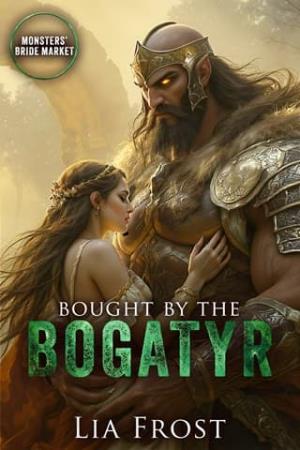
Bought By the Bogatyr (Monsters’ Bride Market #10)
Maren
Three rules for working the hard roads.
Don't stop after dark. Don't accept credit. Don't get involved in anything you can't stitch closed in under an hour.
The thing in the ditch is going to break all three.
I'd been walking since dawn, counting miles the way other people count coins.
Fourteen down, six to go before the next settlement.
My boots have worn a blister on my left heel that I've been ignoring since midmorning, and my pack digs into the groove it's carved between my shoulder blades over the past two years.
The straps need adjusting. I'll do it tonight when I stop.
The road stretches ahead, rutted and mud-slick from last week's rain.
Birch trees crowd the edges, their bark peeling in white curls, the leaves just starting to turn gold at the tips.
Autumn coming. I can smell it under the mud and the green, that faint sweetness of decay that means the cold isn't far behind.
I should pick up the pace. Winter on the roads is its own kind of death sentence. A portal would cut three days off the route, but portals cost more than a wandering healer makes in a month.
So I walk.
The sound stops me first.
Something big, breathing wet and wrong. Not an animal. I've heard wounded deer, gored bears, dying wolves. They don't sound like this, this wheeze with holes in it, this gurgle underneath that means blood in places blood shouldn't be. This is different somehow.
I slow down before I can tell myself not to.
The ditch runs along the road's edge, carved deep by spring floods and filled now with dead leaves and shadows. I make out the shape of something down there, too big to be human, too still to be alive.
I should go around. The tree-line curves north and I could skirt the whole mess, add maybe two miles to my day, still make the village before full dark if I move fast and don't look back.
My feet stop walking.
Damn it.
I pick my way down the embankment, mud slicking under my boots, grabbing at birch saplings to keep from sliding.
The smell hits me first.
Blood, copper-bright and fresh. Underneath it, something that smells like hot metal, like nothing that should be coming from a living body.
The body takes up most of the ditch.
Nine feet of armored flesh, maybe more, twisted into the mud with his limbs bent wrong.
His skin is bronze and rough, the texture of old oak.
Blood everywhere, black and red mixed together, soaking into the dead leaves, painting the mud.
The wounds are deep. Four parallel gashes across his chest and side, the edges already going gray with the first creep of infection.
Bogatyr.
The word surfaces from somewhere deep, from stories my father told me when I was small. Giants who swore oaths and kept them, who fought monsters. Berserkers.
I’d heard they were extinct.
This one's breathing. Barely. Each inhale sounds like tearing cloth.
I slide the rest of the way down and land on my knees beside him.
Up close he's even bigger, shoulders three times the width of mine, hands that could wrap around my entire head with room to spare.
The heat coming off his body is wrong, too hot, fever-hot, and when I press my fingers to his throat to find a pulse, his skin burns against mine.
“Still alive,” I mutter. “Barely. Blood loss severe, infection starting, internal damage unknown. Possibly unsurvivable. Definitely stupid to try.”
I rip my pack off.
The supplies spill out onto the muddy leaves.
Needle and thread, the good kind I traded three days' work for.
Clean bandages, not enough but better than nothing.
The half-empty bottle of alcohol that cost more than everything else combined.
I line them up on a flat rock and try to see the wounds as wounds, as problems to solve, not as the death sentence they probably are.
Pressure first. The worst bleeder is the gash across his ribs, pulsing dark with each labored breath. I press both hands against it and lean my weight in. His blood wells up between my fingers, hot enough to make my skin ache.
“Pressure on,” I tell the unconscious body. “Just keep breathing. You keep breathing and I'll keep working and we'll see who quits first.”
The light shifts from afternoon gold to gray to purple as the sun drops toward the tree-line. I should stop. Should admit this is beyond me, beyond anyone, should climb out of this ditch and keep walking toward the village and a warm bed and people who are actually savable.
I don't stop.
The bleeding slows. The infection keeps trying to creep forward.
I keep pushing it back with alcohol and prayers and the sheer stubborn refusal to let another body go cold under my hands.
His blood runs hotter than human, doesn't clot quite right, and I have to adjust, have to learn his body as I go.
The blood loss is severe, but his heart is still beating, stubborn as mine.
I'm elbow-deep in his chest cavity, holding torn tissue closed while I try to stitch one-handed. I'm working blind, stitching what bleeds and hoping the rest sorts itself out. My hand slips against the ridge of a broken rib and the jagged edge bites into my palm. I hiss.
Blood wells up, mine this time, red and thin against the dark mess of his. It drips into the open wound before I can pull back.
His eyes snap open.
Gold. Bright and wrong and nothing human.
His hand moves faster than something that size should be able to move. Fingers close around the air an inch from my throat and stop there, trembling, close enough that I can feel the heat radiating off his palm. One more inch and he'd crush my windpipe without effort.
I don't pull back.
“You're dying.” My voice comes out steadier than I feel. Surprise, that. “Hold still. I'm trying to fix that.”
His eyes track across my face. I watch something move behind them, something trying to make sense of what he's seeing. The hand at my throat shakes. Once. Twice.
It lowers.
“Good choice,” I say, and get back to work.
I finish the chest. Tie off the last stitch inside, pull my arms out, press a pad of bandage over the wound, and hold it until the bleeding slows.
My palm is bleeding where the rib caught me.
I wrap it quick with a strip of cloth and move on to the gash on his shoulder, the one across his hip, the dozens of smaller cuts that need cleaning before the infection takes them too.
He watches me the entire time. His eyes never close, never drift. I feel them on my hands as I stitch, on my face as I mutter my way through the process.
“Cleaning this one now. It's going to sting.” I pour alcohol into a gash on his shoulder. He doesn't flinch.
“You talk,” he says. His voice is deep enough to feel in my chest, rough with disuse and blood loss. “While you work.”
“Habit.” I tie off a stitch, cut the thread against my blade. “You're not the first dying thing I've put back together. Probably won't be the last.”
“Most would have left me.”
“Most have better survival instincts than I do.”
He makes a sound that might be a laugh if it had more air behind it. “Why didn't you?”
I don't have an answer. Not one that makes sense. Habit, maybe. The inability to see something broken and not try to fix it. A flaw, my father called it, back before it killed him.
“Seemed like the thing to do,” I say instead.
The moon is rising by the time I tie off the last bandage.
My arms are covered to the shoulder in his blood, rust-red and black, drying tight against my skin.
My back aches from hunching over him. My blister tore open hours ago and the raw skin has been grinding in my boot since. I'll be limping tomorrow.
Worth it. He's still breathing. The wet rattle is gone. His lungs are working.
I sit back on my heels. “Done. For now.”
He struggles to sit up. Gets halfway there and stops, muscles shaking, sweat beading on his forehead. The wounds pull but hold. My stitches are good. They'd better be.
“You saved my life.”
It's not a question. A fact, stated and certain. His voice has changed. Gone formal. Ancient. He looks at me, those gold eyes cataloging every detail of my face. I wonder what he sees. A tired woman in a muddy ditch, blood to her elbows, too stubborn to let him die in peace.
“You should have walked past. Left me for the crows. Your life was never at risk until you climbed down into this ditch.”
“And now?”
“Now it is.”
Something moves across his face. Not anger.
Dread. “Your blood is in me. Mine is in you. We are blood bound now.” He says it like a diagnosis.
Like something gone wrong that can't be fixed.
His eyes drop to my bandaged hand, then back to my face.
“By your blood and mine and the old ways that bind my kind. I am yours until the debt is paid. Your life for mine, balanced. This I swear.”
The words don't sound chosen. They sound pulled out of him. His hands are shaking. His jaw is tight and I can see the strain in his neck, the cords standing out, his whole body fighting against something and losing.
The air changes when he says it.
I feel it. Something old and heavy, pressing down on my shoulders. The hairs on my arms stand up. The sounds of the forest dim, the wind dropping, the birds gone quiet.
I look at my bandaged palm. At the pad of cloth over his chest, dark with blood underneath. Your blood is in me. Mine is in you.
Not just words. Something triggered when that happened. Something dark. Magic or a curse. Hard to tell.
“That's not necessary.”
“It is not a matter of necessity.” He holds my gaze. The dread is still there, but underneath it, resignation. “The oath is made. It cannot be unmade by wishing. I am bound to you now, healer. Until I save your life as you saved mine, or until one of us stops breathing.”
I should feel trapped. I should feel panicked, tied to this massive stranger by magic I don't understand, my life suddenly tangled up with his in ways I never asked for.
I'm too tired to feel anything but annoyed.
“That's inconvenient.”
His expression shifts. “Yes.”
“And I can't just... release you? Tell you the debt is forgiven?”
“No.”
“There's no loophole? No early termination clause?”
“The oath is not a contract. It is a binding.” He shifts, tries to stand, fails. For a moment I see pain crack through the stoic mask, real and sharp. “It was made. It must be honored. This is the way of my kind.”
“Your kind being Bogatyr.”
“Yes.”
“Who are supposed to be extinct.”
“Many things that are supposed to be dead are not.” His eyes meet mine again, and there's a warning in them, buried deep. “I am not safe to be near, healer. The oath binds me to protect you, but what I am... you should be afraid. Everyone is afraid.”
“Are you going to kill me?”
“Not by choice.”
“Then I'll take my chances.” I push myself to my feet, legs protesting, back screaming. “Can you walk?”
“I don't know.”
“Let's find out. Because whatever did that to you?” I nod at the claw marks. “I'm guessing it's still out there.”
He looks at me for a long moment. Those gold eyes, slowly fading to amber, searching my face for something.
I hold out my hand, and he only stares at it. The offer seems to confuse him.
Then, slowly, carefully, he takes it.
His fingers engulf mine. His palm is hot, rough, scarred in ways I can feel but not see. When he pulls himself upright, I have to brace hard to keep from being dragged off my feet by his weight.
He stands there in the moonlight, swaying, bleeding. Nine feet of wounded Bogatyr, oath-bound and barely upright. Standing, he blots out the tree-line. I have to step back just to see his face without craning my neck to the point of pain. The forest is getting dark around us.
“Maren,” I say. “My name. Since we're stuck with each other.”
“Kovren.” He looks down at me, and there's something in his face I can't quite read. Confusion, maybe. Or wonder.
He takes a step, then another. Limping but moving.
I scramble up after him, shoulder my pack, wince at the blister, and start walking.
He waits at the top, helping me up, then follows.
The road stretches ahead of us, dark and empty.
Behind us, somewhere in the trees, something that isn't an animal makes a sound like breaking.