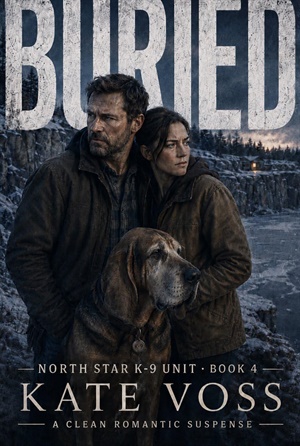
Buried (North Star K-9 Unit #4)
1. THE GRAVEL ROAD
one
"THE GRAVEL ROAD"
At four forty-five the kitchen window was the only lit square for a half mile in any direction, and Casey Yates had built his mornings to keep it that way.
Mose lifted his head from the rug at the foot of the hall and did not get up.
Fourteen years old now, and the bloodhound had earned the right to measure a morning before he committed to it.
He watched Casey cross to the stove, decided the crossing did not concern him, and lowered his chin back to his paws.
Casey set the enamelware pot on the burner and waited for the blue ring to catch.
Outside, the dark held the shape of the spruce line he knew without seeing.
Eighty acres of it, kennel barn and bunkhouse and the south fence he still meant to walk before the ground froze hard.
Junebug was a sound on the porch boards, one circle and a sigh, settling back into the perimeter she'd chosen for herself three years ago and defended every night since.
Bess slept down in the kennel beside the rehab intake, a shivering pointer that had come to him in September not trusting hands.
The coffee came up. He poured one cup, black, and drank it standing at the counter while the day assembled itself in his head.
Feed at five. The pointer's first off-leash session at seven.
A phone consult at nine with a woman in Bemidji whose shepherd had started guarding the baby's high chair like contraband.
Ordinary work, good work, and three years out of the federal service the ordinariness still landed on him some mornings like a thing he'd gotten away with.
He did the feed in the dark and the off-leash session in the gray, the shivering pointer ranging out and finding its way back each time he called.
Then he took the nine o'clock call from the truck with the heater running, walking the woman through the difference between a dog that was dangerous and a dog that was frightened of losing something.
"Stop apologizing to him," he told her. "Start being boring.
Boring is safety. A boring man with a calm hand fixes more dogs than a kind one ever has.
" She laughed, a little wet, and thanked him.
He hung up and sat a minute in the cooling cab, because that was the job now and the job was supposed to be enough.
He had spent three years convincing himself the last part of that sentence was true.
By noon the pointer had taken a treat off his open palm without flinching, which was the whole job. He ate a sandwich over the sink thinking about nothing in particular.
The sedan came up the gravel at twenty past four.
He heard it before he placed it, a low sound climbing the half-mile grade, careful with the washboard, not a truck.
Junebug came off the porch and stood at the head of the drive with her ears up, and did not bark, because she didn't, and Casey wiped his hands on a rag and came out to stand beside her.
A gray county sedan, the kind that meant a social worker or a hospice visit.
The woman who got out of it he had never seen before.
She was tall and slow about closing the car door, like somebody used to being quiet in rooms where quiet was the actual work. Dark coat. A thin manila envelope held flat against her chest with both arms, something she had decided not to drop no matter what the gravel did to her climbing it.
"Mr. Yates." She didn't come closer than the front of the car. "I'm sorry to come without calling. I didn't trust myself to do this over a phone."
"Most people who climb that road are selling something," he said. "You don't look like you're selling."
"No." A breath. "My name's Hannah Iverson.
I'm a hospice nurse, Beltrami County. I had a patient who told me something before he died, and I've spent two weeks deciding whether I imagined it.
" She looked past him at the barn, the spruce, the dogs, checking an address against directions somebody had given her.
"Somebody told me you used to track. That you're who people send the hard ones to. "
"People say a lot of things at the feed store." He didn't move toward her. "I train dogs and I breed a few and I fix the ones other folks have broken. I'm not a man who reopens things. That was the old job. I left it on purpose."
"I know what you left." She said it without heat. "I looked you up before I drove out here to stand in your yard. I'm not here for the old job. I'm here because the new one is the only one that can do what I need done."
Behind him the screen door knocked once on its frame.
Mose came out onto the porch. He took the two steps down with the deliberate care of an old dog managing his own hips, crossed the gravel without hurry, and pressed his head against Hannah Iverson's leg and stayed.
Not a sniff and a turn. He set his weight into her, leaned the whole creaking front of himself against a stranger's knee, and stood there while the woman went still.
Casey read it the only way that had ever told him anything.
He read her body, and he read the dog, and he left her face alone.
The old dog had decided something about this stranger in the time it took to cross fifteen feet of gravel, and the dog was not often wrong about people, and never that fast.
"He doesn't do that," Casey said.
"I'm sorry." Her hand hovered and didn't land. "Should I—"
"Put your hand on him. He's asking." He heard the catch that came into his own voice and didn't care for the chance she would hear it too. "He's fourteen. Retired two years. He spends his evenings on a rug and he does not get up for sedans."
She lowered her palm to the broad warm head, and Mose leaned harder, and something in the woman's face came loose for half a second before she folded it back where she kept it.
"Come inside," Casey said, before he had quite decided to. "It's getting cold, and you've held that envelope the whole climb up my drive."
The kitchen took them both. He poured her coffee from the enamelware pot without asking, and she took it with both hands, careful with it, and sat across the table while he waited.
"Tell me the man first," Casey said. "Not the envelope. The patient."
She looked up, and he watched her set aside whatever she had rehearsed in the car.
"Roger Belcher. Eighty-one. He was the county coroner a long time ago, and then he retired, and by the time he came to me he was dying of the thing that takes its time.
" Her thumb moved on the mug. "I had him eleven days.
You learn a person fast at the end — they stop performing, there's no fuel left for it.
On his last clear afternoon he told me he'd signed a girl's death up wrong, eight years back.
Ruled it accidental when he knew better.
Took money to look the other way while the scene got tidied before anyone careful walked it.
" She breathed. "He died two nights after.
I have the recordings — he consented, that part's clean.
I have the file he kept in a coffee can in his garage. And I have this."
She slid one photograph out of the envelope and turned it to face him.
Two men stood at the lip of a quarry, dusk gone orange and low, the date burned into one corner, old-camera style. Casey knew the rim. Everybody up here knew the rim.
"The girl," he said.
"My sister." She said it flat, the flatness practiced so it could not open her in front of strangers.
"Ronja. Twenty-six. She was a photographer, and she was up on that rim shooting a cut zone for a magazine.
Somebody was logging outside the permitted line.
They told me she'd gone hiking alone and slipped.
" Hannah set her hand on the file and didn't open it.
"I believed it eight years because I had a sixty-hour week and a body to identify and nobody standing next to me to argue.
Then a dying man told me I'd been right to wonder, and now I can't put it back where it was. "
Casey turned the photograph under the light. Then he opened the file himself, because she had stopped being able to, and read it slow, page by page, hunting the one line that wouldn't sit down.
He found it on the second page.
"This is wrong," he said quietly.
"Which part?"
"The lividity." He turned the page so she could see, and laid his finger under the typed line.
"When the heart stops, the blood settles.
Pools to whatever's lowest and fixes there inside a few hours.
You can't move a body after that and hide that you moved it — the pattern tells you the position she was actually in when she died.
" He looked up. "You read the dead for a living.
You'd have caught it, if anybody had let you believe you were allowed to look. "
"I read it as a sister." Her voice didn't break. It thinned. "Not as a nurse. There's a difference, and it cost me eight years."
"The report says she went off the rim and drowned face-down.
" He tapped the line. "The marks say she lay on her back for hours before she ever touched water.
Somebody moved her after. Your coroner knew it, sat at his own table and knew it, and signed it anyway.
" He closed the file. "Belcher told you the truth. "
For a while neither of them said anything. The stove ticked. Mose lay down across Hannah's feet under the table with a grunt and didn't get up.
"I'm not asking you to be a policeman," Hannah said.
"I already had a policeman, eight years ago.
He filled out a form. I'm asking. There's a thing the state won't open a file for unless a working dog confirms a scent first. A cold one.
Eight years cold." She looked down at the old dog on her feet.
"I want to know if your dog can still do that. And whether you'd let him try."
Casey looked at the rim in the photograph, and felt three years of ordinary work lift off his shoulders like it had never weighed anything at all.
He didn't trust the feeling. He had it before, the lift of work that mattered, and the last time it ended in a folder he kept in a drawer and read once a year.
"It's late," he said. "You've driven a long road to hand a stranger the worst thing that ever happened to you. Go home. Sleep if you can manage it." He squared the file and pushed it an inch toward her. "I'll take it up the day after."
He watched her decide not to push. It was a discipline in her, the not-pushing, and he recognized his own trade in somebody else's hands.
"The day after," she agreed.
She gathered the file and left the photograph where it lay, on purpose, so he would have to keep it. He walked her out. The taillights went down the grade, turned onto the county road, and were gone, and the dark came back over the yard and the spruce.
Inside, Mose crossed and pressed his head to Casey's hip. Casey poured the second cup and did not drink from it. He set it on the table where the steam could rise and be company.
Then he went down the hall to bed, and stopped.
Mose was not on the rug.
The old dog lay square across the kitchen threshold, nose down to the cold gap under the door, facing the gravel and the dark and the place the sedan had gone.
He raised his eyes to Casey and didn't come, and didn't move, and put his chin back down on the boards to wait out a morning that hadn't been given a name yet.