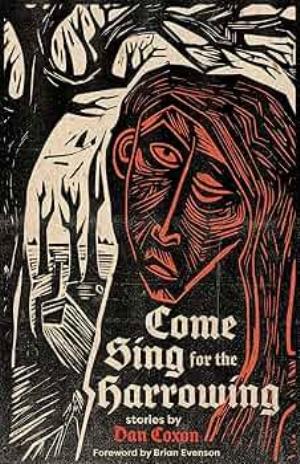
Come Sing for the Harrowing
Come Sing for the Harrowing
Jack stands in his briefs in the basement while Big Mike holds the cold measuring tape up against his chest. He can smell an odor coming off him like pig fat and onions, with just a hint of lavender curdled into the mix. His skin pimples with gooseflesh.
“Not bad,” Big Mike mutters as he works. “Not bad at all.”
It’s his first day in Historytown and he’s already regretting it. He still owes his mom two hundred for the window. This is a penance of sorts; he is paying for his mistake with his humiliation.
“No back pain or injuries?” Big Mike asks, stepping back to appraise him from a distance. “Allergies?”
Jack shakes his head and wonders if he can put his clothes back on. Only his mom has seen him this naked; the older man’s gaze feels like a violation. “Nope and nope. Neither, I mean.”
Big Mike stares at him, his shoulders hunched beneath his sackcloth robe. The moment stretches and stretches. He hears a faint drip-drip of water in another room.
Eventually, Big Mike’s body shudders with what may be a shrug, or possibly some kind of nervous spasm. “Good. All good. You’ll do, I guess.”
Jack bends and reaches for his clothes, but Big Mike grasps them first, tucking them under his sweaty arm.
“You won’t need those. All costumes and uniforms are provided. I’ll stow them in your locker.”
Jack didn’t even know he had a locker, but he follows as Big Mike leads him out of the basement and into the light, his naked legs shivering in the cold.
* * *
They put him on stable duty. There aren’t any horses, and it isn’t really a stable.
The shed looks like it’s built from oak planks and thick iron nails, but when you stand close, what looks like texture is actually flat, a plastic laminate stuck over plasterboard.
The knots in the wood repeat every four planks.
It’s near enough to the real thing that the overall effect is disorienting and slightly sickening.
The hay, however, is real. Jack has to fork it into a barrow round the back of the BDE—the Black Death Experience—trundle it along the rough dirt path, then unload it again in the stable.
People watch him as he does this, cameras clicking, fingers pointing.
It’s meant to be interactive, but nobody speaks to him; he might as well be a mannequin—an animatronic Jack wound up each morning and left to do his thing, back and forth, back and forth.
Once, he stops to pose for a cute girl taking pictures on her phone, but she tuts and waits until he starts moving again.
Each morning, when he arrives at work, the hay is piled back behind the BDE. Each day he sweats and toils, doing the same job for a new audience.
Nobody warns him that the hay will invade his life, working its way into the weave of his clothes, his private thickets of hair.
Big Mike’s question about allergies suddenly makes sense.
From dust particles to strands as long as his fingers, it finds its way into everything, digging drifts of it from his ears, spitting blades from his food.
It’s scratchy, too, and where it has worked its way beneath his coarse sacking tunic there are red welts across his skin, like he’s been whipped by tiny flagellants in his sleep.
He itches almost constantly, fine slivers of hay burying themselves as splinters in his flesh.
The rub of the sackcloth keeps them from healing.
The paycheck is welcome at the end of the first week, he won’t pretend it isn’t.
But once he’s paid his mom the first installment for the window and taken out the cost of his travel and lunches, he’s barely made enough to buy a mid-priced Xbox game.
His arms and shoulders ache from lifting the hayfork over and over, his eyes are scratchy and pink from all the dust.
Still, Mom seems happy with him, for once. He supposes the money is better than nothing.
Plus, there’s Julia.
* * *
He’s sitting with Julia at lunch when he first sees it.
Well, not with her—he doesn’t know her well enough to be that familiar.
She’s sitting on a haybale with two of her friends, the huddle of them laughing over something on her phone.
He’s opposite, perched on the hard edge of a half-barrel, the metal band digging into his bony thighs. Watching her.
He thinks she knows he’s watching, but she’s pretending she doesn’t, possibly because she likes him too and is playing hard to get, or maybe because she actually doesn’t like him and would rather he just went away.
He finds it so hard to tell. Her friend, the dark-haired one, whispers something then looks over at him.
They erupt into fits of giggles, which again might mean anything or nothing at all.
He does his best to look cool and down with it despite the heat blushing into his cheeks.
Trying not to look their way, he examines his food, pulls out a piece of hay, stares meaningfully into the trees behind them.
And that’s when it happens. He’s staring at nothing, trying to tune out their muffled laughter; then it isn’t nothing anymore, because there’s something there. He jumps to his feet, spilling the contents of his burrito down his front.
“Did you see that?” He’s pointing without even realizing. The three of them follow his finger, conversation interrupted.
“See what?” says Julia, turning to look at him; and he can’t help it, the words stutter and die in his throat.
“The…thing? Something, I mean. I don’t know…in the woods? There was something there.”
He knows the description is inadequate, but it’s the best he can muster.
It was dark and formless, but heavy, like smoke made solid.
He saw its eyes smoldering under the canopy of the trees, set too far apart to be human.
Most of all, though, he felt it, the way you can tell when someone walks into a room, even before you see them.
She looks at the trees and then back at him, as if trying to decide who to believe.
“Where? There? I see nothing.”
She’s right, of course. There’s nothing there, just the shadows and a growth of bracken, broken in places as if someone has trodden it underfoot.
“It’s not…I mean, it’s gone. It was there. Honest.”
The dark-haired one puts her hand to her forehead as if she’s about to faint. She cries, “Oh who will save us from the foul beast?” as the three of them start cackling again, no mistaking who their laughter is aimed at now.
They gather their lunch things and push past him, avoiding the spoiled heap of rice and beans at his feet.
He hears one of them mutter to her friends as they walk away.
“Freak.”
* * *
From that moment on, he only sees the Watcher when he is alone. It’s never in the same place but always under the trees, in the shadows. Just dark enough to sow a seed of doubt.
He’s gone to fetch another barrow of hay when he spots it in the woods, closer than usual but still hidden, a blot on the undergrowth.
Clearer than before. A hint of weave in the darkness, like it’s shrouded in coarse black cloth.
It’s slightly bigger than a man, bulky, and Jack wonders if it’s Big Mike playing a prank.
He can’t imagine what the purpose might be, but it feels like something he would do. Scare the new kid. Terrorize the weak.
“Hey!” he shouts, letting the barrow drop. “You! What are you following me for? Mike? Is that you?”
“Is what me?” says a voice behind him, and he turns to find Big Mike standing there, not in the woods at all, with two full garbage sacks slung over his shoulder. “Can’t a guy do his job around here without getting yelled at?”
When Jack turns back, the Watcher is gone. He wonders if it was ever there.
That evening he mentions to his mom that he thinks he might have sunstroke, and she suggests he turns in early.
She’s right, he has a long day tomorrow.
The following morning, they give him a new assignment.
No more hay, no more dust. He’s still in the stable, but there’s a pile of sticks in there now, dry and brittle like bones.
Big Mike has sketched a picture on the back of a ketchup-stained napkin.
It looks like a giant star, the top point smaller than the other four, a complex scaffolding of branches holding it upright. They want him to build it.
“But what’s it for?” he asks as he organizes the pile into thicker, sturdier branches and thinner sticks. “What is it I’m making?”
Big Mike shrugs and smiles, the expression sickly and unfamiliar on his face.
“A thing. Medieval thing. The crowds’ll love it, you’ll see. Build it nice and strong, we don’t want it falling down.”
The job is harder than it looks. Jack knows nothing about engineering or the use of trusses in transmitting loads.
His first efforts collapse into piles of kindling, a game of Jenga that he keeps losing, over and over.
Splinters work themselves under his nails, under his skin.
After two days he’s back where he started.
He learns, though. If he winds the twine around a joint before tying it off, it can support a greater load.
If he ties the main branches together like this, they hold each other up.
There are still a few stumbles along the way, but by the end of the day he has created the framework of the star: five points, the uppermost level with his head, the bottom two rooted in the dirt.
He gives it a shake and it barely moves.
There’s a swelling of pride in him for a moment, standing in this dusty arena in his sackcloth robe, admiring his structure of sticks.
He wonders what comes next.
* * *
It’s Julia who suggests the game. They’re litter-picking after the park has closed for the day, the last children ushered out clutching plastic swords and castle-shaped sippy cups, leaving a wave of garbage in their wake.
Jack makes sure he’s on the same clean-up detail as her, just in case the opportunity arises to chat.
He has no idea what he’ll say if it does.