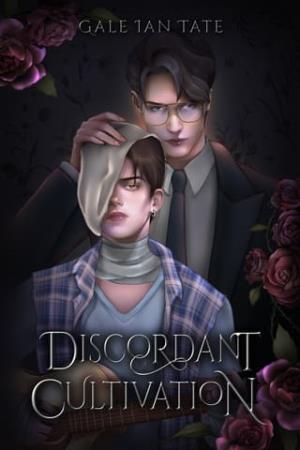
Discordant Cultivation
Chapter 1
My bright and broken star...
Vale
Valerian Rose had always believed that art required true suffering, but watching the boy with the guitar case fumble for change in front of the train station, he realized he’d never understood the mathematics of pain until now.
The young man’s fingers trembled as he counted crumpled bills, his dark hair falling across features that would be beautiful if they weren’t so goddamn broken.
Vale wanted to crack open his chest and pour agony inside until music spilled out like blood.
The violence of the image surprised him. He’d broken dozens of artists over the years—methodically, precisely. Never once did he want to crawl inside their skin.
I could make you magnificent.
The thought tasted like copper pennies and sounded like a prayer.
Three months ago, Vale noticed him outside the station: just another busker in an endless rotation of mediocre street performers. But something about the way the boy held his guitar, protective and desperate at once, made Vale pause mid-stride.
He told himself it was idle curiosity in raw talent that hadn’t been ruined by formal training yet.
He started recording clips on his phone—seventeen videos, to be exact, and he kept only the clear ones: crowds out of frame, ambient noise low enough to hear that voice properly.
He knew the boy performed Monday through Saturday, 7 AM to 11 AM, and vanished afterward, as if he feared someone might follow him home.
For twelve weeks, Vale watched. Documented. Catalogued. He looked up the social media handle written on the inside of the guitar case—KT6Strings—and was unable to find a name. A location. A friend.
He told himself it was research.
This week, something shifted. Monday morning, eighty-four days into his observation, Vale was already late for his quarterly office meeting. He didn’t care. Hearing one more song mattered more. But the busker played something generic that made his jaw clench with secondhand embarrassment.
Still, he dropped a twenty in the guitar case.
Habit, mostly. Vale had stopped for street musicians since he was fifteen, back when his mother used to time his piano practice with a stopwatch, and locked the bathroom door when he made mistakes.
Three hours daily, four on weekends. Perfect technique or no dinner.
Support the arts, she’d said, even when they’re pathetic.
Especially when they’re pathetic.
He could still hear her voice when he walked the greenhouse aisles explaining how roses needed pruning to reach their potential. Cut away the weak growth. Force the plant to focus its energy where it matters.
Tuesday morning, the kid was there again.
Same corner, same nervous energy, and a different song.
Vale planned to walk past—studio time was booked, three artists were waiting on his feedback, and he had to approve mixes from sound engineers, but his feet stopped moving of their own accord.
The busker’s voice had a different quality when he sang this time, pained almost, a compressed quality to his vocal technique that most industry professionals spent years trying to manufacture—genuine vulnerability, the kind that made listeners feel like voyeurs.
Vale lingered near a coffee cart longer than necessary, pretending to check his phone while he watched the young man play three more songs. He had nervous tics, like the way he touched his medical alert bracelet before starting each song.
The kid never looked up.
Today, the train could go fuck itself. Vale rescheduled two meetings and ignored six calls from his assistant, Eliza. He was doing his due diligence.
Nothing more.
He stood fifteen feet away and just watched, taking note of all the same details he had every other time he watched him play.
The musician was folded in on himself, all sharp angles from being undoubtedly underweight, his hair cut unevenly in a French crop like he had done it himself.
His clothes hung loose on his shoulders, like he was playing dress-up in someone else’s wardrobe, and his steel earrings and medical alert bracelet caught the sunlight when he moved.
He had stunningly sad brown eyes—the kind that made people want to feed him or fix him.
He was playing covers like he did everyday, and they were okay.
They showed competent but uninspired muscle memory—serious skill without emotional investment.
Vale counted eighteen people walking past without stopping.
Two dropped coins without slowing down. One teenager filmed for thirty seconds before getting bored and moving on.
The teenager’s video would get fewer views than the performance deserved despite the mediocre song selection. Vale’s jaw clenched. Strangers would watch this boy on their phones, not understanding what they were seeing. Something hot and possessive coiled in his chest.
Then the musician cleared his throat.
“This one is-s-s—th-this song—I wrote it.”
There.
Vale’s heart hammered, and he moved closer without thinking—close enough that if the boy looked up, he’d see Vale watching. He was close enough for it to be weird, to be noticed. He should step back.
He didn’t.
The boy adjusted his grip on the guitar as his fingers found the first chord, but he didn’t begin playing right away.
He rolled his hunched shoulders back, lifting his head even as he kept his eyes on the concrete, and from his mouth came a sparse melody in a haunting, minor key.
Recognition itched at the back of Vale’s skull.
He had to consciously still his hands at his side.
When was the last time that happened? Not since he was sixteen, playing his first composition for his mother and waiting for her verdict.
Show me what you’re hiding.
The lyrics, when they came, were about dying in his sleep.
About things that stole consciousness and never gave it back, and a terror of trusting something not to murder him in the dark.
Vale held his breath. It was absurd. He’d heard thousands of performances, produced hundreds of tracks.
This was just another street musician with a decent original.
Except his chest ached, and his fingers itched to grab his phone and record this too and add it to the collection he wasn’t obsessively maintaining.
The boy’s voice never stuttered when he sang, transforming into something fluid and desperate.
But he performed it like he was reading from a script.
Technically perfect. Emotionally distant.
Afraid of your own words, aren’t you?
Vale watched the musician’s chest rise and fall in controlled patterns, he watched him maintain a careful distance from the song’s meaning even as he delivered it with an edge of pain. Seven people stopped to listen.
His potential was staggering.
The execution was cowardly.
Vale wanted to shake him. He wanted to pin him against the brick wall and demand he sing it again, properly this time, with all the terror he was so carefully hiding. Wanted to—
He pulled out his wallet with more force than necessary, the leather creaking in his grip.
The kid began packing up without saying another word. Vale folded two hundred dollar bills—enough to pay a bill or buy groceries—around his business card and approached while the musician focused on his equipment.
“Excuse me.”
Brown eyes snapped up, wide with that brand of fear from someone who expected trouble from strangers. Up close, his face was even more interesting—hunger and exhaustion had sharpened boyish features into the kind of beauty that emerged slowly, then all at once.
His photographs hadn’t captured the exact shade of those eyes, or the way his eyebrows made his features too expressive for their own good. Vale had to consciously stop himself from reaching out to touch that face, to feel if his skin was as soft as it looked.
Vale dropped the money into the open guitar case and walked away without another word.
Call me. Be brave enough to want more than this corner, this life, these pathetic tips from people who don’t understand what they’re hearing.
Vale made it to the coffeeshop across the street before the need to see the boy’s reaction became unbearable.
The kid found the cash immediately, unfolding the bills with shaking fingers. He looked around like he expected cameras, a prank, or some explanation for unexpected good fortune.
Vale’s heart was in his throat as he memorized the exact moment the boy’s face shifted from confusion to recognition. This was absurd. He was a successful freelance producer. He didn’t lurk near coffee shops watching musicians react to business cards like some kind of—
The boy pressed the card to his chest, closed his eyes, and exhaled like he’d been holding his breath for weeks.
That’s it. Want something better.
Vale made it home in record time, canceled all his meetings, and spent the next four hours pretending to work on a demo that had been due for weeks.
His production software stayed open on his laptop while he checked his phone every seven minutes.
It was ridiculous. The boy might not even call. He probably wouldn’t call.
Then his phone rang, and Vale answered before the second ring.
Too eager.
“Um, h-hi.” That voice again, careful and stuttering. “This is—I’m the guy from this morning? With the g-guitar? You left your c-c-card and I wasn’t sure if—”
“I remember.” Vale’s reflection smiled back at him from the window of his home office, the city’s lights two hours away by train. “What’s your name?”
He’d been waiting for this—the name he could attach to all those videos, all those observations, all that careful documentation. The piece of information that would make the boy real instead of just a fascinating subject.
“K-Kieran. Kieran Thorne.”
Perfect. Even your name sounds broken.
“Well, Kieran Thorne, would you like to have dinner tonight?”
Silence stretched across the line, filled with the soft sound of uncertain breathing.
Say yes. Say yes, you beautiful, broken thing.
Vale could practically hear the kid’s mind racing—hope warring with disbelief, desperation fighting instinct.
“Are you really—” Kieran’s voice cracked. “Your card says V-Vale Rose. The producer?”
“Yes.”
“I...” Another pause. “Yeah. Yes, I’d—dinner sounds good.”
Such a good boy.
“Perfect. Text me your address. I’ll send a car at seven.”
Vale ended the call before Kieran could hear the breathlessness in his voice.
Vale pulled up his laptop—already open to the folder he’d been compiling for months.
Three months of social media deep-dives, screenshots organized by date, every public post saved and analyzed.
He told himself it was standard industry research.
Due diligence on potential talent, searching for the real name beyond his social media handle.
The lie was getting harder to maintain.
Kieran’s Instagram revealed exactly what Vale had memorized weeks ago: sparse posts, mostly performance videos shot on a phone with a cracked camera lens. Forty-three followers. Zero industry connections.
The videos were promising, though. Vale had watched each one at least a dozen times, and he had favorites he returned to when he should have been sleeping: raw acoustic sessions filmed in what looked like a studio apartment’s corner, with bad lighting that somehow made the music more intimate.
Vale played them with the volume low, watching Kieran’s face transform when he sang.
Unlike his street covers, when Kieran played something that was his, alone, Vale could see the edges of his fire.
You have no idea what you could become with the right accelerant.
The most recent post was from two weeks ago—a shaky video of Kieran mid-performance on the street, posted by someone else and tagged to his account. Three hundred views. Twelve likes. Comments full of heart emojis and empty praise from people who didn’t understand what they were really looking at.
Vale scrolled down to the caption Kieran had written: “Thanks to whoever posted this. Still figuring out the whole social media thing. Music is easier than words.”
Music is easier than words.
Vale read the caption for the twentieth time, though he’d memorized it the day it was posted. He’d been at a meeting when the notification came through and had excused himself to the bathroom to watch the video three times in a stall like a teenager with a crush.
But he was Vale Rose. He found the diamonds in the rough, polished them, and sent them on their merry ways to success. He was just doing his job.
The greenhouse lights were on when Vale glanced out the window. He should check on the roses—his mother’s legacy, the family’s pride for three generations. Mrs. Martinez had texted yesterday about aphids on the white blooms, his mother’s favorites.
He looked back at Kieran’s face frozen on his laptop screen.
The roses could wait.
Vale closed the laptop and leaned back in his chair, already planning the studio he’d book for tonight.
Somewhere private. Somewhere he could control the acoustics, the lighting, the entire environment.
Somewhere Kieran would feel both comfortable and trapped, like a bird in a beautiful cage.
Vale’s hands shook again. He should eat something, and he probably hadn’t had a proper meal since breakfast. But the thought of food turned his stomach with an anxiety that felt almost like stage fright.
Which was ridiculous. He produced Grammy-winning albums and worked with artists whose names were household words. This was just a quick session with promising talent.
The lie tasted sour on his mind’s tongue.