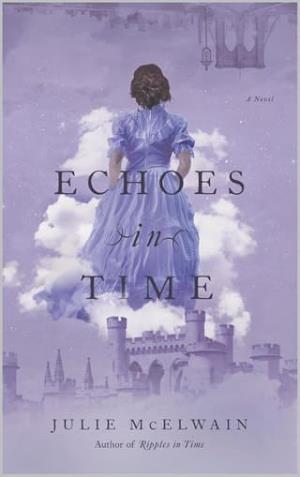
Echoes in Time (Kendra Donovan Mysteries #7)
Chapter 1
“No—!”
Edwina looked up at the faint cry. The Bowden Theater had been designed so that you could hear a whisper on stage even if you were sitting on the other side of the auditorium.
Here, in the small area near the backstage door, sound carried like a faraway echo, indistinct enough to make Edwina wonder if she’d heard anything at all.
Her fingers, chilled from her recent trip to the baker, tensed on the handle of the wicker basket. She held her breath, listening intently.
Nothing. Not even the normal creaks and groans often heard in the old building.
Maybe she’d imagined it. She’d always had a vivid imagination. Get yer bloomin’ head out of the clouds, girl, ye’ve got chores to do! Her mum’s voice rang across the years, making her stomach twist. Stop wool-gathering, Edwina, and milk that cow!
It was that imagination—and the stubborn belief that she was meant for greater things than languishing on her family’s small farm in Dorset—that led her to run away at the age of fourteen.
For a time, she hadn’t regretted her decision.
She’d been a bright-eyed, pretty child, and had found a home in one of the smaller theater companies on Drury Lane.
Oh, not as one of the performers. But she hadn’t expected that, had she? Leastwise, not right away.
The theater’s owner, Old Man Bolling, had allowed her to sleep in one of the playhouse’s dusty cubbyholes, and gave her a shilling a week to fetch and carry whatever the company required.
Bottles of gin and goblets of wine for after-performance toasts—or to drown their sorrows for poorly received shows.
Shawls for chilled shoulders. Tubs of hot water for aching feet.
Not exactly what she’d envision when she’d come to London, but it was less work than churning butter or picking weeds out of her mum’s garden patch.
And there was always a chance, shimmering in front of her like a golden dream, that she’d bewitch someone enough to allow her on stage.
Everything had been going fine until the night she’d woken to Old Man Bolling crawling on top of her, his hands sliding up her skirts.
Even now Edwina shuddered at the memory of his fetid breath and rough, roaming fingers.
Afterwards, no one had been particularly interested in her tale of woe.
Not the watchmen or local constable, who’d leered at her and offered to look into her claim—if she was friendly to them.
Not the actresses, who’d studied her with hard eyes and wondered what the bloody hell had she thought would happen when she fluttered her eyelashes so prettily at Old Man Bolling, no doubt hoping that he’d send one of them packing and give her their role.
Best to get used to such things, they told her.
And, if she had more than fluff betwixt her ears, she’d find a protector among the randy bucks who flooded the theater each night.
At least she’d be able to earn a few coins and trinkets, because, heaven knew, she wouldn’t get one more tuppence out of that bastard Bolling when he tumbled her.
Certain she would never be free of Old Man Bolling’s lechery, Edwina bolted for another theater in Covent Garden. It hadn’t taken her long, though, to learn that the actresses had been telling her the truth, to realize that Old Man Bolling wasn’t the only libertine in town.
She should have run back home then, except for the sickening sense of shame.
After three years in London, she was no longer an innocent, and, God save her soul, she’d even occasionally bartered her body for money to eat, her wages barely affording her a bowl of jellied eels sold by a costermonger who worked the lane.
Maybe she would have eventually returned home, if her fortunes hadn’t changed.
Now her breath hitched, a lump lodging painfully in her throat. This was another memory that she preferred to avoid, much as she shied away from the looking glasses stationed in the dressing rooms and hallways.
But the fire haunted her dreams.
She couldn’t remember how the blaze started, but the speed—oh, Lord, the speed—of the flames had been terrifying.
Her skirts had become engulfed by the time she’d fled the theater.
She should have perished. She wished she’d perished, wished her flesh and bones had turned to ash along with the theater’s walls and roof.
However, the eel costermonger who’d set up his cart outside the theater saved her.
Edwina would never forgive him.
In an odd quirk, the right side of her body remained relatively unscathed, while her left side . . . oh, God. Her flesh was scorched and scarred from ankle to brow.
Her visions of sharing the stage with the likes of Edmund Kean and Maria Davison were shattered that night.
So was her half-formed idea of returning to her family.
Not now. Not when she’d become this hideous creature with her twisted, pitted flesh.
She couldn’t bear having her siblings stare at her with fear, or her mum and pa looking at her with pity.
Or, worse—scorn. Ye always thought ye were better than us, didn’t ye, girl? Now look at ye!
Tears gathered in Edwina’s right eye, blurring her vision. Her left eye, with its puckered skin around the orb, remained dry. The fire had made it impossible for tears to ever form in that eye.
Determinedly, she blinked away the moisture.
The fire was two years ago. She was seventeen now, no longer a baby.
She’d learned, hadn’t she? A Quaker family had taken her in, tended her wounds until she was strong enough to leave.
She’d found work at the Bowden Theater. Again, she fetched and carried, but it was her skill with needle and thread that had become her greatest asset.
She assisted Old Beatrice, the company’s seamstress, in creating new costumes and patching up old.
It was a job done mostly in the shadows.
She’d merged into the background, much like the props and timber cutouts wheeled on stage for each act.
No one wanted to look too closely at her scarred face.
A mirthless smile twisted her mouth. At least she could sleep unmolested in one of the theater’s cubbyholes.
Still, Edwina had her peepers, even if her left eye was deformed and dry. She’d become a keen observer, noticing things others did not.
Like the two gentlemen.
Oh, they were dapper, all right, with their expensively tailored topcoats and curly brimmed beaver hats, blending in with the other swells.
But they were . . . different. Like the other bucks, they would smile, their expressions affable, but their eyes were always cold.
Lust didn’t drive them as it did the others, but something else, something that made Edwina back away whisper-soft, deeper into the theater’s gloom, so as not to attract their attention.
Still, she hadn’t given them a thought until yesterday, when the lady had come asking about Clarice.
Clarice had been cast in the coveted role of Portia for the upcoming production of The Merchant of Venice. For one week, she’d reveled in her new status, strutting around the stage like she was a bloody duchess.
Then, a week ago, she’d vanished.
When Edwina had overheard the lady quizzing Mr. Myott, the theater manager, about Clarice, her mind had instantly flashed to the two gentlemen. They’d been part of Clarice’s circle of admirers.
Unfortunately, the lady’s timing had been poor—less than an hour before Saturday evening’s opening act, and the troupe was scurrying to and fro across the stage in their final preparations.
Tempers were short and anxiety high. Normally, Mr. Myott treated Quality with a toad-eating deference, but stress had made him snap at the gentry mort, ordering her to leave.
Edwina had waited until Mr. Myott ran off to scream at the jugglers for wearing incorrect costumes for the opening act, then approached the woman.
Ignoring the lady’s start of surprise and the way her eyes darted across Edwina’s scarred face, Edwina had offered to share what she knew if the lady returned to the theater at ten o’clock on the morrow.
She only asked for a few coins in return.
“Stop! No! . . . PLEASE!”
Edwina came back to the present in a rush. That wasn’t a figment of her imagination. Pulse accelerating, she gathered her skirts to hurry down the long, shadowy corridor connecting the theater’s backstage to the auditorium.
The scent of linseed oil, greasepaint, sawdust, and melted tallow assailed her nostrils.
The morning’s cold, gray light streamed through skylights and windows, an architectural necessity to save on candles during rehearsals and when sceneries were being built.
The playhouse was small by Covent Garden standards, seating a mere three hundred.
Four balcony tiers with private boxes flanked the stage.
Iron spikes bordered the audience pit. Auditorium seats fanned out in three sections from the pit and stage.
Edwina stepped into the auditorium and froze when a scream shattered the silence.
Movement caught her eye and she looked upward, to the top balcony on the right side of the stage.
Her good eye widened in horror as a winged creature rose up and soared over the railing.
Instead of flapping its wings to take flight, the creature let out an unearthly shriek as it plummeted down .
. . down . . . down. The shriek was abruptly cut off as it hit the back of the seats with a startling crack.
Edwina’s hand flew to her mouth to stifle her own scream.
The silence that followed was so dark and vast that she had the dizzying sensation that she’d dropped into a bottomless well.
Her gaze locked on the figure bent at an awkward angle over two seats.
Not a supernatural bird of prey, but the lady she was supposed to meet.
The black velvet cape she wore spread around her like broken raven wings.
Slowly, Edwina raised her gaze from the unnaturally still form to the top balcony and the man leaning over the balustrade.
His face was partially hidden by his wide-brimmed hat and the collar of his greatcoat, but she knew who he was.
For a brief moment, she met his eyes. They seemed to scorch her like the fire she’d survived.
Then he was gone.
Edwina didn’t know how long she stood there transfixed until her inner voice screeched: Don’t stand there, you stupid cow—run!
Drawing in a shuddering breath, she yanked her skirts past her knees and pelted down the hallway.
In the distance, she heard the pounding of boots as he raced down the stairs.
Terror speared her as she launched herself against the backstage door—and nearly screamed when it didn’t budge.
Trapped, she thought wildly. It took her a second to realize she hadn’t unlatched it. Stupid, stupid girl!
The running footsteps behind her sounded like thunder. Slick with sweat, her hand fumbled with the latch. She threw open the door. Stumbled. Righted herself, then bolted down the alley. Heart hammering, she ran like the devil was chasing her.
Because he is. And if he catches me, I’m as good as dead.