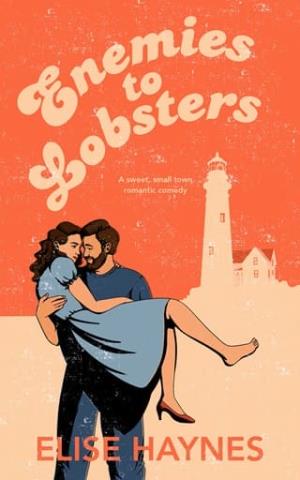
Enemies to Lobsters (Rumors of Cape Georgeana #1)
Chapter 1
Diana
Last night I dreamed that I kissed Tom Selleck at the top of the lighthouse.
I climbed up into the lantern room and he was standing there, grinning under his iconic mustache.
His eyes twinkled as he threaded his fingers through the hair at the nape of my neck, then he planted a big one on me. We made out for quite a while, in fact.
I woke up with the strangest sense of not knowing myself. Do I have a thing for Tom Selleck? Do I like mustaches? I Googled him as I brushed my teeth. The jury is still out.
The dream reminded me of the person I used to be—young, carefree, with a future like a blank canvas waiting to be painted. I was an early iteration of Diana York who laughed and watched old Gene Kelly movies without considering whether she might die alone.
Now, after six hours on the road and a stop at the Taco Bell drive-through, I’m sitting in front of my lighthouse with a steaming bag of tacos, tapping my thumbs on my steering wheel.
I want the happy version of myself back.
Maybe if I climb up to the lantern room and stare out at the dark sea I’ll find her. It’s why I drove up here, after all.
The tide is coming in, though, and I’m being a chicken.
“Just do it, Diana,” I mutter to myself. “No one will see you.”
On one hand, the rocky strip of beach that connects the lighthouse’s tiny island to the mainland will be covered by water soon. And being spotted by the residents of Cape Georgeana after so many years will spark a fresh round of stories about me.
On the other hand, Tom Selleck could be up there—as well as my hope-filled, girlish heart. I’ve missed it so much.
“I’ll go, I’ll go, I’ll go, I’ll go,” I murmur like I’m psyching myself up to jump in the cold ocean.
“Okay. I’m doing this,” I announce to no one as I swipe my Taco Bell and cell phone off the passenger seat.
I slam my car door and march across the rocky tombolo to the tidal island—no small feat in these dumb heels.
I’m conspicuous and uncomfortable in this dress that I wore to appease my grandparents, and carrying an incriminating bag of fast food in broad daylight.
I pick my way carefully up the windy hill to the lighthouse, then begin to climb the creaking spiral staircase to the top of it, feeling monumentally stupid.
Tom Selleck isn’t here and neither is the youthful, happy version of myself.
I said goodbye to her when I graduated from Dartmouth ten years ago and moved to New York permanently.
The late afternoon light is fading gold through the intermittent, narrow windows. If I don’t hurry I’ll be marooned on this tiny island until the tide washes back out in the morning. I’m not eager to spend the night in an abandoned lighthouse wearing this vice-like blue dress.
In my hurry, my red heel catches on a rusted iron stair. I stumble, falling against the rail, which disconnects from the crumbling, painted wall on impact. My heart sinks. What happened to this place? Years of disuse and salt air have not been kind. It’s disgraceful. The old girl is falling apart.
I can relate, I think with a crooked frown.
A chunk of wrought iron breaks away from the staircase, dropping thirty feet before hitting the floor with a clank that reverberates ominously through the tower. I gulp and step more lightly. Forty-four stairs lead to the lantern room at the top of the Cape Georgeana Lighthouse. Only twelve to go.
“Thirty-seven, thirty-eight, thirty-nine…” My old habit of counting the steps as I climb didn’t used to leave me so winded.
“Forty-two, forty-three,” I groan, slowing as I reach the top.
“Forty-four.” I let out a raspy whoop. I’m too young to be winded from climbing—well, running—up a few flights of stairs.
The minor victory has my thirty-two-year-old heart banging against my ribs.
But I made it. I take in the familiar room with its defunct light and salt-crusted windows. There is nary a handsome, mustachioed actor in sight. What a pity.
I can fulfill my other purpose, though, which is to resurrect Young Diana. I step carefully to the window, fingering the strand of pearls at my throat. I don’t remember this wood floor feeling quite so precarious before.
I take in the three-hundred-and-sixty degree view.
The navy blue sea stretches out to a gray horizon, indefinable with early evening fog.
I breathe in and out. Images of the hopeful girl I used to be flicker in my mind like an old film strip.
She listened to a lot of Pavarotti with her grandparents and a lot of Led Zeppelin in her earbuds.
I think about the late nights tiptoeing through the woods to Stevie’s house to watch Brigadoon with the sound low because we weren’t interested in anything but Gene Kelly’s face.
I remember the scent of Stevie’s cucumber-melon lotion mixed with boiled red hot dogs.
I shudder when I think of how their casings snapped on every bite.
I can’t remember the last time I ate a red hot dog—probably the last time I visited a few years ago. Has it really been so long?
That’s too long to go without dreaming. I used to dream—about things other than Tom Selleck, anyway.
The future used to feel like an unopened gift.
Lately it feels like regifted dress socks.
I picture my grandparents shoving some gold toe men’s socks in my face: Here.
We’ve all worn these. You might not like them, but it’s the way things are done.
But phantom echoes of my old self make my heart thump.
Once, when my mother and I had finished our usual lighthouse picnic of crunchy tacos and Mountain Dew—two menu items that were unheard of in my grandparents’ house—she told me about the Tourlitis Lighthouse in Greece. It was one of her dreams.
Her eyes sparked with life when she described how she was going to row through the turquoise water of the Aegean sea, claim the tiny spire of an island as her own, and spend her days eating moussaka and working on her suntan.
I listened with rapt attention, leaning against the wall of the lantern room and taking mental notes.
Based on my mother’s descriptions of it, life was going to be like a movie, and she was the star.
The life my grandparents wanted to force on her wasn’t going to stop her.
She was going to live. Real talk: I think she wanted to be Donna from Mamma Mia. That’s my mom in a nutshell.
But her optimism and ebullient laugh were contagious.
I can almost hear it echoing in the tower even now.
I was a teenager the last time we came here, but I swear I can smell the citrus scent of my mother’s perfume in the air.
I can hear her shrill voice belting "Wide Open Spaces” with her whole chest until it filled the lighthouse tower.
Her voice was awful. My lips curl. A tiny spark of joy lights in my chest.
There she is.
And there I am.
“I’ve missed you,” I mouth the words to my old self.
Fingering the satiny pearls at my neck, I stare out at the ocean, trying to summon some tears.
I deserve a good cry. I start by humming the opening lines of “Nessun Dorma” because it has always been my go-to when I’ve needed a cleansing cry.
My humming turns to singing because I can’t help myself with this aria.
It’s impossible not to belt it once it’s in my head.
My middling singing echoes through the tower exactly like my mother’s used to, but I've got nothing—not a solitary tear.
Then a boatload of screaming partiers skims close to the island, the thumping bassline of a Britney Spears song drifting faintly in the air behind them.
“You are ruining the vibe, sir,” I mutter at the driver. “I'm being dramatic here.”
I mouth the words of “Toxic” despite myself, determined to visit my lighthouse more often.
Sitting at the top of the spiral staircase, I dig a taco out of the bag before the tide gets any higher.
My phone buzzes on the weathered floor beside me, and my heart thumps with the feeling of being caught.
But it’s just Stevie. How does she know I’m here? I swear she has me chipped.
I swipe it open mid-bite. “Heh-oh,” I answer around my mouthful of food.
“Are you in town?” There’s no greeting, only an accusation in my best friend’s question.
My half-eaten taco lands on its wrapper with a crinkly plop. “Are you serious?”
“Marlow’s brother said he saw a car that looks like yours in the Taco Bell drive-through.”
This town. “Yeah, I’m here.” I swallow my food that doesn’t taste so great anymore. “I was just on my way to see you.”
“Diana York.” She scoffs. “Shows up in town for the first time in years and doesn’t tell her lifelong friend Stevie Sullivan.” Some people are guilt trippers. Some have Catholic guilt. Then there’s Stevie. She’s perfected the hybrid Irish-Catholic guilt trip.
I can’t hide my smile. I’ve missed her. “I’m coming. I had an errand to run first.”
“The lighthouse?” There’s no accusation in my friend’s tone this time. She just happens to know me better than anyone.
“Yeah.”
“‘Kay well, you don’t have all night to be dramatic at the lighthouse. Get your butt over here.” She finishes her threat with a few choice words and an “I love you,” then hangs up in my ear.
I chuckle as I wad up my half-eaten food. I’ve done what I came up here to do, and it’s getting late.
When I stand, the rocky base of the island is barely visible in the quickly fading light. The tide is crashing too high against the rocks. Oh, no. I need to move—if I’m not too late already.
I work my way quickly down the curling staircase, counting backward. “Twenty-four, twenty-three, twenty-two…” The light is dim down there, out of the reach of the sun. “Twenty-one, twenty—”
A scraping noise makes me freeze on the eighteenth step.
Then a snapping sound fills the tower, followed by a series of cracks.
The stairs beneath me shudder, then break away, inches from where I’m standing paralyzed, mouth agape.
A cracking sound speeds and intensifies, and I can only watch as the bottom of the staircase topples into a mangled pile of iron beneath me, sending up a cloud of dust.