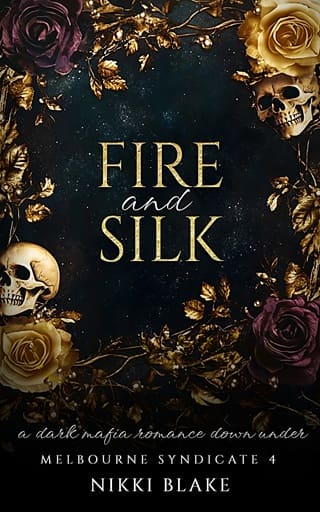
Fire and Silk (Melbourne Syndicate #4)
Prologue - Chiara
Santa Lucía della Pietra
The chapel is colder than I remember.
Its walls are carved from volcanic stone, black and veined with silver ash. Light spills through the high, arched windows like diluted gold—filtered through stained glass depicting martyrs I stopped praying to long ago. Even the crucifix looks tired. Or maybe I’m projecting.
I sit in the second pew, hands folded, the tips of my fingers pressed so tightly they ache. My rosary is coiled in my palm, not for prayer but for steadiness. The pew beneath me creaks like it remembers every confession I’ve never spoken aloud.
Above the altar, the Virgin holds her dead son with the same quiet I’ve carried since Melbourne.
I’m dressed like a woman untouched by grief. Deep plum silk, gloves that climb to my elbows, pearls at my throat, hair swept into a soft chignon. I look like I belong here—like I’m the widow of some wealthy Sicilian politician come to pay her respects.
I hear him before I see him. The measured rhythm of his leather soles on stone.
He slides into the pew beside me, uninvited. Of course.
He smells like sandalwood and danger, always has.
He’s older now—gray hair cut close, suit dark and perfectly tailored, cufflinks shaped like daggers.
There’s a scar across his jaw that wasn’t there the last time.
It suits him. He wears regret like he wears everything: sleek, pressed, and buried under control.
He turns his head slightly toward me, not enough to make it seem tender. Just enough to provoke.
“How are you?”
I don’t look at him. “Does it matter to you?”
His voice softens in that way it does when he wants to disarm. “You have always mattered.”
I smile. Bitter. Like ash.
Of course I mattered. Until I didn’t.
There was a time he couldn't keep his hands off me. Back when we were both stupid and young and so in love it hurt to look directly at each other. We left Italy like fools in a story—no plan, no money, just matching arrogance and a rented Vespa. Melbourne was a dream with sharp teeth.
We fought. We starved. I remember pasta nights made with boiling water and a single bouillon cube. And I remember the day he came home bloody, jacket torn, knuckles split.
“I’ve made a decision,” he’d said, eyes wild.
I thought he meant he’d found a job. A real one.
But no. Pietro had joined the mafia.
I’d laughed then. It sounded absurd. We weren’t criminals. We were dreamers. But he was calm.
“This is the only way, Chiara.”
We rose fast. Better food. Better wine. A flat with windows that locked. He went out early, came home late, sometimes not at all.
I stopped asking questions.
He was still mine; I told myself. He came back with roses, and gifts. He kissed me like he still loved me.
Then the night came.
Our home invaded.
Gunshots and glass everywhere. Screams. My screams.
And blood.
I still remember the white.
The kind of white that hurts to look at—walls, sheets, lights. A sterile, humming whiteness that swallows everything. Even the sound of a heartbeat.
I remember not feeling my legs. Just the heaviness. Just the hollow. Just the ache curling in a space that should’ve held life and instead held nothing at all.
The room smelled like antiseptic and wilted flowers. A nurse moved silently around me, pretending not to notice that I hadn’t blinked in ten minutes. That my hands hadn’t unclenched from the sheet since they told me.
You lost the baby.
Just like that. Four words. A bullet sentence.
He came later. Pietro.
Still wearing blood on his collar. Not mine. Maybe not even his. I didn’t ask.
He stood at the edge of the bed like he was afraid to touch me. Like I’d break if he did. Or maybe he’d break. I don’t know.
I looked at him, and I remember my voice—not a whisper, not a scream, just… still.
“I lost our child.”
His mouth opened, closed again. And then he said it.
“I can’t stay.”
It was quiet. So quiet. Like it wasn’t abandonment. Like it was logistics.
“They’ll come again,” he said, like that made it rational.
Like that made it okay. Like I hadn’t just bled out the only good thing we ever made.
I remember wanting to scream. To tear something. To tear him .
But all I did was turn my face to the wall and say, “Then give me something in return.”
A demand spoken from the pit of me, hollowed out and raw. Because if he could walk away from the body that carried both of us…Then he damn well better leave a piece of himself behind.
I remember the IV drip ticking like a metronome beside me. The bag above my head half-empty, the color of faint iron. I couldn’t feel anything below my hips, but my fingers... they twitched with something ugly. He had turned to leave.
I didn’t call his name. I didn’t plead. I just said, “I know what you’ve been doing.”
He stopped mid-step.
“I know about the shipments moving through Dock 17. I know about the quiet meetings at Teatro Del Mare. I know about the names you erased to rise.”
Silence.
“I know enough to walk into a police station and tell them everything.”
He turned, slowly. His expression wasn’t anger. It wasn’t even fear. It was grief.
“You’d die,” he said.
“So would you,” I answer.
He stepped closer, his jaw clenched, his voice a low rasp. “Then why say it?”
“Because I’ve already died,” I whispered. “They buried our child inside me.”
His eyes shone wet under the cheap fluorescent light.
Still, he didn’t speak.
“I don’t care about vengeance,” I continued. “I care about survival. So, if you’re going to disappear, if you’re going to leave me in this bed with nothing—then give me something to live for.”
His voice broke. “What do you want?”
“Half.”
He flinched like I’d hit him.
“I want half of everything you will ever own. Everything you will ever build. I don’t care if it’s blood-stained or gold-plated. If I’m to be erased from your life, I will not be erased from your legacy.”
He nodded. Then something cracked inside him. And for the first time since the attack, he cried.
“I swear it,” he said. “Chiara, I swear—half of everything I ever build will belong to you.”
It wasn’t enough.
I reached for the side table. My hand closed around the steel fork resting on the plastic tray, untouched since the nurse dropped off the last meal.
I jab it into the soft meat of my palm, between thumb and forefinger, where the pain is sharpest. It sinks in, not deep—but. Blood spills instantly, vivid and hot against my wrist.
His eyes go wide. “Chiara—”
“Swear it in blood.”
He stares. Just for a breath. Then his jaw tightens. He takes the fork, rolls up his sleeve, and without hesitation, jabs it into the base of his palm. Same place.
Blood meets blood.
He reaches for me, grips my hand, the mingling streaks already pooling onto the edge of the sheet between us. We shake—firm, trembling.
No ceremony. No priest. No paper. Just skin and oath and blood.
A pact made from ruin.
I left Melbourne a month later. Packed what was left of my dignity and boarded a plane to Catania. I married the man my parents had always wanted. A banker with clean hands and dead eyes. We built something cold and safe. But I never burned that oath. Never forgot.
He shifts beside me in the pew. The air still smells faintly of beeswax and damp stone.
I glance sideways, voice low but steady. “Give me what you owe me.”
He turns to face me fully. The candlelight hits the silver in his hair. His hands—those same hands—are bare now, no gloves. Just the faint scar across his palm where I marked him.
He sighs. The sound is quiet, but it pulls the breath from the chapel.
Then, without a word, he reaches into the inner lining of his coat—a smooth, practiced motion—and withdraws a folded document bound in ribboned twine. He doesn’t hand it to me right away. He holds it in his palm, staring down at it like it’s heavier than it looks.
When he finally offers it, I hesitate. My hand closes around it slowly, my glove whispering against the parchment. I pull the ribbon free, unfold the pages with care.
My eyes skim the lines. And then I stop breathing.
His signature. His seal. Every asset under the Dantès name—transferred.
Land. Properties. Offshore holdings. The estate. The vineyards. The safehouses. All of it.
I blink. Look up at him, shaken. “ All ?”
He gives a soft smile. It doesn’t reach his eyes, but there’s something old and tender in the way his mouth curves.
“I don’t want all of it,” I say, the words cracking mid-breath.
“You deserve all of it,” he replies gently. “But it’s not just for you.”
I shake my head. “Don’t—”
He cuts me off, voice softer now. “Your daughter… she’s beautiful. Like you were. Like you still are.”
My stomach tightens.
He tilts his head slightly, his eyes tracing me with something like reverence. “And your son… brave. Daring. Just like mine.”
I freeze. My body goes cold with instinct.
“Stay away from them,” I whisper. “They are not part of this.”
“They already are.”
I turn sharply, ready to leave, my heel scuffing softly against the ancient stone. But he holds my wrist—not hard, not pleading. Just firm . His touch is warm through the glove.
“That deed,” he says, “only takes effect through the marriage between one of your children and mine.”
I stop.
Slowly, I turn back to him.
My glare is unforgiving. “You’d tie them with a leash soaked in our sins?”
He lifts his hand to my face—slowly, so I don’t recoil—and brushes his thumb across the slope of my cheek. An intimate gesture, fragile for a place like this. His fingers tremble as they touch me.
“All I have,” he says, “is yours.”
His voice drops to a whisper, almost reverent.
“And all you have is mine.”
I don’t respond. I can’t. My throat locks around the breath I meant to take.
He leans in, not rushed. There’s no heat in the kiss, no hunger. Just sorrow. Memory. His lips press to mine—like he’s saying goodbye to a version of me that no longer exists.
He lingers for a second. One second longer than he should. Then pulls back.
“The choice is yours,” he murmurs. “Burn the deed and no one ever hears of it. Our children remain free. Unburdened. They’ll never carry the weight of what we did.”
He pauses, his gaze steady. “Or… hand it to your lawyer. Make it law. And unite them. Permanently.”
He stands then, as elegant and calculated as always, adjusting the cuffs of his jacket. He takes two steps down the aisle before pausing.
His head turns slightly, just enough that I see his profile in the flickering candlelight.
“My biggest regret,” he says, “is not realizing sooner that you’ve owned my heart for a very long time.”
And then, without another word, he walks away.
The sound of his footsteps fades into the stone around us, swallowed by centuries of silence.
I remain seated. Rosary in one hand. Deed in the other. And the past breathing down my neck.