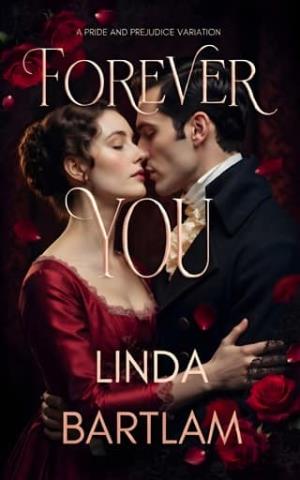
Forever You (Pride and Prejudice Variation)
One
Fitzwilliam Darcy could not hear the birdsong.
Or, he could hear it. It simply did not register. Not over the ringing in his ears, the hammering of his pulse, the sound of his boots grinding gravel into dust as he paced the grove at Rosings Park.
He stopped and took his hat off. He ran a trembling hand through his hair and put the hat back on, then gritted his teeth and paced some more, for good measure.
Last night had been a massacre.
Elizabeth Bennet had taken a knife in her slender hand and made several precise cuts, slicing his heart into small, neat pieces.
Then she had thrown them into the fire at Hunsford parsonage, and he, fool that he was, had stood beside her watching them burn to ash.
He had not even argued well. He had stammered.
He had justified. He had stood there, explaining to his executioner that the axe was at the wrong angle, and she had swung it anyway.
The last man in the world I could ever be prevailed upon to marry.
That one left a mark. That one left a crater.
The letter was his last card. His only card.
Eight pages, front and back. Written between midnight and dawn in a fury of ink and sleeplessness, one broken nib, and hands that would not stop shaking.
Everything he should have said last night and could not, because she had been standing there with eyes burning with fury and he had forgotten how words worked.
He checked his watch. She walked the grove most mornings. He knew this because he had made it his business to know it. To be fair, even he found it disturbing. If it were someone else doing it, he would have informed the magistrate. But she came every morning.
He looked down at the letter he held firmly. She had to read it. And she had to understand. Or else... No, he would not think of that. Not when there was the slightest possibility of hope.
She appeared on the path, and his chest clenched, a fist closing around his lungs. Even now. Even after she had gutted him and left him bleeding on the parsonage rug. The sight of her dark curls, the straight shoulders, that walk, God, that walk, hit him square in the sternum.
She saw him and stopped in her tracks. Her face shuttered.
“Miss Elizabeth.” He stepped forward and extended his hand, which—damn it—was visibly shaking. “I have no intention of repeating the sentiments that so disgusted you last night. But I beg you to read this.”
Her hand instinctively opened, and he placed the letter firmly in her palm. She looked at it, blinking. Then she pinched her lips.
“No, Mr Darcy. My dignity suffered more blows than it could survive last night. I have no desire for a second round.” Her eyes flicked to the letter. “Thank you. No.”
She tore it in half, and handed him the pieces. The remaining pieces of his broken heart.
“I wish you a good day, Mr Darcy. And a good life.”
Then she turned and stomped in the opposite direction. Her spine was ramrod straight, unhesitating, magnificent. She had just delivered the final blow, and he was still admiring her figure as she went out of his life forever.
The birdsong was loud, melodic, and obscene around him. But inside his chest there was only a roar, covering the beats he knew must be there, although he was absolutely certain he was dead.
Darcy stared at the pieces, then thrust them into his pocket, his fingers trembling against the torn grain of the vellum.
The walk back to Rosings was a blur of punishing footfalls.
The air smelled of early lilac, a sweetness so misplaced it made him want to retch.
He kept seeing the set of her jaw. She had not even paused to wonder if he were offering an apology or a curse.
She had simply reached out, taken the labour of his soul, and broken it.
I have no desire for a second round.
He set his teeth, his jaw aching with the force of it. He would leave. He would go to London, find a dark corner of his club, and stay there until the image of her finally faded from his mind. He would never speak her name again.
He crossed the threshold, barely registering the motion.
“Mr Darcy.”
He stopped. Mrs Jenkinson stood at the foot of the stairs, her face the colour of pale bone. She did not linger in the shadows as she usually did. She stepped directly into his path, her hands knotted so tightly in her skirts that her knuckles were white.
“Her Ladyship requires you. In Miss de Bourgh’s chambers. Immediately, if you please.”
Darcy frowned, his hand instinctively twitching towards the pocket containing the letter. “The drawing room, surely.”
“No, sir. Her chambers.”
There was a strange urgency in the woman’s whisper that managed to intrigue him. He followed her up the stairs.
The door to Anne’s rooms stood ajar.
Lady Catherine was there, sitting in a high-backed chair by the window, her face a mask of frozen, aristocratic fury. Her eyes, usually darting with judgemental energy, were fixed on a point in the centre of the rug.
Across the room stood Anne’s maid. The girl was silent, her hands folded primly.
She did not look like a servant in distress.
She looked like a soldier who had just delivered a report.
Darcy recognised the expression. She was his aunt’s creature, and the cold glint in her eyes suggested she had found exactly what she had been paid to look for.
Darcy’s eyes went from his aunt to his cousin. Anne was sitting on the edge of her mattress, her hands fidgeting with a handkerchief.
“What is the matter, Aunt? Is Anne not well?” he asked and closed the door behind him.
Lady Catherine shot a glance at him, as if she only then realised he had entered the room. “Yes, Fitzwilliam. Anne is not well.” She turned to the maid. “Higgins, you may go now. You shall be rewarded for your loyalty. And your discretion.”
The maid bobbed a small curtsy, gave a side glance at Anne, and swept past Darcy closing the door behind her.
Lady Catherine sighed, which was very much not like her. She usually harrumphed. “Fitzwilliam, sit.”
Darcy was grateful for the command. His Hessians felt heavy on his feet, carrying the burden of his body from the grove and the letter in his pocket. “I am all ears, Aunt.”
“Do not be impertinent, nephew. We have a situation. Higgins informed me that there are signs, or lack thereof, which indicate your cousin,” she pointed an accusatory finger towards her daughter, “is with child.”
Darcy stared. His eyes darted between the two of them, disbelief written all over his features. “What in the blazes...!”
“Do not be impertinent!” his aunt hissed, as if this was the real problem here, and not the world tilting on its axis for the second time in two consecutive days.
He turned to Anne. “Is it true?”
Anne’s fingers stilled on the handkerchief. She did not look up, but her chin lifted a fraction, barely perceptible, and she gave a single, small nod.
Darcy leaned back in his chair and pressed his fingers to the bridge of his nose.
He had woken this morning with one catastrophe.
He had gone to the grove to repair it and had instead acquired a second, considerably worse one.
And now, apparently, the Almighty had decided that two were insufficient and had furnished him with a third, because why not? The day was still young.
“How far along?” he asked, because one of them had to be practical, and it clearly was not going to be Lady Catherine, who looked as if she might combust on the spot.
“Higgins estimates five months.” Lady Catherine’s voice dropped to a furious whisper.
“Five months, Fitzwilliam. Five months of... of...” She could not bring herself to say it.
The word was too vulgar, too real, too much evidence that her fragile, biddable daughter had a body and had used it.
“The gowns have concealed it thus far. They will not conceal it much longer.”
Darcy looked at Anne again. She had always been thin, but now that he knew, he could see it. The slight roundness beneath the high waist of her dress. The way she held the handkerchief low, across her lap, a habit he now understood had nothing to do with nerves.
“Who is the father?” he asked.
Anne’s mouth pressed into a line. She shook her head once, and her fingers resumed their work on the handkerchief, as though she intended to shred it to ribbons rather than answer.
Lady Catherine made a sound that was somewhere between a growl and a prayer. “She will not say. I have asked. I have demanded. I have threatened to dismiss every male servant on the estate.” She drew herself up in the chair. “It does not matter. What matters is the solution.”
And here it came. Darcy could feel it approaching the way one felt a carriage rounding a bend before it appeared—the rumble, the shift in the air, the certainty that something large and unavoidable was about to arrive.
“You shall marry her, Fitzwilliam.”
There it was.
He should have been outraged. Any reasonable man, presented with the information that his cousin had got herself with child by an unnamed lover and that he was expected to step in and play the husband, would have risen from his chair, expressed his profound displeasure, and walked out of the room with his dignity intact.
Darcy did not move. He sat very still and felt the torn letter shift against his chest as he breathed, and he thought, with the peculiar clarity that comes when a man has been beaten so thoroughly that further blows cease to register, What does it matter?
Elizabeth Bennet had looked at him this morning with contempt so pure it was almost beautiful, and she had torn his heart to pieces without even bothering to read it first. There was no future waiting for him beyond this room.
No grand love. No partnership of equals.
No dark-eyed woman laughing at him across a breakfast table for the next fifty years.
That door had been shut, locked, and the key thrown into the shrubbery.