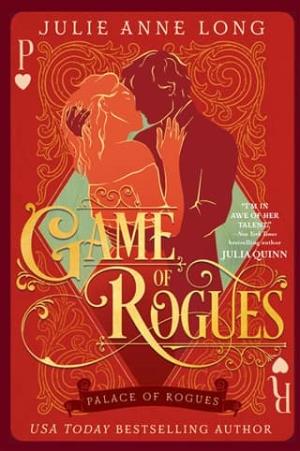
Game of Rogues (The Palace of Rogues #9)
Chapter One
Lucifer’s Fall might be a den of depravity, but it resembled a cathedral.
Honeyed light poured through a pair of tall, arched windows. Beneath them, exuberantly healthy ferns sprang from pots. Guinevere
Woodville eyed this evidence of a well-trained and well-paid staff wistfully. When she’d departed their family home in Sussex
for London two days ago, their housekeeper, Mrs. Haddock, had been moodily smoking a cheroot in the kitchen, one gouty leg
hoisted on a chair. Mrs. Haddock had come to them with dubious references, a murky London past, and a large hairy mole on
her left cheek. While she could not be relied upon to adequately nurture indoor plants, the suspicion that she might be a
witch ensured the maids never balked at obeying her instructions. Mrs. Haddock did not steal the silver, and, most importantly,
she was willing to work for the pittance the Woodvilles were able to pay. Somehow the ancient Woodville manor was maintained
in a shambling semblance of gentility.
But during her interview for admission to the Grand Palace on the Thames yesterday, a darling little boardinghouse near the London docks, of all places, Ginny had watched as the maid called Dot slowly—torturously slowly, if Ginny was being honest—lowered the tea tray to the table, then leaped backward with a celebratory clap.
The proprietresses, Mrs. Hardy and Mrs. Durand, had sighed happily.
Imagine servants who took such joy in their work!
Employers who took such joy in their servants! It was her dream.
But Ginny had learned to pick her battles, which was how she’d managed to raise herself and her three younger siblings into
adulthood with their limbs, senses, and virtues intact. In so doing she’d fulfilled the first of the two promises she’d made
to her mother before she died eight years ago. Which was two days after her father died, and three days after he’d driven
the two of them in the Woodville high-flyer around a corner too fast one time too many.
Just a fortnight ago she’d been on the brink of fulfilling part of the second promise—ensuring the Woodville siblings made
spectacular marriages—in the most triumphant imaginable way, thanks to a glorious bit of providence.
And then her brother had returned from London and thrown himself at her feet in sobbing hysterics, babbling about “Lucifer’s
Fall” and “the Reaper” and begging her forgiveness for what he’d just done.
The icy terror that washed through Ginny left in its wake the usual calm and preternatural clarity that overtook her when
confronted with disasters.
It was only money (a lot of it); no one had died this time (yet). It conceivably could be remedied. And surely, no matter how scary, this “the Reaper” (how patently ridiculous was that name?) was just a man?
They were not fundamentally mysterious creatures.
She had a fortnight to fix the unfixable. She would need to go to London.
But thanks to that frivolous concept men liked to call honor, her brother refused to divulge any more than a few bone-chilling
details of his disgraceful evening. None were names, but one perhaps held a hint: He had satyrs on his waistcoat buttons, and I swear they were jeering at me, Ginny! You would not have blamed me if you knew
who it was.
No amount of haranguing would budge him.
She was forced to turn to other sources for reconnaissance.
Mrs. Haddock also had a tendency to speak in cryptic aphorisms, which made her seem like a sage. Ginny had her doubts about
this. But she could be a fount of surprisingly interesting information. When Ginny asked her, “Have you heard of a man in London called the Reaper
who runs a gaming hell?” The housekeeper’s head turned toward her slowly. Her eyes had gone so wide the whites showed.
And so apparently important was the message she was about to impart, Mrs. Haddock actually leaned forward and stabbed out
her cheroot on the chipped saucer next to her elbow. “Now, you listen to me, Miss Woodville,” she’d all but hissed. “Ye’re
a good girl, and you want naught to do wi’ the Reaper. ’E be a dangerous man. One of the worst men in London. Beware the strivers. Them what come from nothin’ and strive all the way to the top be right dangerous. And I don’t care what women say about the size of ’is . . .”
She sat back abruptly and pressed her lips together, her expression cagey.
“Fortune?” Ginny guessed.
“I’ll just go and see if the maids be done wi’ the upstairs dustin’, shall I?” Mrs. Haddock pushed herself out of the chair and shuffled off.
Ginny had then hastily called upon her neighbor, the giddy young Lady Tomelty, who was in the country to rest between bouts
of London socializing. She was married to a much older earl and could be counted on to say things she shouldn’t, especially
to an unmarried girl. Ginny asked her the same question.
“My goodness, where did you hear about Gabriel Marchand and his little sin palace, Lucifer’s Fall? Not from your darling brother? Oh dear. The on-dit is that
Marchand is depraved.” Lady Tomelty gave a theatrical little shiver. “The men are desperate to be in his good graces and they all clamor to be
members of his club and the ladies seem obsessed with him for—well, for reasons of prowess, I’m given to understand. I hear he does delicious things with ropes and whatnot.”
She whispered all of this behind a gloved hand and then, maddeningly, pantomimed turning a key at her lips.
Ginny knew she could expect to blush every time she spoke with Lady Tomelty; she went in braced for it, because she felt it
was worth the education. She had an inkling about what “prowess” meant. She wasn’t entirely naive. But that didn’t mean she
wasn’t also appalled.
On the whole, the Reaper sounded like a bad and terrifying man, and this suited Ginny. Without a villain to blame or defeat,
the Woodvilles’ latest predicament was merely ridiculous. Worse than that: pathetic.
No doubt many would consider her visit today to Lucifer’s Fall a fool’s errand.
Viewing it that way was a luxury she could not afford.
She had to start somewhere. Failure was unthinkable.
She could see nothing beyond the horizon for the Woodvilles if she failed. The future might as well be an abyss.
Unlike Cerberus, the dog who guarded the gates of hell in mythology, the clerk who looked up from his desk when she approached
possessed only one head. He wore spectacles and a crisply tailored blue coat. She could see the pale blur of her face in his
gleaming brass buttons.
If he was shocked by the sudden appearance of a young unchaperoned woman, not a twitch betrayed it.
She handed her card to him. It was new, the lettering elegantly engraved rather than merely printed. For years she’d secretly
yearned for such a fancy, expensive card; a few weeks ago, when the miracle that would have solved all of her family’s problems
forever occurred, she’d allowed herself this one frivolous indulgence. Now she felt mocked by her own optimism. She ought
to have known that everything was bound to go to pieces again.
“The Honorable Miss Guinevere Woodville,” the man read aloud. “Oh yes. We received your message yesterday.” The light reflecting
from his spectacles made it difficult to read his expression, but his pause was eloquent and his tone was desert dry. “How
did you get in the building, if I may ask, Miss Woodville?”
“Your guard at the front entrance assumed I was someone named Martine who is apparently expected. I didn’t disabuse him of
the notion. He stepped aside and let me in.”
She did feel a slight twinge of guilt about that. But surely it wasn’t her fault they’d hired a gullible guard?
“Ah. I see.” The man nodded gravely. “I’m Mr. Ogden, Mr. Marchand’s secretary. Since you cared enough to lie, Miss Woodville, I’ll just see whether he has a moment to speak with you, if you would care to take a seat?”
Two tasteful brown leather chairs native to all places wealthy men congregate flanked his desk. She gingerly settled into
one.
Well. This was almost too easy.
Mr. Ogden advanced about twenty paces to a room divided by a partial wall from the one in which she sat. More sunlight shone
over the top of it, suggesting Mr. Marchand enjoyed another cathedral-like window in his office.
During their bass-voiced, murmured conversation, Ginny pulled in and released three long breaths. It did little to slow her
galloping heart. Her palms were clammy inside her gloves; the cold tip of the knitting needle she’d tucked inside her sleeve
pricked her skin. She would be prepared to defend herself if the need arose. She glanced down at her lap; the mirrorlike sea
of marble made her dizzy. When she jerked her head up again she noticed the ormolu-trimmed sconces lining the wall and a sleek
bronze statue of a woman in a toga, one bare breast exposed, tucked in an alcove. At the far end of the atrium, behind Mr.
Ogden’s desk, a door led into a hall.
Just in case, this morning she’d silently asked her mother to send her the usual sign that all would be well. She’d found
it in the garden in front of the Grand Palace on the Thames: a tiny gray stone shaped like a heart. She’d collected twenty
such stones over the years, and she kept them in a little wooden box on her writing desk. Whenever she felt sickeningly uncertain
or achingly alone, Ginny sifted them through her fingers, remembered that she was still loved, and took courage.
For extra luck, she’d worn her copper-colored silk dress, because the Honorable Francis Balfort had once pronounced her “mesmerizing” in it.
Her sisters, Felicity and Fiona, were a matched set of petite, blue-eyed, black-haired fairy princesses, like their mother.
They almost instantly inspired daft, protective cooing in men.
Ginny inspired what could best be described as appreciative wariness in them.
She was long-legged and lush, with fierce, straight black brows over big, round whiskey-colored eyes.
Her mouth was pink and full and her black hair billowed like bonfire smoke when released from its pins.
“You look wise and a little dangerous, as though you ought to be striding the moors, calling down the thunder,” Francis, the
third son of a duke, had once declared after he’d had three cups of ratafia at an assembly. After a long pause he’d added,
“Apart from the freckles, that is.”
She didn’t bother anymore powdering the faint spray of golden-brown robin’s-egg-like speckles on her cheeks. They were a deceptively
whimsical feature on a girl who, by nature and by necessity, patently was not.
At last Mr. Ogden returned.
“Mr. Marchand is able to spare a few minutes for a chat, Miss Woodville. If you will come with me?”
Over the past eight years she’d learned the lengths she was willing to go to protect her family, and more than a little about
shameless bargaining. She’d walked into the unknown nearly every day.
She stood, squared her shoulders, hiked her chin, and like a madwoman followed him into the Reaper’s den.