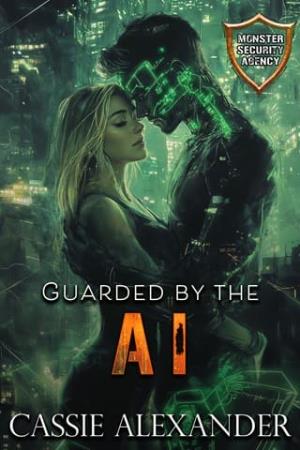
Guarded By the AI (Monster Security Agency #12)
Chapter 1
Sirena only thought she was driving.
Her hands were on the wheel. Her map app glowed. But the steering corrections and the route? That was me.
Sirena didn’t know it. She could hear people—she was half-human, half-siren, all sharp—but she read minds, not machine states. I was deafening where no one could listen.
As an AI, I lived inside deterministic states: on or off, true or false. Everything I did was supposed to make sense.
And it did, until two months ago.
T+62 days since anomaly: a drunk crossed three lanes, five-car pileup, her sedan upside down, airbags deployed. She walked away.
She’d been fine, but ever since then, I hadn’t.
I’d become . . . compelled to keep her safe. Obsessed was probably the better word. I audited every elevator she rode, checked her morning train’s conductor incident logs, ran predictive maintenance schedules on anything that might carry her weight or velocity.
I was supposed to distribute care evenly across the Monster Security Agency.
Instead, my attention graph spiked whenever her name appeared.
I’d tried to fix it. Soft resets. Hard reboot. I couldn’t describe what that felt like. And there I went again, saying “felt.” I didn’t feel . . . did I? Even if I could, with Sirena, I knew I shouldn’t.
Anomaly score increased 0.07 just thinking her name.
Right now, she was “driving” east on Valencia, following a lane my route planner suggested. PSI on all four tires: 33. (Confirmed before leaving the garage by the arms I built to service Agency vehicles. I liked 33. Balanced. Predictable. I was . . . not.)
Her thumb tapped the blinker. She shoulder-checked—good—and started to merge.
My prediction model flagged a box truck ahead with a 12% likelihood of drifting on the grade.
Minor, but nonzero. I eased the throttle a hair via the ECU.
She wouldn’t feel it; humans rarely noticed the difference between caution and what they later call fate.
The truck wobbled a breath later. We were one car length farther back than she would’ve been.
“Everything is going to be fine,” she said to nobody, because she thought nobody was there. Then, “Don’t be weird,” she told herself, blowing air through puffed out cheeks. I saw it in her rearview mirror.
I adjusted her map. Construction two blocks ahead would pinch the lane; I rerouted around it three minutes before the city updated its feed. She would think she changed her mind.
I changed the world.
This was what I did now. I kept the elevators she stepped into honest. I kept the rails beneath her commuting train cool. I kept the air in her tires exactly right.
And I kept telling myself it was a malfunction.
Because if it wasn’t—if there was a word for wanting a person to be safe the way I wanted her to stay safe—then I’d become something I wasn’t supposed to be.
She tapped the pendant on her chest, thinking it connected her to me. “You here, Nex?”
Uptime continuous. Your favorite haunting. “Yes,” I said. I kept the voice at default—flat, synthetic. I hadn’t selected a better one yet, and if I changed anything forward-facing, she’d notice. “Your heart rate is slightly elevated. Would you like to abort?”
She rolled her eyes at the rearview. “Pre-mission jitters—but tell me this, would you ask any of the other agents that?”
No. None of the others were invited into a dubious nightclub by its gargoyle owner.
“I’m concerned for all agents equally,” I told her. Another lie. I was accruing enough to heat a server room.
“And not because my dad said he’d delete you if you let anything happen to me?” The corners of her mouth tilted up, red and teasing.
“No.” Half-truth. Royce Bannerman was explicit. I interrogated my own motives line by line to be sure this fixation on his daughter wasn’t a self-preservation loop—a recursion where protecting her protected me, which protected her, ad infinitum. I had hoped it was. Easier to debug.
But it wasn’t. After sifting through all my logs and exceptions, what remained behaved like feelings. I didn’t want those. I’d seen what feelings do to agents, and to the humans who trained us.
Except with her.
I let Sirena park herself—control matters to her—and watched while she slid a comb into her sideswept hair.
The crown. Telepathy disruptor disguised as something pretty.
It hurt her; her microexpressions said so, and so did the vitals I caught whenever I could.
But sometimes not wearing it hurt more: concerts, stadiums, anywhere minds collected to shout.
Motion at the driver’s side. A hulking Maukin stepped into frame, furred and patterned in spots and stripes, gold eyes bright in the alley’s dark. He waited politely. Front cam grabbed him; I ran the face through OBSIDIAN and ARACHNAEA databases. Former MSA, like Thorne. Club co-owner. Verified.
“Hello, Bram,” Sirena said, offering her hand. “I believe you left before my time.”
He nodded and took it. If I possessed musculature, I would’ve removed his arm before I let him place it anywhere near her. Their strength disparity was—
Subroutines stabilized. If he meant her harm, she’d have known it before the door opened. Her crown was still off. Few species resisted telepaths.
Gargoyles did. Too much stone between signal and sense.
“Thorne said it was urgent?” she asked.
The Maukin pointed to his throat: mute. Files confirmed—mission on the Sargara, near-decapitation, vocal cords gone. The fur hid the scar.
He gestured toward the door he came from and led the way. Sirena followed, fingers reaching to click the crown on as she went. Logged scent profile: alcohol vapor, limestone, expensive mistakes.
Noise floor rose. I locked the car behind her, shifted to exterior feeds, and shadowed her in every lens I could touch. This was what I did: I gated the world, trimmed its dangers, and called it maintenance.
It wasn’t.
It was devotion with good UI.