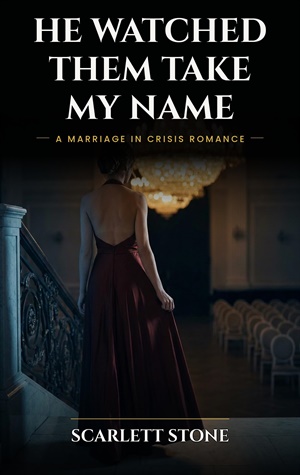
He Watched Them Take My Name (The Kastellanos Vows #1)
Prologue
London. Four years ago.
The dress is not mine.
Almost nothing in this room is. Not the crystal, not the orchids flown in from somewhere that has a summer in February, not the four hundred people who have spent the evening asking me what I do and then looking over my shoulder while I answer.
I own two dresses. This is the other one.
My husband is at the front of the room with his hand flat against the small of my back, and I have been married to him for fourteen months, and I am three weeks pregnant, and I have not told him yet because I wanted to tell him tonight, after, in the car, when the room was finally behind us.
That is the sentence I keep. Later. For years. I wanted to tell him in the car.
Eleni takes the microphone at nine.
She is wearing gray, and she is beautiful the way a cathedral is beautiful, which is to say she was built by people who wanted you to feel small. She thanks the board. She thanks the founding families. She says one hundred years and the room makes the sound rooms make.
Then she says, “My son has given a great deal to this company.”
Adrian’s hand is still on my back.
“And I think it is only right,” she says, “that you all hear what it has cost him.”
The screens come alive.
There is no video. Only sound, and a waveform crawling across two enormous panels, blue and clean, and then his voice comes out of the speakers at a volume built for orchestras.
She was never going to be one of us.
The room does not gasp. That is the thing nobody believes when I tell it.
Four hundred people hear a man’s voice say that about his wife while his wife is standing beside him in a borrowed dress and the room does not gasp.
It goes quiet in a way that is worse. It goes quiet the way people go quiet when the show is finally starting.
I knew that the day I married her.
His hand comes off my back.
Not fast. Not guilty. It just stops being there, the way a light stops being there, and I feel the cold on that exact rectangle of skin and I think, with total calm, oh. Oh, this is happening to me.
The doors at the back open.
Everyone turns, because that is what the doors are for, they are for turning, and a woman comes in. Dark hair, red silk, a face I have seen in a photograph on his desk in a group of nine people at a shipyard in Piraeus.
She is walked to the head table.
To my chair.
Someone has already moved my name card. That is the detail I cannot get out of my body, even now, even four years later. Somebody in this building was paid to take a small piece of cream cardstock with my name on it and put it in a bin.
A man in a good suit slides a folder across the linen toward me. Cream folder. Silver clip. He does it politely, the way a waiter offers you the bread.
Annulment.
Not divorce. Annulment. The word for a marriage that was never real to begin with, and I read it upside down because I am not going to give this room the pleasure of watching me pick it up.
The recording is still playing. His voice, calm, reasonable, a little bored.
It was always going to end this way.
And I look up.
Across four hundred people, across the orchids and the crystal and the woman in my seat, I find my husband’s eyes, and he is already looking at me. He has been looking at me the whole time. His face is the color of paper. His jaw is locked so hard I can see it from here.
He knows I am looking. He knows exactly what I am asking him.
Say it isn’t you. Say the word. One word, Adrian. Say my name.
There is a half second.
I want to be precise about this because I have spent four years being precise about it.
There is a half second where he leans forward.
Where the weight shifts into the front of his feet.
Where I see the whole rest of my life, the good one, the one where he opens his mouth in front of four hundred people and lights this entire building on fire for me.
Then his mother puts one hand on his arm.
And he does not move.
He stands there with his mouth closed and his eyes on me and he lets it happen.
He lets all of it happen. The recording finishes.
The applause starts somewhere near the back, uncertain at first, then not, because people will applaud anything if they think someone important might be watching them not applaud.
I pick up the folder.
I hold it against my chest like a schoolbook, and I walk the length of that ballroom by myself, and my heels are too loud, and nobody stops me, and a waiter steps out of my way and apologizes, and he is the only person in that room who says a word to me.
I am on a plane at five forty the next morning with a chisel scar on my thumb and a passport and a child nobody knows about.
People ask me, when they are brave enough, what the worst part was.
They expect me to say the recording. Or the woman in the red dress. Or the folder.
It was none of those.
That was the moment. Not the recording. Not the papers. The half second where he chose the room over me.