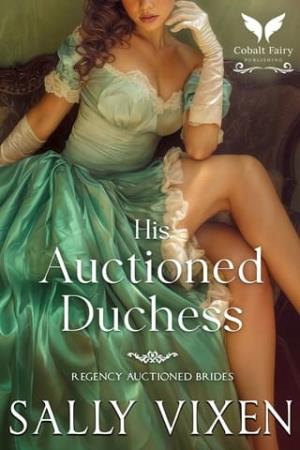
His Auctioned Duchess (Regency Auctioned Brides #1)
Chapter 1
Richard Belford, Duke of Ashwood, felt no warmth at the sight of the Ashwood road.
Bordered on either side by beeches whose branches, dark with late autumn foliage, arched overhead like the ribs of a vaulted nave, the road to Ashwood stretched long and unwavering.
The leaves were already turning, some burnished gold, some copper, and they whispered in the wind with the faint rustle of old secrets.
Beyond them, the estate unfolded in sweeping parkland: meadows sloping to the river, fields dotted with deer, the faint line of cottages that belonged to his tenants.
All of it, every acre, was his by right.
Richard Belford's eyes, gray as winter stone, moved over the familiar landscape without softening.
He had dreamed once, years ago, of riding home to triumph, to embrace, to welcome.
Those dreams had been burned out of him, consumed in fire and blood, leaving only the scar that scored his face from temple to jaw.
A brutal reminder of what he had lost, and of the man he had become.
The horse beneath him snorted, its hooves striking sparks on the gravel as the long facade of Ashwood Hall came into view.
The house rose in dignified majesty, pale Bath stone catching the late afternoon sun, its rows of windows glittering like watchful eyes.
There was symmetry in its lines, order in its wide sweep of steps, but to Richard, it loomed more like a judgment than a welcome.
It has not changed, he thought grimly. But I have.
The gates swung wide as he approached. Stable lads froze in their tasks, pitchforks and buckets suspended mid-air.
A groom nearly dropped his bridle. Servants spilled into the courtyard, mouths agape, eyes fixed upon him.
He felt the weight of their stares as though they were stones hurled at his back.
Some crossed themselves, as if to ward off an apparition.
They thought me dead, he realized, grim satisfaction cutting through the cold. Perhaps they preferred it so.
The horse halted at the bottom of the grand staircase.
Richard swung down, his boots crunching against gravel.
The scar was visible in the full light, carved deep and angry across the once-handsome symmetry of his face.
He did not flinch beneath their stares. Let them look.
Let them name him devil, beast, spectre. He had no care for their whispers.
Then, “Richard!”
The cry rang out, clear and broken by sobs.
A figure hurried down the marble steps, silk skirts gathered in trembling hands.
His mother, Ophelia Belford, the Dowager Duchess of Ashwood, descended with such haste that propriety was forgotten.
She was smaller than he remembered, her once-dark hair almost wholly silver, her shoulders bent beneath years of grief.
But her eyes, the blue of summer skies, were unchanged, bright with tears as they fixed upon him.
She reached him in an instant, arms outstretched, and flung herself against him with the desperation of one who clings to the dead restored. Her fingers pressed into his coat, her cheek against his chest.
“My son, my son,” she sobbed. “Heaven forgive me, I thought you lost forever. They told us you were dead. Letters ceased, word came of ships gone down, of fever sweeping through the ports. I prayed until my knees bled. And now, oh, merciful God, you stand before me.”
Richard endured the embrace. For a moment, his arms closed about her with mechanical strength, but there was no yielding in him. He did not linger, could not. The years had made sentiment a luxury he could ill afford. After a heartbeat too long, he eased her back, his voice gravelly from disuse.
“I am alive,” he said simply. The words were fact, not comfort.
She searched his face, her fingers rising to brush the scar. He caught her hand before it could touch, holding it firm but gentle, and lowered it. “Do not,” he murmured. Her lips trembled, but she obeyed.
A sound drew his attention. From the shadow of the doorway, a man leaned against one of the carved pillars, posture languid, eyes alight. Jasper Belford, his cousin. Dressed immaculately in navy and ivory, he smiled faintly, but the expression did not reach his eyes.
“Well, well,” Jasper drawled, his voice carrying easily.
“The prodigal duke returns. Forgive me, cousin, but you were more entertaining as a legend. Drowned at sea, rotting in some ditch, or slain by a jealous husband, every tale more delicious than the last. And yet here you stand, with proof enough etched upon your face. That scar, it begs for a story.”
“Have my chambers prepared,” he ordered. “I require a bath, food, and solitude. Nothing more.”
The servants shifted uneasily, glancing between them. Richard’s mother shot Jasper a sharp look.
The silence thickened, heavy as velvet. His mother opened her mouth, but no words came. Jasper’s smile sharpened, almost a sneer, and he inclined his head in mock courtesy.
“As you wish, Your Grace. Solitude, after all, is your truest inheritance.”
Richard turned without another glance and strode into the hall, his tall figure cutting through the gathering like a blade.
The long dining room blazed with candlelight that evening, every silver branch of the candelabra aflame, every polished surface reflecting fire.
The house had always been proud of its grandeur, mahogany paneling, gilt-framed portraits of solemn ancestors, a table that could seat thirty.
Tonight, the grandeur felt oppressive, like a weight upon the three who sat to dine.
Richard resumed his rightful place at the head of the table, a position he had not held since youth.
His mother took her seat at the right hand, her delicate fingers folding and unfolding upon her napkin.
Jasper sat farther down, draped lazily in his chair, but his posture belied his interest. His eyes were keen, fixed upon Richard with the fascination of a cat regarding a rival tom.
Servants came and went in silence, setting before them roast pheasant, glazed carrots, steaming bowls of potatoes.
The air smelled of wine and spice, yet Richard ate as if the food were rations, his movements economical, his appetite driven by necessity alone.
He neither lingered over the dishes nor spoke to remark upon them.
Each mouthful was chewed and swallowed with the detachment of a soldier accustomed to harder fare.
The silence stretched, punctuated only by the clink of silver on porcelain. It was Jasper who broke it, voice light as though he intended to charm, though there was steel beneath.
“So, cousin,” he began, twirling his goblet between his fingers, “shall you not indulge us? That scar upon your face, why, it cannot have come from a gentleman’s quarrel. Too deep, too brutal. Was it a blade? Or fire? Or perhaps”—he smiled faintly—“some lady’s husband, caught unawares?”
Richard’s fork stilled mid-air. His gaze lifted, met Jasper’s, and held it. His eyes were gray stone, unflinching. “I do not know,” he said flatly. “Nor do I care. I do not waste time on the past.”
A pause followed, taut and heavy. Jasper arched a brow, then let out a soft laugh.
“How pragmatic. But surely society will not be so easily satisfied. You are aware, I trust, that they have named you already? The Devil of Ashwood, risen from the grave. They will demand a tale to match the moniker. Shall I invent one for you?”
The dowager flinched. “Jasper, for shame–”
Richard’s voice cut clean across hers. “Let them invent what they please. I will not waste breath upon their amusement.”
His mother reached forward, her eyes wet, her hands trembling.
“Richard, I do not understand this hardness, this silence. I lost you once—I buried you in my heart. Do you not see what it means to me to have you back? Can you not grant me even a fragment of what you endured, a single memory to hold–”
“No.”
The word was a blow, sharp and final. Even the servants froze, their movements stilled as though the very air had grown brittle.
Richard’s jaw tightened, but his eyes softened just enough to betray the smallest flicker of regret.
“The years are gone, Mother. To speak of them will not return them. Better to speak of what matters now.” He set down his goblet, fingers steady upon the stem. “Tell me of my father.”
The dowager’s breath caught. Her lips parted, but no sound came.
Jasper leaned back, his smile curving, relishing the silence.
“Dead these three years,” he said smoothly, his voice pitched with practiced sympathy.
“A stroke in his study. He died believing you were long buried. The dukedom passed to you in absentia. Why, many assumed it would devolve upon me, in due course.” He sipped his wine, eyes gleaming.
“Your resurrection has surprised more than a few.”
The words were honey, but Richard heard the venom beneath.
For the briefest moment, his composure wavered.
The thought of his father—stern, unyielding, yet ever-present—dying with belief in his son’s death flickered across his mind like a blade drawn in darkness.
He felt it cut, sharp and silent. But just as swiftly he suppressed it, burying the emotion beneath iron resolve.
He drained his glass in a single swallow, set it down with quiet finality, and rose. “Then I inherit his responsibilities. That is all.”
His mother rose half out of her chair, one hand reaching, her voice breaking. “Richard–”
But he had already turned, his great frame striding from the room, his shadow long against the candlelit floor.
Behind him, the dowager whispered Jasper’s name, a warning. Jasper only smiled into his wine, languid and satisfied, as though the evening had given him precisely what he desired.
The following morning dawned pale and cool, the sky washed in that uncertain gray between dawn and daylight.
Mists curled low across the parkland, softening the shapes of trees and fences, wrapping the estate in veils of secrecy.
Ashwood Hall, however, was already stirring; the kitchen fires roared, the bells clanged, and the household, once sluggish with grief, now moved with new purpose. The Duke had returned.
Richard was seated in the breakfast room before the rest of the household had risen.
The chamber looked out upon the east lawn, its tall windows streaked with condensation.
The table was laid with polished silver and fine porcelain, though he required little.
He ate deliberately, his movements efficient as ever, but with none of the idle enjoyment of a man at leisure.
To him, sustenance was habit, not pleasure.
The door opened, and his mother entered.
She wore a gown of lavender silk, the shade chosen no doubt to soothe the eye and soften her own weariness.
Her face bore the shadows of a sleepless night.
She carried herself with quiet dignity, though her eyes sought his face with a mixture of yearning and fear.
She sat opposite him, her hands folded upon her lap, watching as he poured tea with precision.
Moments later Jasper appeared, faultlessly dressed in a coat of deep green that brought out the brightness of his hazel eyes. He bowed perfunctorily before taking his seat, his gaze deliberately settling upon the scar that marred Richard’s features. He smiled faintly, as though it amused him still.
The silence was taut, broken only by the faint crackle of the fire and the scrape of silver against porcelain. Richard ate, finished, and laid aside his knife and fork. Then he cleared his throat, his voice low but carrying, iron wrapped in calm.
“I have made a decision,” he said.
Both his mother and cousin looked up sharply. He held their gazes in turn, unmoving.
“I shall marry. And soon. Ashwood will have an heir.”
The words dropped like stones into water, sending ripples through the air. Ophelia gasped, her teacup rattling so violently against its saucer that a drop spilled onto the tablecloth. “Marry?” she repeated, as if the word were foreign upon her tongue. “So soon, after all these years–”
Richard’s expression did not alter. “I have wasted enough time. The line must continue. Ashwood requires stability.”
His mother’s hands trembled as she set down her cup. “But Richard,” she whispered, “you have not been seen in society for years. You cannot simply appear and–”
“I can. I will,” he cut across her, his tone brooking no argument. “I require a wife who understands her duty, nothing more.”
From the corner, Jasper’s laugh was soft and mocking. “How practical, cousin. Most men return from war dreaming of pleasure, yet you dream of an heir. Admirable—or perhaps pitiable. Will you not even seek affection in such a union?”
Richard’s eyes fixed upon him, steady and unblinking. “Affection is a bauble, Jasper. I require blood, not baubles.”
The dowager pressed her hand to her breast, appalled by his harshness, yet she knew better than to challenge him further. She studied her son—scarred, unyielding, yet undeniably magnificent—and for the first time since his return, a spark of mischief glimmered in her eye.
She leaned back, folded her hands, and allowed a slow smile to curve her lips. “Then, son,” she said softly, her voice carrying a note of amusement that belied the tension, “you are in luck.”
Richard’s brow lifted, suspicion flickering across his hard features. “In luck?”
Her smile deepened, her eyes bright with some secret knowledge. “Yes,” she murmured, lowering her gaze to her teacup. “As it happens, I know of precisely the young lady who will suit your purpose.”