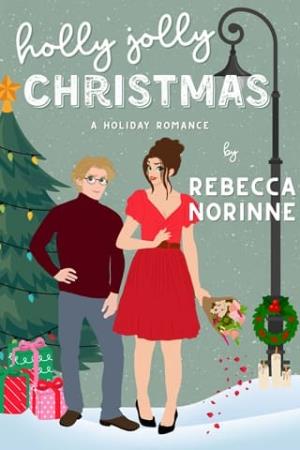
Holly Jolly Christmas (Christmas at Mistletoe Bay #8)
Chapter 1
one
. . .
Holly
I’d never met a man who could bolt out of a room faster than Luke Byron.
The first time it happened was at Mistletoe Mercantile, and I thought there had to be some kind of emergency. A fire, or a plumbing disaster. Or maybe he suddenly remembered he’d left a million dollars sitting unattended somewhere.
The second time, I was waiting for my peppermint mocha at Dockside Cafe—the one small indulgence I allowed myself—when the chime rang out over the entrance door.
I turned to see him frozen mid-step, his eyes wide as saucers.
When our gazes connected, his Adam’s apple bobbed visibly in his throat, and then he turned and high-tailed it right back out into the snow.
By the third time it happened, it felt a bit like deja vu, and I had to admit the obvious: I was the emergency.
Which begged the question: out of all the decorators and florists available for the Mistletoe Bay Christmas Eve Candlelight House Tour, why had Luke Byron chosen me?
Honestly, I still wasn’t convinced this wasn’t some kind of elaborate prank to make me feel even worse about myself than I already did on a daily basis.
“This way, Ms. Bascombe,” said the woman who’d introduced herself as Ava Kincaid, Luke’s personal assistant.
Of course the famously reclusive tech billionaire had an assistant. Probably more than one. That was what happened when you were the kind of man who invented a wildly successful dating app, then bought a shipbuilder’s house that looked like something out of a movie about the founding fathers.
The Stephen Crossmore House, circa 1761, sat at the top of Candlewick Lane, right where the original town streets narrowed, and the brick sidewalks became uneven.
Up close, it was even more beautiful than photos could ever capture.
Three stories. White clapboard with black trim and shutters. A beautiful, stately front door.
Byron could have knocked it down and built a glass-and-steel monstrosity with a rooftop helipad. Instead, he’d painstakingly restored every detail down to the original twelve-over-twelve windows.
I’d liked him for that before we even met. Which made the fleeing-from-me thing sting more than I cared to admit.
I clutched my portfolio to my chest and followed her deeper into the house. “Please, call me Holly,” I corrected automatically. “Ms. Bascombe makes me sound like I’m about to assign homework.”
She smiled politely, the sort of practiced, neutral expression I was sure she gave everyone, and guided me into a room with high ceilings, exquisitely detailed crown molding, and wide-plank floors that were buffed to a soft glow.
The December light filtering through the wavy old glass in the windows gave everything a dreamy, slightly blurred quality, like we’d stepped into an old photograph.
“This is where Candlelight Walk guests will start the tour,” Ava said. “Mr. Byron was hoping you could suggest a focal arrangement here, and then something smaller on the console, and—”
A movement in the doorway to the hall caught my eye.
Luke Byron hovered for half a second, a shadowed shape in a green sweater and dark jeans, his hands shoved deep in his pockets.
His light brown hair was a little messy, like he’d dragged his fingers through it a dozen times already today, and his glasses were slightly askew.
He wasn’t a tall man—maybe four or five inches shorter than me in my heeled boots—but he somehow managed to fill the space around him.
Our gazes collided, and his eyes, a warm brown framed by thick, dark lashes, widened.
“Hello,” I said, injecting extra cheer into my voice. “Luke, right? I’m Holly.” I lifted my hand in a half-wave, the portfolio tucked against my chest with the other like a shield.
Color flushed over his cheekbones. “Yes. Right. Sorry. I just—uh—Ava, did you show her the … thing?” he asked, gesturing vaguely toward the hallway. His voice wasn’t what I expected based on his appearance. Deeper. Rumbly, like he didn’t actually use it all that often.
“We were just getting started, Mr. Byron,” Ava said smoothly.
“Good. Great.” He nodded quickly, his eyes flicking over the space. “Carry on. I’ll just—” He jerked his thumb over his shoulder, took a step back, then pivoted and disappeared. Poof. Gone. Again.
I stared at the empty doorway.
“Does he … ” I fished for a polite way to describe his behavior, and came up with nothing. “Umm … do that a lot?”
Ava’s mouth twitched. “Mr. Byron prefers to avoid being the center of attention.”
“I say this with all due respect,” I murmured. “But it’s hard to be the center of anything when he’s always on the move. I swear there are scorch marks on the floor from his disappearing act.”
She didn’t laugh, but the corners of her eyes crinkled in amusement. “You said you had some drawings you could show me,” she said, bringing us back to why I was here in the first place.
I set my portfolio on the console table and flipped it open, letting myself slide into the familiar comfort of work.
“So,” I said, pulling out the first mock-up, an ink and watercolor I put together as part of my pitch.
“The Candlelight Walk is all about nostalgia, right? People wandering through historic homes, feeling like they’ve stepped back in time.
We definitely want to lean into that. I’m picturing lots of greenery, candles—flameless, obviously—winterberry, pinecones, dried orange slices, velvet ribbon.
A little maximalist, like Stephen Crossmore himself. ”
I slid the painting toward her. In it, the parlor’s fireplace mantel—which I’d taken from a photo from the real estate website from when the house was last for sale—was draped in thick cedar garland, with brass candlesticks at varying heights, clusters of white roses, amaryllis, and eucalyptus tucked among the greenery.
The arrangement on the low table in front of the sofa echoed the mantel.
“It’s beautiful,” Ava said. “Very in keeping with the house’s style.”
Relief loosened a knot between my shoulders.
“If we coordinate the front door with this—garland on the door, wreaths in every window, candles inside so the flame shows through each wreath’s center—it’ll make the whole place glow,” I said.
“Your boss will be the unofficial star of the Walk. In a low-key, tasteful, not at all the center of attention way, of course.”
Her lips curved. “Luke will appreciate that.”
Would he? Hard to picture him appreciating anything that involved letting strangers tromp through his home, but he’d volunteered the house for the event, so he couldn’t hate it that much.
We moved room by room, me talking through options, Ava taking notes on her tablet. A garland staircase moment, a smaller arrangement for the library table, something simple but elegant for the dining room, just in case anyone wandered off the path to sneak a peek.
Through it all, every time I assumed Ava and I were alone, I would catch a glimpse of Luke in my peripheral vision—a shadow at the edge of a doorway, the creak of a floorboard, the whisper of a breath. And every time I turned my head, he vanished.
By the time we reached the kitchen, my nerves had settled into something halfway between annoyance and curiosity.
“Okay,” I said, leaning against the island and scanning the room.
“This space is tricky. There’s a separate kitchen tour that takes place in the fall, so normally this room wouldn’t be included, but given folks will exit out that door—” I pointed toward a heavy antique wooden door that led into the back yard, we should do something.
Make it feel like someone actually cooks here. ”
The marble counters were spotless, gleaming as if they’d never seen crumbs.
No dish towel was draped over the oven handle, no coffee cup was left sitting next to the sink.
No stack of mail—mostly junk—threatening to topple over.
It was the kind of kitchen you saw in magazines, where everything was styled to within an inch of its life while the caption tried to convince you a family of six lived there.
Too perfect. Too staged. Too unrealistic.
“I cook here,” came a low voice from behind me.
I spun so fast my boot squeaked against the floor.
Luke stood leaning against the door jamb. From here, the faint stubble along his jaw softened the sharpness of his features. I had an uninvited flash of what it would feel like under my palms and mentally tossed that thought into a snowbank.
“Oh, uh. Hello,” I said again, cursing myself for the inept greeting. “We were just talking about decorating your kitchen so it looks like someone actually uses this space, which you have now helpfully confirmed.” I winced.
God, could I sound any more awkward? Normally, I was good at banter and professional charm. But something about Luke Byron made my usual confidence slip.
To my surprise, his mouth quirked. “Happy to be of service.”
I straightened. “Do you have any hard limits?”
The second the words left my mouth, I wanted to stuff them back in. Heat flooded my cheeks. That sounded like …
Oh God.
“I mean, things you hate?” I rushed to clarify, my voice climbing half an octave. “Allergies to pine, for instance? Traumatic childhood experiences involving wreaths?”
Ava made a small sound that might have been a stifled laugh.
Luke’s gaze flicked to her, then back to me. “No wreath-related trauma that I’m aware of. And, um … no hard limits.” He cleared his throat. “I—I like what you’ve suggested. Ava showed me the photos you submitted with your proposal.”
My cheeks warmed. “Oh. Great. I’m glad.”
He crossed his arms over his chest and shifted his right leg in front of his left. “The spray with the white amaryllis and eucalyptus was … uh … nice. And the one with the blue thistles. Those were interesting.”
“Eryngium,” I said automatically. “Sea holly.”
His eyebrows lifted behind his glasses. “Sea holly. Fitting.”
It took me a heartbeat to catch the reference. “Because of my name?”