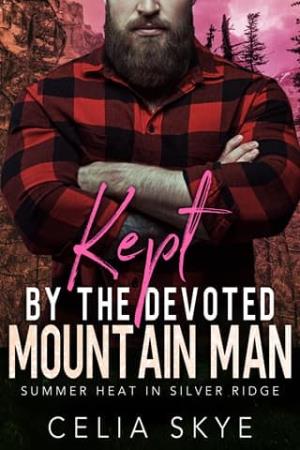
Kept By the Devoted Mountain Man (Summer Heat in Silver Ridge #1)
Chapter 1
one
Tessa
The drive from Vancouver takes nine hours and I only stop twice. Once for gas outside Kamloops, once because I'm crying too hard to see the highway.
Silver Ridge appears around a bend in the road like it wasn't there a second ago, the valley opening up without warning, and I have to slow down just to take it in.
Mountains. Real ones, not the ones you can see from the city on a clear day.
These ones fill the windshield, snow still caught in the high places even in June, the lower slopes dark with pine.
The town below them is wooden and sun-bleached and small, and there's a river somewhere nearby because I can hear it even with the windows up, or maybe I imagine that, maybe I want it to be true badly enough that my brain supplies it.
I want it to be true. I want a lot of things.
Brooks Boutique Hotel sits at the end of Main Street, a converted Victorian painted the colour of storm clouds and trimmed in cream.
There are flower boxes under every window and a hand-lettered sign above the door that looks like it was done by someone who actually knows calligraphy.
I park and sit in my car for a moment, hands in my lap. The engine ticks.
Okay. Here.
Inside, a woman looks up from behind the front desk. She's maybe thirty-five, dark hair pinned up, wearing a linen apron over a floral dress, and she has the particular warmth of someone who genuinely means it when she says welcome.
"You must be Tessa." She comes around the counter with her hand extended. "I'm Maple. We spoke on the phone."
"Thank you for fitting me in at the last minute." I'd booked two days after the breakup. It wasn't a plan so much as an impulse that turned into a credit card charge before I could talk myself out of it.
"We had a cancellation. Timing worked out.
" She leads me up a wide staircase, talking as she goes.
The walls are hung with old landscape photographs of the valley in different seasons, the mountains at different hours of light.
"Breakfast is seven to nine, but I usually have coffee out by six if you're an early riser.
There's a trail map on the dresser and I've marked the easy ones in green. Juniper's Diner is two blocks north."
My room is on the second floor, east-facing, with a window that frames a slice of mountain between two spruce trees. There's a quilt on the bed that looks handmade and a jar of wildflowers on the dresser. I stand in the middle of the room and the tightness in my body loosens just a bit.
"If you need anything," Maple says from the doorway, "I'm usually around."
"Thank you," I say, and I mean it more than she knows.
I spend the first morning doing nothing in particular. I walk Main Street in both directions. I drink Darlene's coffee at the counter at Juniper's and eat eggs I don't taste, but I’m sure they’re delicious.
I sit by the river on a flat rock and watch the water and try not to think about Daniel's face the night I finally say it out loud — I want children, I have always wanted children, and I think you've known that and chosen not to say anything for three years — and the way he looks at me, not surprised, just tired.
Like I've finally gotten around to something he's been waiting to deal with.
I don't cry. Progress.
By early afternoon I'm restless in the particular way that happens when I don't have enough to do with my hands, which is probably how I end up in front of the Silver Ridge Public Library at half past two on a Tuesday in June with no intention of going in.
The library is a narrow wooden building squeezed between a hardware store and what looks like a former post office.
There's a sandwich board out front: SUMMER READING PROGRAM — TUESDAYS AND THURSDAYS, 1–3 PM — VOLUNTEERS WELCOME.
Through the window I can see children's drawings taped to the glass, bright suns and lopsided animals, the particular aesthetic of primary grades.
I go in.
I'm a teacher. I've been a teacher for four years. I cannot walk past children's drawings and a sign that says volunteers welcome and keep walking — it's physically impossible, like asking someone to step over a dog without petting it.
Inside, the library is small and cool and smells like old paper and the particular kind of quiet that only exists in rooms full of books.
A teenager is running the program. She’s seventeen, maybe eighteen, looking slightly overwhelmed by the eight kids arranged on a rug in the reading corner.
She looks up when I come in and her relief is so immediate I almost laugh.
"Hi. Are you here to volunteer?"
"I guess I am," I say.
Her name is Kaylee. She's filling in for the regular program coordinator who's on vacation until Thursday. She's wonderful with the older kids and completely out of her depth with the four-and-five-year-olds, which is exactly the gap I was built to fill.
I settle and find the kids who are tuned out and pull them back in, adjust the read-aloud pace, do the voices. I do the voices because a teacher who won't do the voices is a teacher who's lost the plot.
That's when I notice her.
She's sitting slightly apart from the group, at the end of the rug nearest the window, with a picture book open in her lap.
The other kids are listening to Kaylee finish a story about a bear, but this one isn't. She's studying the page in front of her with the focused expression of someone doing something difficult, and it takes me a moment to understand: she's pretending to read. The book is upside down.
I cross the room and sit down on the floor beside her. Cross-legged, at her level, not hovering. She goes still without looking up, the way small animals go still when they sense something nearby.
"That one's good," I say, nodding at the book.
She fixes the book without acknowledging that it was upside down. Five years old and already committed to the bit. I respect that tremendously.
"What's your name?"
A pause. She's deciding whether I'm worth answering. "Nora," she says finally.
"I'm Tessa. Do you want me to read it to you?"
She looks at me then. Her eyes are very dark brown and very serious, the kind of eyes that see more than they let on. She's wearing a yellow shirt with a small strawberry on the pocket, and her hair is in two uneven braids that someone clearly did their best with.
"Okay," she says, and slides the book over to me.
It's a chapter book — well above her level — about a fox who learns navigation by the stars.
I read the first chapter slowly, with a voice for the fox that's slightly pompous and a voice for the owl that's dry and unimpressed, and Nora sits beside me and listens with her whole body, leaning in by degrees without seeming to notice she's doing it.
By the end of the chapter her knee is touching mine.
"The fox thinks he knows everything," she says, when I close the cover.
"He does," I agree. "Does that remind you of anyone?"
She thinks about it seriously. "Tommy Birch," she says. "He's in my class."
I press my lips together. "The fox gets better," I tell her.
"Does Tommy Birch get better?"
"I genuinely don't know. But in my experience, most of them do eventually."
She considers this. Then: "Can you read the next chapter?"
I'm on the third chapter when I hear the truck.
It's particular thrum of a large engine and big tires on a gravel road, pulling up to the curb outside.
Nora hears it too. I know because she goes straight and still the way she goes still when I first sit down, except this time it's not caution.
It's anticipation — the precise, contained excitement of a child trying not to show how much she's been waiting.
She's off the rug and across the library before I fully register the movement. I track her through the window by instinct, teacher brain, and I see the dark green truck.
Then, I see the man who gets out of it…
Big. Very big, the kind of big that reads as mountain before it reads as man.
Jeans and a grey t-shirt, sawdust on both, boots that have been everywhere.
He's moving fast, not quite running, with the particular walk of someone who's late and knows it and is annoyed with himself about it.
The scowl on his face is set deep, like it's where his face rests when he's not paying attention.
Then Nora hits the door at full speed and he drops.
One knee, right there on the sidewalk, catching her without breaking stride.
She barrels into his chest and his arms close around her and his whole face — the scowl, the tension, the late-and-annoyed — all of it disappears.
He tucks his face into her hair and holds her like she's the thing he was actually rushing toward.
He stands, Nora on his hip, one hand flat on her back. He's saying something to her, head bent, and she's talking back with the full-body animation of a child who has been saving things up all afternoon. Then she points through the glass and I am a half-second too slow to look away.
His eyes find mine through the glass.
Dark. Steady. He holds the look a beat longer than he needs to, long enough that I feel it in my ribs, before he says something to Nora and turns toward the door.
Oh no.
I close the book. I'm standing by the time the door opens, which is either good instincts or a fight-or-flight response, I'm genuinely not sure.
Nora comes in first, still on his hip, and points at me again with the conviction of someone introducing two people who don't yet understand how important this is.
"That's Miss Tessa. She does the voices."
He stops a few feet away. Up close he's even bigger, which I hadn't thought was possible, and he smells exactly like I'd guessed — pine resin and sawdust and something warm underneath, like sun on wood.
His jaw is dark with a few days of growth.
His hands, wrapped around Nora's small back, are broad and calloused and careful.
I notice all of this in about four seconds. I'm a little horrified by myself.
He looks at me. Just looks, the way people do when they're actually paying attention rather than performing it.
"Beckett Hale." His voice is low. The kind that you feel slightly more than you hear. "Her uncle."
"Tessa Marlowe." I manage this at a normal volume, which I'm counting as a win. "I'm visiting for the week. I used to — I teach. Back in Vancouver. I saw the volunteer sign and came in."
I'm aware I've said too much. He doesn't seem to mind. He's still just looking at me, and Nora is watching both of us.
"She read three chapters," Nora reports. "With voices."
For one second I see what's underneath the scowl: something warmer, something that looks like a man who laughs when he thinks no one's watching. "Thank you," he says. "For sitting with her."
"She's easy to sit with."
Nora beams. Beckett looks at me for one more moment and then he nods, once, and turns toward the door.
I watch him leave. I watch the door close behind him. Through the window I see him settle Nora into the truck, check her seatbelt, say something that makes her throw her head back laughing.
Kaylee appears beside me. "That's Beckett Hale," she says, unnecessarily. "He's, like, a lot."
"Yeah," I say. That is one word for it.
I gather my things. I walk out onto Main Street into the full weight of the June sun, which is golden and relentless and hits my skin like a warm hand, and I think about a voice like gravel and woodsmoke and a man who looks at me like he's actually seeing me.
I need to call my sister. I need to drink some water. I need to remember that I drove nine hours to clear my head, not to complicate it.
I have a feeling it's already too late.