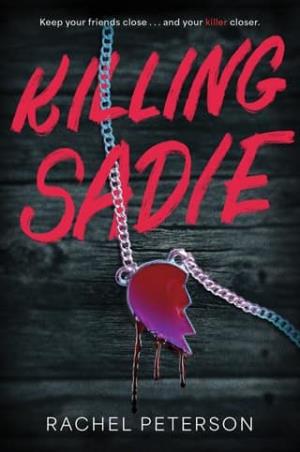
Killing Sadie
1. Liz
LIZ
SOUR PATCH KIDS.
That’s what I’m thinking about when the police detective walks in the door.
He starts talking before it even latches shut behind him.
I try to control the feeling of panic that rises up in me when I hear the click that tells me the door is, definitively, shut.
It’s just him and me—and whoever is probably watching us from behind the two-way mirror.
This is everything my parents always said would end up happening to me.
Well, everything my stepfather always said would happen, anyway.
Stuck in a police station, trying to explain myself to someone because of something terrible.
He just always figured that whatever the terrible thing was, it would be my fault. Everything is my fault to him.
They probably never imagined that the terrible thing would be my best friend’s murder. And I swear, I had nothing to do with it. The murder, anyway.
But just because I didn’t kill her doesn’t mean it isn’t my fault.
She’s why I’m thinking about Sour Patch Kids. My best friend, Sadie, is, I mean. She always called me “Patch”—a shorthand reference to the fact that there are two pretty extreme sides to my personality. I never minded the nickname. I’ve been called worse.
“State your name for the record,” the detective is saying.
“Liz,” I reply without thinking.
“Your full name.”
“Elizabeth.”
The detective sighs in exasperation and looks at me like he’s trying to figure out if I am going to be a total pain in the ass or not. Then he seems to remember my best friend is dead and attempts a smile. It looks more like a grimace. I’m really in no mood for fake sympathy.
“Your full name—first and last.”
“Elizabeth Amelia Stratton,” I say, my own voice sounding foreign to my ears. When’s the last time I actually had to say my whole name out loud?
When I say it, my Southern drawl comes through.
We moved here from Alabama five years ago—that’s when I met Sadie, just a few weeks into the school year, when she asked me if my accent was real.
I told her it was, and she promised she wouldn’t let anybody make fun of me for it.
It’s a promise she couldn’t keep, but I loved her for it, anyway.
She also promised she wouldn’t tell anyone that I was held back a year when we moved.
Pretty sure I’m the only nineteen-year-old senior at our school, but to this day, no one knows.
When a friendship starts out like that, with one person sticking up for the other one and keeping her secrets, it never quite evens out. No one tells you that.
At the sound of my voice, the detective visibly softens.
They always do. Adults, anyway. Especially men.
They look at me, and they see a cute little blond girl with big eyes and a soft Southern twang, and they feel like they should be saving me from something.
But there’s a really wide gap between adults who feel like they should be saving you and adults who actually step in when they see something wrong.
My damsel-in-distress act has its benefits.
Mainly, it helped me spend the past three years partying my ass off on the dime of guys who were willing to buy me and my friends a few bottles of vodka from the liquor store.
It’s not my fault they were stupid enough to think that we’d be drinking it with them.
That was the sour side of the Sour Patch Kids joke between me and Sadie.
She’d ask if it was going to be a sweet night or a sour one, and whenever I said sour (which was almost always), she knew it meant we were going to get into some trouble and have a damn good time doing it.
That’s the version of me most kids at school know too.
The party girl willing to put it all on the line for a good time.
And that’s who I was, until it went too far.
I shake my head. Those nights feel like a thousand years ago now. A different girl. A different lifetime. It must have been a different lifetime, because Sadie was with me.
“Thank you. Should I call you Liz, then? Or do you prefer Miss Stratton?” The detective sounds tired as he asks the question and plops down his tragic Styrofoam coffee cup, forcing me back into the present.
It’s such a ridiculous question that I don’t even bothering answering him. I don’t care what he calls me.
I can tell just by the smell coming from his cup that it’s more sludge than coffee—the sort you might be able to chew instead of drink.
I work part-time as a barista at our local coffee place, and I’ve become a bit of a coffee snob.
Sadie is always teasing me about my new “cosmopolitan tastes.” Another inside joke, considering that aside from coffee I still have the taste of a girl who moved to Ohio from a trailer park in Alabama and created a new personality to outrun the old one.
Because that’s what I am. Sadie still teases me for that too, but in a loving way.
Was always teasing me.
Was. Past tense.
Because the whole reason I’m here, staring down a detective who looks like he stepped directly out of life as an extra on a bad eighties cop show, is because my best friend is dead. She was murdered last night.
Without warning, a wave of nausea hits me.
“I think I might be sick,” I say.
The detective grabs a plastic trash can from the corner of the room and hands it to me, and I empty the contents of my stomach.
“Can I have some water, please?” I croak, trying to regain my dignity as I set the can back down. How on earth did I get here, vomiting into a trash can at a police station? It’s a rhetorical question, obviously. I know exactly how I got here.
“How much did you drink last night, Miss Stratton?” the detective asks. He’s speaking to me with pity in his voice, like he thinks some guy at Trevor McClain’s party forced little old me to down a few shots and shotgun a couple of warm beers.
“I don’t drink.” It’s my automatic answer these days.
“Are you sure about that? We’re not looking to get anyone in trouble for drinking here. I just need to know how accurate your memories are.”
“Yes, I’m sure. I’m not worried about getting in trouble for drinking because I wasn’t drinking.
” I really hate that I sound just as deeply annoyed as I am.
Probably not a good look at the moment. I try again.
“It’s true. I used to drink, but I stopped.
Maybe six months ago. You can ask anybody; it was kind of a big deal.
Everyone thought I was kidding at first. Anyway, I stopped, and that’s all there is to it. Now, can I get some water, please?”
He gives me a look that suggests this part of the conversation isn’t over. I hate when people do that, look at you as if they just know they’re going to outsmart you. As if they just know you’re lying, and nothing you say is going to change that opinion.
“I’ll get you water, Miss Stratton. And this doesn’t have to be combative. I’m not trying to fight with you; I’m just trying to understand what happened last night. I know you and Sadie Cooper were close—”
“We were best friends.”
Even I realize how juvenile it sounds when I say it out loud.
But it’s true. I instinctively reach for my half of the “Best Friends” necklace Sadie got for us last year.
The necklace I literally only take off when I shower.
It’s been the one constant in my accessories ever since she gave it to me in a cute little purple box on the day after Christmas.
I reach for it, but my fingers touch nothing.
Then I remember: The necklace isn’t there. It’s gone, probably somewhere in the endless fields of the McClain family farm.
Probably gone forever. Just like her.
It’s only a necklace, but the loss feels overwhelming. My nausea bubbles back up.
“Right,” the detective says, wrenching me away from the horror I’m feeling all over again. “Best friends. And so, since you’re her best friend, I’m sure you want answers as much as we do about how she ended up being brutally murdered last night…”
“Who else have you talked to?”
I ask the question before I can stop myself. Based on the look the detective gives me, apparently it was the wrong question.
“Why does that matter, Miss Stratton? Is there someone in particular you think we should be talking to?”
“I don’t know. Sadie’s sister, Jayne? Her boyfriend, Ben? Literally everyone who showed up to Trevor’s last night?”
We’re interrupted by a uniformed officer, who brings in a bottle of water and sets it down in front of me. For a second, I wonder how she knew I asked for it, but then I remember the two-way mirror. I’m sure the whole thing is being recorded too.
Great.
The detective rubs his eyes. “Look, we got off on the wrong foot here, Miss Stratton. You’ve been through a lot in the past twelve hours, and I sympathize with that.
You must be feeling a million different things right now, and I’m sure you’d rather be anywhere but here.
I didn’t even introduce myself properly.
My name is Detective Norris, and all I care about is understanding what led up to the events of last night. ”
“And by ‘the events,’ you mean the fact that my best friend was stabbed to death and then her boyfriend killed the guy who did it.” I practically choke on the word “boyfriend.” Ben Carrera. God, the look on his face when I walked into that barn. I’ll never forget it.
“That is what I mean, yes.”
I take a long drink of water, and I realize that my hands are shaking. If Detective Norris notices, he pretends that he doesn’t.
“Okay,” I say, setting the water back down. “Fine. Where do you want me to start?”
“How about you tell me what happened leading up to the party? Anything you remember that seemed strange or different, anything about Sadie’s relationship with”—Detective Norris opens the folder sitting on the table and scans it—“Mason Vreeland?”
I let out a short laugh. I can’t help it.
“Something funny about Mason Vreeland, Miss Stratton? Did you know him well?”
“Mason and I were in homeroom together in middle school the year I moved here,” I say finally.
“He was quiet. Pretty nice, I guess, when he did decide to talk, which wasn’t often.
But he wasn’t bullied or anything like that.
Just a loner. If you’d told me that by the time we were in high school, I would be sitting in a police station trying to help the cops understand why he stabbed Sadie to death…
I don’t know. I guess I would have said you were fucking crazy. ”
“You’ve got quite a colorful mouth on you, Miss Stratton.”
I put my hands up in mock surrender. “I hope I haven’t offended your sensibilities, Detective. A lady should certainly watch her language in the middle of a murder investigation.”
Classic Liz. I suddenly hear Sadie’s voice in my head. She always loved to play armchair psychiatrist. Lashing out because you don’t trust authority.
Per usual, Sadie’s right. She was always right about me.
Detective Norris closes the folder and leans in closer to me from across the table.
He’s quickly losing his patience with me; I can tell.
It’s not entirely his fault—I tend to have that effect on people.
“Let’s just stick with the facts, shall we?
Start with yesterday. Tell me everything you remember. ”
I stare at him, wondering if he’s as old as he looks or if it’s just the night shift and bad coffee catching up to him.
He doesn’t look away. Maybe that’s the moment I realize there is no getting out of this.
No amount of charm or Southern accent or any of the other tricks I’ve perfected over the years to protect myself will do me any good.
Because even if I talk my way out of this room, out of this police station, out of this whole damn town, I’ll still be doing it alone.
Without Sadie. Without the Cooper family.
So, this detective wants to know about everything that led up to the party. But if he wants to understand Sadie and all the rest of them, it’s not just about yesterday or even the past week. It isn’t just about the past year.
Sadie is the sister I never had. The only one who actually understood me and somehow loved me and accepted me anyway.
Her family is the family mine couldn’t be, even if the cracks in their perfect facade started to show in a big way during spring break last year.
And I’m the sister Sadie deserved. Sure, she and Jayne were twins.
But I was Sadie’s best friend. I had the necklace to prove it. Well, I had it first, anyway.
My hand goes up to my neck again, and I remember, again, that my necklace is gone. It feels almost cruel, and I choke back another sob.
“I’m waiting, Miss Stratton.” The detective’s voice cuts into my thoughts. “Whenever you’re ready.”
I take a deep breath.
“Okay. Fine. You want to start with what happened yesterday? I’ll tell you what happened. But there’s gonna be a lot more to it than just the stuff right before the party.”
“Well, then, Scarlett O’Hara,” he says, clearly delighted by his own joke (and the fact that I’m finally going to play ball with him) and giving me a smile that reminds me of that cat in the Alice in Wonderland books, “enlighten me.”