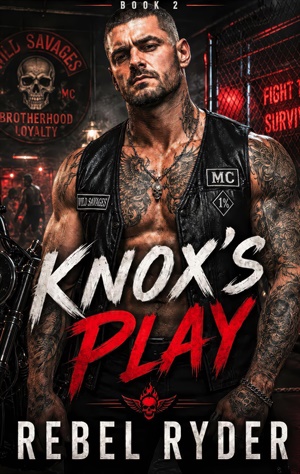
Knox's Play (Wild Savages MC #2)
1. Mari
ONE
MARI
The Pit smells like sweat, hot metal, and money.
Money doesn't have a scent, not really, but I can feel it moving through a room. It gathers in the roar when a favorite lands clean, leaks away in the silence after an upset, and turns men reckless when they decide the next bet will repair the last one.
My grandmother taught me to hear it.
Mémère Castex ran a card game out of her Mid-City house for forty-one years. She taught me odds before long division and bluffing before I was old enough to understand why grown men lied over twenty-dollar hands. Her rule was simple: never sit in a game where somebody else controls the deck.
Tonight, the deck is mine.
I run the book for the Pit, the Wild Savages MC's underground fight circuit.
Three fights, two hundred and thirty-one people through the door, and just over a hundred thousand dollars already moving across accounts that don't stay open long enough to attract attention.
I set the lines, manage the exposure, and make sure enthusiasm never outruns arithmetic.
Knox Barrera makes sure everything else behaves.
He's at the cage door now, broad shoulders under his leather cut, speaking to Hendricks while the crowd screams for Santos.
He's the Sergeant-at-Arms, fight manager, and a former heavyweight who still moves like the cage belongs to him.
He recruited me eighteen months ago after watching me run a poker tournament in the Marigny, and he's been irritatingly difficult not to want ever since.
He looks across the warehouse and finds me without searching.
Two fingers lift from his side.
You good?
I tip my coffee cup toward him.
Always.
His mouth pulls at one corner before he turns back to the cage. That's more of a smile than most people get from Knox on fight night, and I hate how much I know that.
The main event line has Santos at minus-205 and Hendricks at plus-165. The public loves Santos because he's built like a refrigerator and has three knockouts in a row. Knox loves Hendricks because Knox trained him to make big men impatient.
"Hendricks in three," he told me an hour ago, setting a fresh black coffee by my laptop exactly the way I drink it.
"Confident," I'd said.
"Prepared. Different thing."
I hadn't asked how he knew my first cup had gone cold. Knox notices more than he admits. So do I.
The opening bell sounds. Santos charges, Hendricks circles, and the room tilts toward violence.
My screens start moving.
Normal action first. Fifty here. Two hundred there. A thousand from an account that has lost money on Santos twice and apparently considers consistency a virtue.
Then eleven bets land in four seconds.
Each one is for $4,850. Each one takes Santos at the same stale price, despite the live line already shifting. Different names. Different payment accounts. Same device signature buried beneath the masking software.
My fingers stop over the keyboard.
That isn't a crowd following momentum. That's one person wearing eleven coats.
If I accept the bets and Santos wins, the Pit owes more than ninety thousand dollars on a line that should no longer exist. Enough to wipe out tonight and damage the next two cards. If I reject them too quickly, whoever built the attack knows I saw the connection.
I let three through.
Freeze four.
Delay the rest.
Then I move Santos to minus-275, shorten the live window, and push a promotional line on Hendricks to every regular account in the room.
Money swings. The fake accounts try to cancel and resubmit. I trap them at the worse price and flag every linked wallet for manual settlement.
Across the warehouse, Knox looks at me again.
This time I don't lift my coffee.
I touch two fingers to my wrist, our signal for a problem that can wait until the bell.
His face changes. Not dramatically. Knox doesn't do dramatic. His attention simply widens until I know he's aware of every exit, every unfamiliar face, and every body between me and the door.
In the cage, Santos burns through the first round trying to take Hendricks's head off. Hendricks gives him space and lets him spend energy. By the second, Santos's feet are heavy. In the third, Hendricks slips a right, takes him down, and works to the back.
Santos taps to a rear-naked choke with forty-two seconds left in the round.
The warehouse erupts in two different directions. Half the crowd is celebrating. The other half is discovering that confidence and solvency aren't the same thing.
I close the live book and calculate the damage.
The three coordinated bets I allowed cost their owner $14,550. The rest never reached settlement. The Pit clears twenty-seven thousand on the main event.
Not bad for a trap.
Knox is beside me before Hendricks finishes climbing down from the cage.
"What happened?"
He doesn't bother with hello or congratulations. His hand braces on the back of my chair, close enough that the heat of him settles against my shoulder.
I turn my screen. "Somebody tried to hit a stale line with eleven linked accounts. Same amount, same second, same device underneath the masks."
His eyes move over the data. "Could've been an automated betting group."
"Automated groups don't try to cancel only after I move the line. Somebody was testing how fast I see them."
"Did they get anything?"
"A fourteen-thousand-dollar lesson."
That earns me the real smile, brief and sharp. "Remind me never to play cards with you."
"You don't have enough money."
"Cruel, Castex."
The way he says my name shouldn't feel like his thumb dragging over bare skin. It does anyway.
My phone buzzes beside the laptop.
Unknown number.
Nice catch, Mariana. Next time I won't be testing the door.
A second message appears before I can take a screenshot.
Tell Knox that Leveaux sends his regards.
Knox reads it over my shoulder. Every trace of warmth leaves him.
"Don't delete it."
"I wasn't going to."
"You're leaving with me."
I swivel in my chair. "That sounded suspiciously like an order."
"It was."
"Then try again."
His jaw tightens. Around us, the crowd drains toward the exits, loud and drunk and unaware that the room has changed.
Knox lowers his voice. "Somebody just proved he knows your name, your number, and exactly what you do for us. Let me get you home and check the place before you go inside."
That changes the order into a request. The words aren't softer, but he bothered to give me a reason instead of assuming his patch made one unnecessary.
"Fine," I say. "You can follow me."
"You're riding with me."
"I have a car."
"Then I'm driving it."
"You hate my car."
"Your car has decorative mirrors and no acceleration. I distrust it."
I close my laptop before he can see me smile. "You drive like traffic laws are a personal insult."
"And yet we're both still alive."
We finish the reconciliation together. That's our pattern after every card. I call figures; Knox checks transfers and signs off on cash. Usually, the work stretches past two in the morning and loosens into conversation. Tonight, he doesn't leave my side long enough to pour coffee.
At twelve thirty, Hendricks appears beside the table with an ice pack pressed to his eyebrow and dried blood at the corner of his mouth.
"Tell me she found money for a win bonus," he says to Knox.
"There wasn't a win bonus," Knox replies.
"There is now." I turn the settlement screen so they can both see it. "Your upset moved eighteen thousand dollars of late action onto the right side of the book. Seven percent performance bonus, already transferred."
Hendricks lowers the ice pack. "Forge approved that?"
"Forge is going to discover he approved it when he reads the reconciliation."
Knox scans the figures, then signs beneath my authorization without changing a number. "He'll complain."
"Forge complains when coffee is hot and rain is wet. It keeps his lungs healthy."
Hendricks grins, thanks us, and limps toward the locker room.
Knox stays beside me. "You know which fighters are late on rent, which ones have kids, and which ones are one bad purse from taking money they shouldn't."
"A man who's paid fairly is harder for a rival promoter to buy."
"That why you gave him the bonus?"
"That, and he followed your plan instead of trying to impress the crowd. Good decisions should pay."
His gaze settles on me, warm and assessing. "That's why I hired you."
"I thought it was because I took nine hundred dollars from you at Cécile's poker table."
"You took eleven hundred."
"I was being kind."
"You also stopped the game when Marcel started betting with his watch because you knew his wife had given it to him."
I look back at the screen. "Knowing when not to take money is part of running a room."
"Most people never learn that."
The quiet after his words carries more weight than the compliment should. I clear my throat and hand him the next cash sheet before I do something irresponsible, like ask what else he noticed that night.
At one forty-seven, we walk through the loading bay into the sticky Louisiana night.
My car sits beneath a security light. The front passenger tire is flat.
Not flat. Slashed.
A white envelope is tucked under the windshield wiper.
Knox catches my wrist before I reach for it.
"Gloves," he says.
"It's paper, not plutonium."
"Humor me."
He pulls a pair of black nitrile gloves from the emergency kit in his saddlebag and opens the envelope himself.
Inside is a photograph of me leaving my apartment that morning. My hair is wet. Coffee in one hand, laptop bag in the other. On the back, six words are written in block capitals.
THE BACKBONE IS ALWAYS brOKEN FIRST.
For one ugly second, the parking lot feels too open.
Knox steps between me and the darkness beyond the fence. He doesn't touch me, but his body becomes a wall without discussion.
"This isn't about a betting line," I say.
"No."
"He wants access to the book."
"He wants the Pit."
I look down at the photograph. Whoever took it stood close enough to see the chipped blue paint on my building's front rail.
Fear arrives cold and clean. I don't enjoy it, but I recognize it. Fear is information. It tells you where the risk is. Panic is what makes you ignore the rest of the board.
"Then we find out how he plans to take it," I say.
Knox looks at me. "We?"
"He put my name on the invitation. I'm not sitting this hand out."
His eyes stay on mine for a long moment. "You're coming to the clubhouse."
"To work."
"To stay where I can keep you alive."
"Those can be the same place for one night."
He exhales through his nose, which is Knox's version of losing an argument without admitting it.
"One night," he says.
I glance at the slashed tire, the photograph, and the dark road beyond the warehouse.
Neither of us believes that.