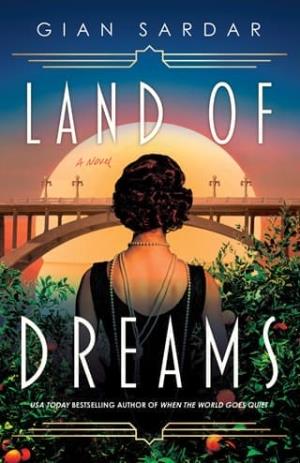
Land of Dreams
Chapter 1 Do What You Gotta Do
Do What You Gotta Do
New York City
A city full of people with no place to go.
They walk just to walk, move to not stand still; they do anything they can to not feel where they are or, worse, who they are.
Up and down Mott Street, cars crawl and horns make almost comic protests while signs blink on and off, on and off.
At the corner, a newsie, a boy no older than ten, stands on a crate and waves a newspaper, bundles tied with twine at his feet, and a movie palace’s marquee is missing half its bulbs, the entire a in theatre dark.
But it doesn’t matter; the line to the box office stretches the length of the building, everyone shifting and restless.
Though no one should be spending the thirty-five cents for a movie, all are desperate for the warmth and the escape.
Sit back, look up, and leave your life behind.
Though nobody has enough money, all have plenty to forget.
Frankie’s the only one not moving, struck still by the racing of her heart.
A block over, there’s a job interview taking place, but the line was around the corner when she went to drop off her application, and if she doesn’t make it uptown within the hour, she’ll miss the only other opening she knows about.
Yesterday she found the man she’s been working for hanging from a rafter.
Today she is unemployed. She told herself to not feel or think, to not even consider her situation, but instead to jump right in and find something new, but the line threw her, sapping her resolve.
She’s twenty-three years old and worn thin.
She knows the exact shade the ceiling gets during every hour of every night, because she’s there, studying the cracks.
Her mother died just months ago, and even though Frankie has worked almost her whole life, she has done so mostly at the whims of others.
The laundress who broke a wrist: I’ll need help this week, and maybe next.
The dressmaker who was fighting with her cousin: Until she says sorry, the work is all yours.
Nothing steady. Nothing under her control.
The one thing she’s done for years is cook for the landlord’s frail wife, but without Frankie’s mother’s income, it’s not enough.
“Only a penny!” the newsboy shouts, slicing the air with the paper, back and forth. “Special deal for a special day!”
She catches the date on the page. The kid’s hawking last night’s edition, hoping no one notices. Most likely he took whatever the New York Times tossed into an alley this morning. Most likely he’s got a mother who always claims she ate just before dinner. Honestly, I’m full. You have that.
“Only a penny?” Frankie manages to say as a man turns the corner. “That’s a deal.” Without looking, the man hands over a penny and grabs a paper and keeps moving. Frankie winks at the kid, who gives her a grateful smile.
Still, her heart hammers. So fast, it’s made its way into her ears, the sound relentless, and she realizes she might be having a heart attack.
It’s actually this thought that calms her.
If she died now, struck down by her grieving and worn-out heart, there would be no blame, no failure.
Never give up, her mother, Fiona, used to say.
Essentially, endure. Bend but don’t break.
It is better to be strong than to be loved, Fiona also used to say, but only after years and years of falling in love with men who lifted her high into cloudy adoration, who made promises and assurances that proved to be nothing more than mist.
But Frankie is tired and doesn’t want to be strong. She doesn’t want to keep going. In this moment, she only wants to stop; she wants to disappear and somehow leave her life, if only for a break or a chance to start over.
Suddenly, the kid hawking papers looks above her head. And it’s the expression on his face that makes her turn.
Above her, the sky has broken open.
A crack. A beam of light has somehow pierced the gray and white, sifting into something like a rainbow.
A slice of color. A wonder, a romantic might think.
Frankie, however, is not a romantic. All the faith she had in miracles died with her mother, because when Fiona was gone, there were no signs, no messages, no chills on her shoulder from a ghostly touch.
And while some might see this beautiful rift as a sign or a miracle, Frankie jumps to suspicion, wondering how someone managed to pull this prank.
But then she sees that everyone has stopped, and is looking up.
Whatever it is, it’s real, and the whole depressed world is caught up in its strange beauty.
And that’s when Frankie looks down and sees that the line for the job interview has scattered, all the women stepping beyond the restaurant’s green awning and into the street, raising their hands to shield their eyes as they look and point at the sky.
Life, Frankie’s mother always said, is a web of choices.
Every decision, every moment, branches off and leads to the next.
Sometimes you actually feel the moment of change, the exact instant your path turns, but more often than not, the real shift was earlier, unannounced and overlooked.
Something small that’s only apparent in hindsight.
Identifying those moments became a game Frankie and Fiona used to play.
If your shoelace hadn’t come untied, you’d have been right there when the dog came loose, or if my stomach didn’t start hurting, I never would have stopped and seen that job sign.
The idea that something little could be essential to something big was comforting to people who lived in a small corner of a small apartment, who were lost in the haze and shuffle of a big city, and who worried that when push came to shove they would slip from the earth unnoticed.
Now it feels as though an entire city is looking up at the sky, and Frankie understands that this is one of those moments. A shift she can feel while it’s happening.
Within seconds she’s there, and while the manager’s pressed against the window, Frankie slips her application on top of the pile.
Nearby, a man in a double-breasted pinstripe suit sees this and sits back, lowering his paper as if he understands a better entertainment is about to commence.
On the plate before him are four dark-purple figs and a scoop of ricotta, and the sight of the fruit—during winter—throws her.
There’s talk among the customers—a sundog, someone calls the occurrence, which hooks into one of the few memories Frankie has of her birth family, whom she last saw when she was five.
Her memories of them are threadbare, worn thin over the years, but one that’s clear was of their dog, who was black and liked to sit on the bricks behind the house and soak up the sun.
Heat radiated off him when he went inside, and Frankie remembers resting her head on his rib cage when he lay down.
Hot, like something left inches from a flame. Dusty, like dry earth.
By the time the manager’s returned, Frankie’s standing near the bathroom, casual, as he picks up the top application.
Beside her, the wall is covered with postcards from Italy and newspaper clippings and a map of the boot with hearts drawn around certain cities and villages.
She’s often assumed to be Italian, someone from the north with olive skin and dark hair but blue eyes, and that, along with the name she was born with, Francesca, could be enough if the man doesn’t fixate on her adoptive mother’s last name.
“Francesca Donnelly,” the manager calls, looking expectantly at the first woman in line.
Frankie steps forward, wiping her hands on her skirt as if she’s just been in the restroom, and tells him to call her Frankie. Out of the corner of her eye, she sees the man in the pinstripe suit smiling as he cuts a fig in half and smothers it with a dollop of ricotta.
“Whoa,” the first woman in line says, a blonde with finger-waved hair, smooth and sculpted like something straight out of a film. “I didn’t see you here.”
“There’s a line,” someone else says.
All the women turn. Disapproving, annoyed, but waiting for Frankie to speak, because, despite the fact that they clearly need jobs as well, part of them must still hope there’d be a reason someone would cut in front of them.
That in the face of everything, kindness and order have not been forgotten.
And this thought breaks Frankie’s heart—or it would, if she had time to let it.
But a glance at the clock on the wall tells her she needs to start the journey uptown in ten minutes if she’s to make it.
She smiles at the first woman. “Honestly, you’re why I left the line.”
At this, the man in the pinstripe suit lowers his paper, abandoning all pretense of not listening in.
“Your hair,” Frankie continues. The woman touches the crown of her own head. “It’s flawless. My mother used to help with mine, but she’s gone and I’m hopeless. Seeing yours made me want to try.”
The woman’s eyes cut to Frankie’s hair, which is chin length and waved naturally and, she’s heard, energetically. “Well—” the woman starts to say, but the manager cuts her off.
“Come on, now. You see what we got here. You think it’s time to talk about hair?”
Down the line, someone says, “And I was just at the restroom, and I did not see her.”
The blonde glances over her shoulder. “Edith, you were outside with the rest of us.”
“Not before that, I wasn’t.”
“I was in the alley,” Frankie says. “The restroom was occupied. I figured it would be a while, and I have a mirror in my compact.” To the manager, she says, “I know this is wasting your time. I’m sorry. I just wanted to do what I could.”
He softens, then shakes the page in his hand. “This you?”
“It is. But I can get back in line. I don’t want to upset anyone.”
Frankie thinks she hears a laugh from Pinstripe, but won’t look his way.