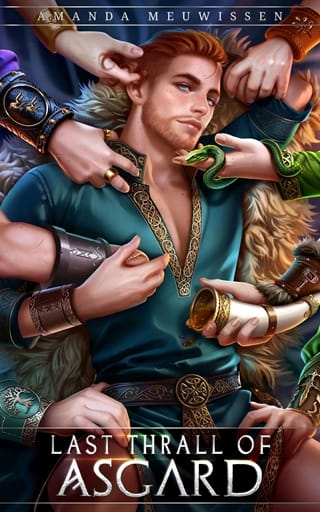
Last Thrall of Asgard (Lovers of the Gods #2)
Glossary
The following descriptions are the author’s interpretations of Norse mythology.
Any deviations from recognized myths are for story purposes, but most of what is recorded here is as close to what we know based on the minimal primary sources available, which are open to interpretation even by scholars.
For a concise but more accurate account, the author recommends Norse Mythology: The Gods, Goddesses, and Heroes Handbook by Kelsey A. Fuller-Shafer, PHD, which was summarized from primary sources, includes a list of them, as well as additional further reading if this mythology interests you.
CELESTIAL RACES :
Aesir : The gods of Asgard, associated with being warriors and the strongest or “hero” gods most believed by ancient Norse people to be worthy of worship. Includes such gods as:
Heimdall
Balder
Thor
Tyr
Mimir
Odin
Vanir : The gods of Vanaheim, associated most with being magical and one with nature. An old Aesir-Vanir War ended with a trade of political Vanir “prisoners” Freyr, Freya, and their father Njord in exchange for the Aesir god Mimir. Includes such gods as:
Freyr
Jotun : The gods of Jotunheim, often referred to as giants, though not actually depicted as larger than other races (more giant in personality), and often at odds with the other gods. Includes such gods as:
Loki
Light Elves : The race from Alfheim, said to be the fairest of celestial beings, with similar proclivities to the Vanir, being magical and one with nature.
Dark Elves (Dwarves) : The race from Nidavellir, who live in subterrain lands, such as beneath mountains, and are darker skinned and stockier than light elves, known for their craftsmanship.
THE NINE REALMS:
Midgard : The realm of humans/mortals.
Asgard : The realm of the Aesir and location of Valhalla—where warriors who die in battle would spend their afterlife until summoned by Odin—among many other godly halls, including Heimdall’s Watchtower that looked upon the realms to keep watch for the coming of Ragnarok.
Vanaheim : The realm of the Vanir, very heavily wooded.
Alfheim : The realm of the Light Elves. Similar to Vanaheim, very heavily wooded but even more ethereal and infused with magic.
Hel : The realm of the dead looked over by Loki’s daughter of the same name, where most mortals ended up when they died. Considered the home of the dishonorable dead in contrast to Valhalla.
Nidavellir : The realm of the Dark Elves or Dwarves, subterrain, all mountainous or within the mountains, with cavernous chambers.
Jotunheim : The realm of the Jotun, sometimes called giants. Its landscape was seen as between the wooded realms of Vanaheim/Alfheim and the mountainous Nidavellir.
Niflheim : The primordial realm of ice and mist.
Muspellheim : The primordial realm of fire. The universe was first created when the competing elements from this realm and Niflheim collided.
OTHER LOCATIONS:
Yggdrasil: The World Tree or Tree of Life, upon which all the realms and other locations resided.
Bifrost : The Rainbow Bridge connecting Midgard to the realms of the celestial races, primarily to Asgard.
Valhalla : One of the halls of Asgard, where the souls of great warriors were celebrated in death, living their afterlives in a state of bliss, feasting, drinking, and fighting, until called upon by Odin to assist in battle, primarily Ragnarok.
Mímisbrunnr : Mimir’s Well at the base of Yggdrasil, also called the Well of Knowledge, where Odin once gave up his eye to retain knowledge of the future, hoping to prevent Ragnarok.
Hvergelmir : The source of all water, also at the base of Yggdrasil, with alternating bubbling hot and frosty cold temperatures, as it balanced the heat and cold from the realms of fire and ice.
Urdarbrunnr : The Well of Urd and third and final well at the base of Yggdrasil, where the Norns weaved the tapestry of life.
Bilskírnir – Thor’s Hall and largest of the gods, enough to fit an entire village.
Gladsheim – Odin’s Sanctuary at the northern center area of Asgard.
Idavollr : Meeting place of the gods, north of Gladsheim, Odin’s Sanctuary, with open-air seating looking upon beautiful fields, as if on the edge of the universe, where the gods could frolic and train as they pleased.
GODS FEATURED:
Loki : Jotun god of mischief, who was both friend and enemy to Aesir and Vanir depending on the day, and was prophesied to start the end of days, Ragnarok, by being the cause of the Aesir god Balder's death.
Notable stories include shape shifting and being the father of Hel and many monsters, such as Jormungandr and Fenrir.
Heimdall : Aesir watchman of the gods and herald of Ragnarok, as well as guardian of Bifrost, the Rainbow Bridge. He was charged with sounding his war horn Gjallarhorn to alert the other gods of invasion and, more importantly, the coming of Ragnarok.
Freyr : Vanir god of fertility and peace, thought to be the most well-endowed, and traded to the Aesir with his sister Freya, and father Njord in exchange for the Aesir god Mimir, as part of the parlay to end the Aesir-Vanir War of old, which predated Ragnarok.
Despite being Vanir, and having been given to the Aesir, Freyr also ruled Alfheim as its king.
Balder : Aesir god of light and beauty, Balder was the son of Odin and Frigg, brother to Thor, and one of the most beloved gods among the others in the pantheon.
After it was prophesized that his death would mark the start of Ragnarok, Frigg demanded of every living thing that none would harm him, making him invulnerable.
She neglected to ask the small, fragile plant mistletoe, however, which caused Balder’s demise at Loki’s orchestration.
Thor : Aesir warrior god of thunder, son of Odin and brother of Balder. He was the most beloved of the gods by mortals due to his heroic stories of epic battles and humorous adventures. Known for his great appetite of feasting, drinking, and fighting—among other pursuits.
Tyr : Older Aesir god of war once revered as much if not more so than Odin or Thor, but who was gradually supplanted by them and other gods. Famously lost his hand to Fenrir, when the giant wolf was being chained up as a precaution to avoid Ragnarok.
Mimir : Aesir god of wisdom traded to the Vanir in exchange for Freyr, Freya, and Njord to end the Aesir-Vanir War.
The Vanir believed they got an unfair deal and beheaded him, but Odin revived the head to seek its wisdom.
Mimir was the overseer of the Well of Knowledge at the base of Yggdrasil, where Odin exchanged his eye to see into the future.
Odin : All-Father Aesir god of war and death who presided over all.
Actual father of Balder and Thor. After Ragnarok was prophesized, Odin’s sole focus was on preventing it, but he gathered honorable dead to be warriors in the battle should it prove inevitable—which it did.
Leader of that undead army, the Wild Hunt, which was also comprised of various beasts.
To witness it before or during Ragnarok meant an omen of death.
OTHER IMPORTANT FIGURES:
The Norns : Three Jotun sisters—Urd, Verdandi, and Skuld—who weaved the tapestry of life and knew the fates of all living things. Stationed at the Well of Urd, another well at the base of Yggdrasil that fed the World Tree’s roots.
Hel : Loki’s daughter and goddess of the dead, as well as the realm of the dead of the same name. She was said to be half living tissue and half skeletal as testament to being the overseer between life and death.
Jormungandr : Also known as the Midgard Serpent or World Serpent, this monstrous snake was the child of Loki and large enough to encircle Midgard. During Ragnarok, he was defeated by Thor, but injured Thor enough in return to mean the death of the god of thunder soon after.
Fenrir : This monstrous wolf was the child of Loki and was prophesized to take part in some of the worst destruction of Ragnarok.
To prevent this, the gods tricked Fenrir into being chained.
Tyr, who Fenrir trusted, put his hand in Fenrir’s mouth as a sign of good faith, and Fenrir bit it off at Tyr’s betrayal.
Fenrir broke free during Ragnarok and swallowed Odin whole before being slain by another god.