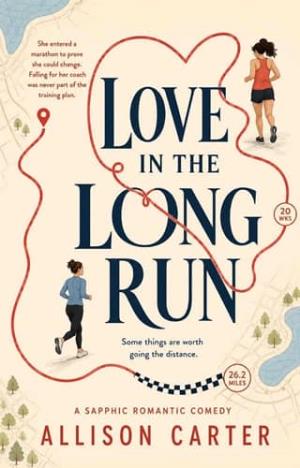
Love in the Long Run
Chapter One The Worst Engagement Party Ever
Chapter One
The Worst Engagement Party Ever
Amy
There were three acceptable reasons to attend your ex-girlfriend’s engagement party.
One: you had remained close friends after an emotionally mature separation and sincerely wanted to celebrate her happiness.
Two: you shared custody of a beloved pet and needed to preserve diplomatic relations.
Three: you had suffered a head injury serious enough to compromise your judgment.
I had none of those excuses. What I had was a navy-blue dress, a color-coded exit strategy, and a best friend standing in my bedroom doorway eating dry cereal from a mug.
“You know,” Tessa said, “we could still fake food poisoning.”
I kept my attention on the mirror as I adjusted the thin silver chain around my neck. “Food poisoning generally requires symptoms.”
“I’m a nurse. I can create believable symptoms.”
“That is not reassuring.”
“It wasn’t meant to be.”
The clasp refused to cooperate. I tried it again, the tiny piece of metal slipping between my fingers.
Tessa set down her mug and came behind me. “You’re shaking.”
“I’ve had too much coffee.”
“You’ve had one cup.”
“It was strong.”
“It was the same coffee you drink every morning.”
I met her eyes in the mirror. “Are you planning to conduct a full investigation, or could you help me with this?”
She fastened the necklace and rested both hands on my shoulders.
Tessa Kim had the kind of face that revealed every thought she had, most of which involved other people’s business.
Her oversized green sweatshirt and mismatched avocado-and-skull socks suggested she had dressed during a minor earthquake.
I had dressed exactly as planned: fitted navy dress, low heels, shoulder-length dark hair, and makeup that showed effort without suggesting the effort had been for anyone in particular.
Especially not Evelyn.
“You don’t have to go,” Tessa said.
“I already accepted.”
“You can unaccept.”
“That isn’t a word.”
“It is when the invitation comes from a woman who cheated on you.”
I turned away from the mirror. “We don’t know that she cheated.”
Tessa stared at me.
“We know there was an emotional overlap,” I amended.
“We know Vanessa was ‘just a friend’ until approximately six minutes after Evelyn moved out.”
“Seven weeks.”
“That is not the defense you think it is.”
I picked up my handbag. Tessa’s gaze dropped to the silver watch on my wrist. It had belonged to my grandmother—simple, scratched, and reliable as long as I remembered to wind it.
I wore it to important meetings, difficult appointments, and apparently the engagement party of the woman who had ended our three-year relationship because she needed a life that felt less predictable.
“You wear it when you’re scared,” Tessa said.
“I wear it when I need to know the time.”
“Phones know the time.”
“Satellites can fail.”
Tessa picked up her mug. “You need therapy.”
“I have therapy on Tuesday.”
“Excellent. Tell Dr. Patel you attended this party voluntarily.”
“I’m going because I am fine.”
She leaned against the doorframe. “People who are fine do not create a document called ‘Evelyn Engagement Contingencies.’”
“You went through my laptop?”
“You left it open. It contained six conversation scripts and a floor plan.”
“The rooftop layout was available online.”
“Of course it was.”
“The scripts are preparation. I don’t want to be caught off guard.”
“You prepared three answers for whether you’re still angry.”
“One is for coworkers, one for family friends, and one for people I actively dislike.”
“That last category is doing heavy lifting tonight.”
I took my coat from the hook. “I want Evelyn to see that I’ve moved on.”
Tessa set the mug down. The teasing left with it. “Have you?”
Eight minutes remained. I checked my watch anyway.
“I’ve moved forward,” I said.
“That wasn’t the question.”
“It’s the answer I have.”
For once, she didn’t argue.
On Saturday, May third, the engagement party occupied the rooftop of the Calder Hotel, a glass-and-steel building in the center of Lake City with a view designed to make ordinary people feel financially inadequate.
Strings of warm lights crisscrossed above white-clothed tables.
Tall heaters glowed in the cool spring evening.
A jazz trio played near the bar, and servers moved through the crowd with trays of drinks too small to justify their price.
Everything was tasteful. Evelyn had always been good at tasteful. Tessa stepped out of the elevator beside me and surveyed the room.
“Last chance,” she murmured. “I could cause a minor ankle situation.”
“No.”
“Your commitment to bad decisions is inspiring.”
A server offered us champagne. I took one glass. Tessa took two.
“For medical reasons,” she explained.
The first person to recognize me was Evelyn’s former coworker, Marissa, who congratulated me on being “mature” enough to attend. Tessa nearly inhaled her champagne.
The next ten minutes became a receiving line of concern.
Someone admired my strength. Someone asked whether I was dating.
Everyone looked relieved when I said no.
My prepared answers performed adequately.
Work was good. I had not moved. Tessa and I still shared the apartment.
I was happy for Evelyn. That final answer became easier with repetition—not more truthful, only less meaningful.
I was reaching for a chocolate tart when the crowd shifted near the elevator.
Evelyn stepped onto the rooftop. She wore an ivory jumpsuit with a deep neckline and wide legs that moved elegantly around her.
Her light brown hair was pinned into a soft twist. A diamond flashed on her left hand as she lifted it to greet someone.
Vanessa stood beside her in a dark green dress.
Six months of avoiding the photographs ended in one second.
Vanessa Cole was the woman from Evelyn’s office holiday party—the one who laughed too brightly, appeared in more and more stories, and inspired the private smile on Evelyn’s phone during the final months of our relationship. Just a friend, Evelyn had said.
Tessa moved closer to me. “That’s her.”
“I know.”
“You knew?”
“Not for certain.”
“Amy.”
“I suspected.”
“You told me Vanessa was someone new.”
“That was the information available in the official announcement.”
Tessa gripped the stem of her glass between two fingers. “I’m going to need a third champagne.”
“You’re holding two.”
“I’m going to need them both.”
Evelyn noticed me. For one brief second, her polished expression broke. Surprise moved across her face, followed by something I could not name. Then she smiled.
“Amy.”
She came toward us, bringing Vanessa with her. I had imagined this moment several times. In most versions, I was cool and gracious. In one particularly satisfying version, I had arrived with a successful architect named Claire who spoke three languages and adored me. No architect materialized.
“Amy, I’m so glad you came,” Evelyn said.
She leaned forward as if to hug me. I adjusted my handbag, leaving no clear path to my body, and she settled for touching my arm.
“Thank you for inviting me.”
“Of course.” She looked at Tessa. “Hi, Tessa.”
“Evelyn.”
Tessa’s tone suggested she was greeting a suspicious growth.
Evelyn turned to the woman beside her. “You remember Vanessa.”
Small. Casual. You remember Vanessa. Not: This is Vanessa. Not: I don’t think you two have met. My suspicion became a fact so cleanly that I almost admired the efficiency.
Vanessa’s smile was careful. “Hi, Amy.”
“Hello.”
“It’s good to see you.”
“That’s an interesting position to take.”
Tessa coughed into her glass. Vanessa’s cheeks colored. Evelyn’s eyes sharpened. I had not planned that sentence. It had simply escaped.
“I mean,” Vanessa said, “I’m glad you came.”
“Thank you.”
Silence opened between us. Evelyn rescued it with the confidence of someone who had spent years managing brand crises.
“You look wonderful,” she said. “Exactly the same.”
There it was. The remark was technically complimentary. Evelyn specialized in statements that looked attractive until you held them under direct light.
“Thank you,” I said. “You look different.”
Tessa shifted beside me, hiding a smile.
Evelyn’s gaze moved over my dress, my hair, the silver watch. “How have you been?”
“Busy.”
“With work?”
“Among other things.”
“What other things?”
She asked too quickly. Vanessa looked at her.
I reached for my champagne and took a measured sip. “This is an engagement party, Evelyn. I don’t think anyone wants a quarterly report on my personal development.”
She laughed, though I had not made a joke. “Still organized, then.”
“I’ve managed to retain several core personality traits.”
“I didn’t mean it as criticism.”
“You rarely do.”
Tessa touched the back of my arm. A warning or encouragement. With her, either was possible.
Evelyn lowered her voice. “I’m happy you’re doing well.”
“I am.”
“I hope seeing you here means we can eventually be friends.”
I had prepared a careful answer about distance and time. What escaped was, “Why?”
Her smile faltered. “We were important to each other.”
“We were.” The past tense did the work. I set down my glass. “I’m going to get some air.”
We were already outside, but neither of them pointed that out. I walked toward the far side of the rooftop. Tessa caught up with me beside a row of planters.
“I can push her into the decorative fountain downstairs,” she said.
“There are cameras.”
“You checked?”
“It’s a hotel.”
“That isn’t a no.”
“I’m fine.”
“You’re gripping your glass like it owes you money.”
I loosened my fingers. Below us, Lake City spread in glittering rectangles.
Cars moved through the streets, their headlights small and orderly from this height.
On a building across the avenue, a digital billboard changed from an advertisement for luxury apartments to a photograph of runners crossing a finish line.
LAKE CITY MARATHON, the billboard announced.
FIND OUT HOW FAR YOU CAN GO. The image stayed for eight seconds before disappearing into an advertisement for insurance.