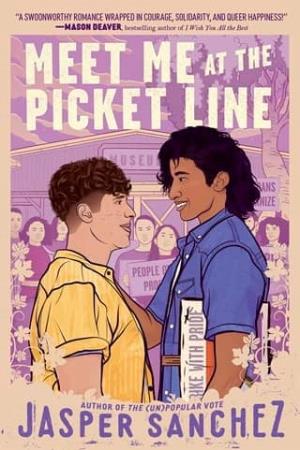
Meet Me at the Picket Line
Chapter 1
One
I’m going to get fired—and it’s only my first day.
I won’t even get to punch into my one-cent-above-minimum-wage summer job. My first shift—okay, training—starts in thirteen minutes, and I’m miles away from the Nuclear Seasons Experience.
Right now, I’m pacing outside a Spanish Mission Revival mansion that could eat my moms’ bungalow for tapas. Harsh morning
light reflects off stucco and punches me right in the eyes, as if the simmering heat and acrid benzine burning off Lola’s
rumbling, Fanta-orange Dodge Challenger wasn’t enough.
The thing is, I’m never late. I have a reputation for being compulsively early. Rewind thirty minutes and I was pacing on
my stoop fifteen minutes before the scheduled carpool pickup. I alternated between poking my head back inside to ask my sister,
Naomi, to hurry; blocking my cat, Sputnik, from bolting outside; and texting our ride, Lola, for status updates that I instructed
her not to answer while driving.
She pulled up one minute early, and once I was in the passenger seat and Naomi was in the back, Lola informed me we had another stop.
If I, Elisha Goldstein, am as reliable as an atomic clock, Efraín Juarez Reyna’s schedule exemplifies radioactive decay. His
plans have a half-life proportional to his interest level, and he isn’t remotely interested in Nuclear Seasons. He once described the ’80s cult TV show as “neoliberal propaganda in provincial drag,” which is absurd. It’s like he’s never
even watched past the pilot.
Besides, no one who lives in a feudal manor like this needs a summer job. I don’t know why Efraín would want to work at the
NSX unless he wants to personally sabotage my summer.
If that’s his plan, it’s working.
When Efraín finally saunters down the steps, I trip over a cobblestone. It has nothing to do with his skinny khaki chinos
or tight uniform polo, collar popped and two buttons undone. It’s how casual he seems, taking his time.
I square my shoulders and force my hand into my pocket because the last thing I need is for Efraín to see me fidgeting. Eye
contact’s out of the question, but I pick a spot on his forehead and steady my voice. “Are you trying to get us fired?”
Efraín looks up. Half his face twists—an eyebrow quirked, a single dimple. Is that meant to signify a smirk? Have I annoyed
him? Amused him? I’m not sure which is worse.
“It’s our first day,” Efraín observes.
I don’t understand why he’s stating something so obvious. I also don’t understand how someone’s eyelashes can be so naturally dense, and this is why I didn’t want to look at his eyes. They’re aesthetically distracting enough before trying to decipher the emotion buried deep in his oil-slick irises.
I blink hard. Again. Then again. If he hasn’t already noticed my excessive stimming, he will now. Today of all days, I need
to appear as professional and high-functioning as possible—not as a malfunctioning cyborg who can’t handle a basic conversation.
“That’s the point,” I say. “If we’re late before we fill out our I-9s—”
“Eli,” Lola hollers from the driver’s seat. “You have to get out of the way if you want Efraín to get in.”
That’s when I realize I’ve been blocking the door this whole time, which may account for his maybe-smirk.
Our would-be getaway car is a two-door, and as I tilt the passenger seat forward, my insecurities are on full display.
This is a comorbid side effect of being short and chubby while transgender: textbook child-bearing hips and that stupid pelvic tilt puberty gave me without a gift receipt. The simple act of climbing over the seat is like steering
an aircraft carrier through the Suez Canal. Even after a year on testosterone, my body is an unwieldy vessel I can’t drive.
This is why I can’t afford to be late. By the end of the summer, I need enough money to make a down payment on top surgery.
Dr. Mburu is one of the best surgeons in the country and, unlike some doctors, doesn’t have a problem working on a DD cup.
But he doesn’t take insurance, and his schedule fills up faster than Taylor Swift concerts sell out.
If I want to secure a surgery date for next summer, I need to make that down payment soon.
My moms said they could afford half, but the rest is up to me—and this job.
That’s why I’m wearing a fuchsia polo two sizes too large over a binder half a size too small. These thrifted baggy khaki
cargo shorts are supposed to straighten out my hips. None of it works. I look like a plus-size pin-up model dressed as a park
ranger for Halloween.
Meanwhile, Efraín looks like a straight-up model. Well. Not straight, but—cisgender. Six feet tall, Tour de France–quality biker’s build, golden skin, glossy black waves down to his shoulders,
and those eyelashes. It’s not a fair competition.
It’s not like I want to be on the cover of GQ. I’d just like to go five minutes without being reminded I don’t fit.
“Elisha.”
“What?” I snap.
“Seat belt,” he chides, high and mighty about vehicular safety when all this is clearly his fault.
The buckle slips through my sweaty fingers before it clicks, and finally, Lola rounds the horseshoe driveway.
“Punch it,” Naomi says, finger guns and all.
Lola raises her heart-shaped sunglasses and grins at the rearview mirror. “You got it.”
“Please don’t,” Efraín grumbles, going through the motions of an argument I’ve heard him lose during every extracurricular field trip.
“Why not?” I ask. “You’re the reason we’re late. We have to make up the time somehow.”
Efraín huffs. “It was only a minute.”
Fact check: It was six minutes from the time we pulled into the driveway until he opened the front door.
“I was listening to this podcast about adjusting taxes for cost of living, and I couldn’t find my black Docs.” He looks at
me over his shoulder, but I keep watching grapevines roll past the window. “If you were so concerned, you could’ve left without
me.”
Lola clucks her tongue. “You really think we’d leave you behind?”
“I could’ve ridden my bike.”
“If only,” I mutter.
Naomi swats my arm.
“We’re ride or die, my dude,” Lola says. “You’re late, we’re late. You get fired, we get fired.” She glances, pointedly, from
Efraín to the mirror. “Right?”
I nod stiffly, and so does he.
It’s a blatant lie. Efraín and Lola may be real ride-or-dies, but the rest of us aren’t. Sure, we go to the same school, and
we’re working the same summer job. Naomi’s my kid sister, but we aren’t the kind of siblings who stay up late braiding each
other’s hair and gabbing about our crushes.
I’m friends with Lola in the sense that she aggressively befriends everyone, right down to the town troubadour.
I consider her one of my closest friends by default because my other option is my cat.
If Lola and I aren’t better friends—well.
Turns out just being the only two trans kids in Egan’s Creek isn’t enough to form a platonic soulmate bond.
As for Efraín and me? Personally, I don’t care that we’ve been passive-aggressively competing for valedictorian since the
fourth-grade spelling bee. Efraín’s hated me since—well, it wasn’t any one thing. Maybe it was middle school, when he rallied
a group of students to crash a town hall meeting and demand rent control. Or freshman year, when he coordinated volunteers
to canvass for an abolitionist county supervisor candidate. Or that winter, when he recruited every warm body he could find
for a sit-in to stop a sweep at an unhoused encampment.
He never bothered to ask why I said no every time. Then again, it took me six months after he stopped asking to realize that I’d failed some unspoken
progressive purity test and he’d written me off entirely.
Because Efraín cares. Some might say his greatest character flaw is caring too much. He cares about everything from racial equity in the state water wars to corporate culpability for wildfires. He cares enough
to argue with NIMBY folk about tearing down the defunct hospital to build affordable housing, and he doesn’t mind when they
slam their doors in his face.
Apparently, he cares enough to listen to a podcast about the cost of living, but he doesn’t care enough to realize that while he’s digging through his walk-in closet to find the right pair of vegan Doc Martens, there might be people in his own carpool who need the criminally low minimum wage because their family is drowning under the bloated cost of living in California wine country.
But it’s fine. I don’t care if Efraín likes me; I only care that he doesn’t cost me this job.
Lola turns onto Highway 12 and punches it.
“You do realize,” Efraín says, “that no fresh coat of paint can change the fact that this gas-guzzling muscle car was built
before the EPA was founded, and speeding burns—”
“None of that!” Lola tsks. She has this way of making herself heard without yelling, a byproduct of growing up in a Dominican
family of seven. “You know I did a full retrofit. The chassis might be Gen X, but she’s all Gen Z under the hood!”
“That math doesn’t check out,” Naomi whispers to me, twirling a stray lock of faded green highlights around her finger. “The
Gen Z cutoff was 2012.”
More math that doesn’t work out: the numbers on the dashboard clock, ticking up.
“Don’t worry,” Lola calls, as if she can hear my anxious internal monologue. “Hawkeye will get us there on time.”
Hawkeye gets us there seven minutes late. Well, seven minutes according to my opa’s watch, which I keep set two minutes fast precisely so I won’t be late. So, technically, we’re only five minutes late, but technicalities don’t count when “late” versus “not late” is an
absolute binary. And we are absolutely late when Lola turns down a narrow dirt road marked:
THE NUCLEAR SEAS?NS EXPERIENCE
The sight of that rusty, corrugated aluminum sign should hit like a defibrillator jolt to my heart, short-circuiting every
current of anxiety and dysphoria. I have loved this weird, kitschy roadside museum so long; knowing I get to work here for