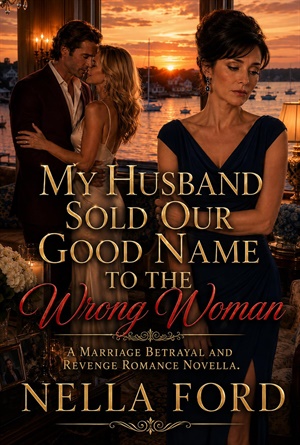
My Husband Sold Our Good Name to the Wrong Woman (Marital Vengeance #3)
1. Reading the Water
Reading the Water
There are two kinds of boat, and the cruel part is that at the dock, in flat water, you cannot tell them apart.
There is the boat built true — every plank sprung and faired by hand, every fastening set where it belongs, a hull that will take a black night offshore and bring you home because there is nothing false anywhere in her.
And there is the other kind. The shell. The one laid up quick and cheap in a shed on the far side of the world, painted fair, dressed to the nines, riding just as pretty as her honest sister at the dock on a still morning — already lying, and simply not yet found out.
In flat water, in a photograph, in a broker's glossy folder, the two look the same.
You have to have had your hands on wood since you were a girl — cold and wet, splinter and tar, stripping a plank down to what's really under the paint — to know that one of them is true and the other is only pretending.
I could always tell. That turned out to be the whole trouble. I could always read the true boat from the dressed-up lie, and I married a man who came, in time, to find that inconvenient.
But I was happy first. I want that on the record before I tell you any of the rest of it, because afterward every soul on the waterfront wanted me to have known — to have felt it coming the way you feel a blow coming in the drop of the glass. I didn't. I slept fine.
On the last ordinary morning of my marriage I was up before the sun in the loft at Winslow's with a sailmaker's palm on my hand and a fair new mainsail spread across the floor, and I was happy — a woman who believed her whole life was built true, clean down to the garboard, when in fact it had opened a seam a long while back and simply hadn't taken water where I could see it yet.
The sail loft at first light is the truest room I have ever stood in.
Long, and clean, and cold, the floor worn pale as bone by a hundred and forty years of stocking feet, and the whole of it smelling of canvas and cedar and Stockholm tar and the cold salt coming up off the water through the cracked window.
I have loved that room at that hour since I was a girl on my knees on my grandfather's loft floor, waxing his twine for a nickel a spool.
My grandfather was a sailmaker and a rigger, and he gave me two things worth the keeping. He gave me an eye — hands, really; a way of reading a boat that you cannot hold in your palm. And he gave me his marlinspike, which you can.
It's a plain bronze one, worn smooth and gone the soft gold of a thing handled fifty years, and it rode in his apron before it rode in mine.
I had it on me that morning. I have it on me most mornings.
It is, I've come to think, about the only instrument in my whole life that never once told me a lie.
A fair hull doesn't lie, Nell, he used to say, running his flat old hand down a plank line the way you'd read a sentence off a page.
You can paint a boat any color you please and call her anything you like — but a fair curve is a true curve, and a true curve holds, and the sea can always tell the difference, even when the buyer can't.
He meant the boats. He meant, I would come to learn, a great deal else besides.
He had another one, my grandfather, for the flash boats — the pretty ones that came through cheap and shining and sold themselves in a season.
He'd stand on the wharf and watch one go out and say it low, mostly to himself.
The sea tries every plank, Nell. It doesn't care what you paid or what you painted.
It finds every lie in a boat — and it takes its own sweet time about it, and then it finds it all at once.
I have had cause to turn that one over more than anything else he ever said to me.
That morning I was doing the thing I have done at first light my whole life, which is read the boats. You can learn more about a hull in the four minutes she doesn't know you're watching — riding to her mooring, empty, honest — than in four months of her paper.
How she sits. Whether she carries her lines fair from stem to stern, or whether there's a hard spot where somebody hurried. Whether she's all of a piece, true the whole way through, or whether the quality stopped at the topsides, where the money could see it.
The boat on the ways that morning was going to be somebody's whole heart.
I knew it the way I know my own name — not from her spec sheet, which was ordinary, but from the plain honest way she took her shape, fair in every strake, a curve you could lay your eye along and never once catch.
A boat built true. My grandfather's whole religion, standing there in frame.
And down at the end of the dock, there was a boat I could not make sense of.
She was a fine-looking thing, new, expensive, exactly the sort the summer people love — and there was a Winslow plate screwed to her cockpit coaming.
Our name. Our hundred and forty years. But she sat wrong.
She sat a strake low and hard in the water, heavy in a way no boat that ever came off our benches sat, faired by a hand I did not know and would have sworn had never once stood on our floor.
I looked at her longer than I meant to.
I told myself it was nothing. A boat takes up a little different loaded than she does light; the low sun plays tricks at that hour. I told myself I was tired. I filed it, the way you file a number that doesn't quite add, and I went back to my sail.
I want that on the record too — that I saw it, that first cold morning, and that I let myself look away. I would not get to look away for long.
Winslow Boatworks is a wooden-boat yard, which is the plain way to say it, and if you follow boats at all you have handled its name.
It's carved in the granite over the shop door.
It is Winslow, and it has been Winslow for a hundred and forty years, and “built by hand at Winslow's” is a thing a certain kind of sailor will pay a great deal of money to have said about his boat.
The name was Winslow. The boats were mine.
The lofting, and the rigs, and the years of standing over a half-model at midnight until I'd found the one fair line nobody else could see — those were mine.
Gray Winslow had the name, and the yacht-club jacket, and a way of walking a summer man down the ways in the fog until he felt the damp on his good coat was part of the privilege. I had the hands.
That was the arrangement, if you'll pardon the word.
I kept the books, too, in the lean years — and there were lean years, whatever the wooden-boat magazines would tell you. Winters when a hundred-and-forty-year-old name was worth a great deal on the granite and almost nothing at the bank.
I sat at the loft bench after the shop went quiet, under a bulb that swung on its cord, with the build log in one hand and the checkbook in the other, and I found the money, plank by plank, back when finding it was the whole difference between another season and selling the yard off for a marina.
I knew where every boat and every dollar at Winslow's slept, because for a long time I was the one who tucked them in.
Then the good years came back, the way they do when a name is old enough to outlast its own bad luck, and somewhere in there Gray stopped bringing me the build log and started bringing me the guest list. And I let him.
Because I was tired, and because being wanted for my hands felt close enough to being wanted.
Gray Winslow has two faces. I should tell you that early, because it explains all the rest.
There's the one he wears for me — or wore; I am still learning the tense of it — crooked and quick and boyish, the face of a man who used to come down to the loft at eleven at night in his stocking feet just to sit on a sail bag and watch me work a seam.
And there's the one he wears for a room.
For a summer client, for a magazine, for a woman his mother approves of: smooth, and warm, and lit from somewhere inside like the window of a good house seen from the water.
For fifteen years I got the first face on the loft floor in the dark, and the harbor got the second one out in the sun, and I thought that made me the fortunate one.
I still think it did. It just turned out that the second face was the one he'd started, somewhere along the way, to believe.
We had a thing, Gray and I, at the launchings.
The morning a new boat went down the ways, before anybody came, the two of us would go aboard her alone in the gray and stand in her cockpit a minute, and he'd lay his hand on the new tiller and say the same thing he'd said the very first boat I ever lofted for his family. She'll swim, Nell. You made her swim.
One minute, in the dark, a few times a year. It was the realest thing we had. I'm telling you it existed so that later, when it stops, you'll know what it was that stopped.
That morning he came down to the loft while I still had the palm on my hand, and I knew before he opened his mouth that this was no launching visit — because he was wearing the second face at half past five, the face he keeps for the yacht club, in a room that had nobody in it but me and a sail.
"There she is," he said, and for half a second I thought he meant the mainsail, spread out fair on the floor. He didn't. He wasn't looking at the sail. He had his phone in his hand.
"Big news," he said. Already smiling the yacht-club smile. "Blythe's coming home. For good, this time. She's going to run the new venture for us."
I set my grandfather's marlinspike down on the bench. Gently. You learn, at a loft, to set a sharp thing down easy before your hands can decide something on their own.
"Blythe," I said.
"Blythe Amory." As if I could have forgotten Blythe Amory — as if there were the least chance in the created world I had forgotten the girl Iris picked out for her son at nineteen, the old summer-money daughter who'd have made the Winslows finally make sense on paper, who went off and learned to sell boats to people who buy them by the brochure and came home this spring in sail-white linen, shining like a thing just out of the box.
"She'll run the client side," he said. "The brand, the new venture.
She's got every buyer on this coast in her phone, Nell — she can take Winslow's national, put us in the glossy folders, sell the name for what the name is finally worth.
And it frees you up. You get to be up here in the loft with the sails, the part you love, and let her handle the noise. "
The part I love. He said it like a gift.
And he did not know — he had genuinely stopped being able to know — that Winslow's was not a yard with a good sailmaker in it. Winslow's was the sailmaker. The sails were the part he could see. They were the least of what I did.
He was standing in my loft at half past five in the morning offering to free me from my own life, and calling it a kindness.
"That's wonderful," I said. Which was true the way a dressed-up shell is true: lovely at the dock, and lying the first time you ask her to take a real sea.
Gray lit up. Relief came off him like heat off a stove — he'd braced for weather and I'd handed him a flat calm. He kissed the top of my head, told me Blythe and I were going to be a dream team, and went back up the ramp already making, in his head, the calls he couldn't wait to make.
And I stood in the truest room I own, with my grandfather's spike on the bench and a fair new sail spread honest on the floor, and I did the thing I do, which is nothing, and I thought about Blythe Amory.
I had met her twice. Both times I'd watched her walk into a room and sell a boat she had never once sailed — take a plain hull and a thin story and talk until the plainness read as rareness and the buyer's own eye quit being any use to him.
She had a gift. I won't pretend she didn't. It was the exact gift the trade rewards now: she could make the folder look better than the boat, and she had never once in her life needed the boat to be anything more than a place to hang the folder.
Down at the end of the dock, the boat that sat a strake low rolled a little to her mooring, wrong, in the first of the light.
I didn't put it together that morning. I want to be honest about that. I did not stand there and see the whole shape of what was coming.
But some older, colder part of me — the part my grandfather put there, the part that reads a thing a long beat before the rest of me catches up — set the two facts down side by side and left them to wait.
A boat at our dock, with our name on her, that never came off our benches.
And a woman coming home whose whole art was the folder.
It was Gray, from the top of the ramp, who called back down the rest of it — the part that was, I would come to understand, the truest thing he told me all morning.
"Oh — and we'll do it here," he called. "The launch, the whole kickoff for the venture. Get the yacht club and the summer people down to the yard, the flagship down the ways, the works. Mother's already on it." He grinned the grin. "Nobody rigs a boat to show like you do, Nell."
So there it was.
I was going to spend the coming weeks getting Winslow's to gleam — sweeping the loft, bending on a suit of my best sails, rigging the flagship until she stood at the dock like a thing out of a painting — so that the whole coast could come and admire the boat, and the woman my husband's family had wanted for him for twenty years could stand in the middle of it all and take it.
You can't rush green wood. My grandfather said that one too.
You bring a boat along at the pace the wood gives you, and you do not, whatever the season wants out of you, close her up before she's seasoned and true — or you build in a lie no amount of paint will ever fair out, and one day, offshore, in weather, she will show you exactly where you hurried.
I had a few weeks. And I decided, standing there in the loft, that I would use them the way you use the last flat calm before a hard passage. I would go slow. I would watch. I would let the thing come to me at the pace it gave me.
And I would find out what that boat at the end of the dock really was.