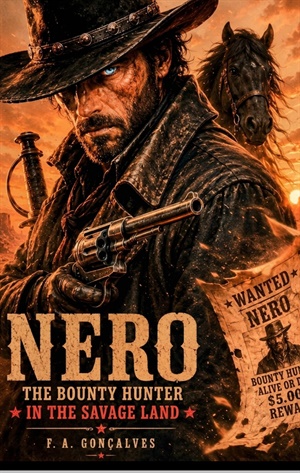
Nero, the Bounty Hunter
CHAPTER 1
TELL THEM NERO WAS HERE
Through that opening the heavy smoke of cheap tobacco climbed in slow, lazy spirals and hung in the air like a mournful fog.
The room was suffocating. The foul air smelled of whiskey distilled from spoiled corn, of old sweat worked deep into leather, and of the fear that men on that lawless frontier tend to carry at the belt, badly disguised as swagger.
Nero occupied the darkest and most forgotten corner of the room.
Seated in a chair whose legs creaked with every deep breath he took, he seemed to fuse with the worn old furniture, all but invisible to the few regulars at the bar.
He was a still, imposing silhouette beneath a long travelling coat — a duster of heavy canvas, stiffened and thoroughly caked with the fine grey dust of the Kansas roads.
Under the low, misshapen brim of his weather-beaten hat, his face stayed drowned in shadow.
And yet, beneath that darkness, his eyes were perfectly visible: two slits of a glacial blue, cutting and unnatural, fixed like a hawk’s on a poorly lit table at the centre of the room.
At his waist, resting in raw leather holsters moulded by use, sat a pair of Colt Paterson revolvers.
They were mechanical relics of a recent and lethally precise engineering, with long barrels of blackened steel.
Ten shots in all. In those days an ordinary man, hands shaking with fear and adrenaline, would need agonizing minutes to reload those cylinders — the whole barrel had to come off the frame before powder and lead could go in.
Nero, however, worked differently; his quick, callused fingers needed only thirty seconds to bring death back to the chambers.
But he knew, with the mathematical certainty of a predator, that no one in that room would get thirty seconds.
No one in that room would get three. Besides, laid crosswise against his back and hidden under the heavy folds of the long coat, rested the grip of a second weapon: a blade, long and heavy and cold.
At the central table, beneath the yellow trembling light of a camphene lamp, three men drank from pewter cups and paid no attention whatsoever to the shadow watching them from the left-hand corner.
In the middle of the tabletop, scored by knives and stained with grease, a rough map of roads and rivers lay spread out, creased under McCready’s heavy elbows.
He was a broad-shouldered fellow whose brutish face was split by a violent whitish scar running from the corner of his left eye to the point of his chin.
Beside him, Thorn scratched a thin beard dirty with food, keeping his eyes fixed on the lines of the paper, while Smiley cleaned his long fingernails with the sharpened tip of a hunting knife.
Smiley wore on his face a wide smile, constant and perfectly empty — the sort of cynical grin that, out on the frontier, usually comes just before a shallow and nameless grave.
They were talking about the south. They were talking about Texas.
Their coarse voices were arguing over the boundaries of the Cross Ranch — the property Colonel Jonathan Vance had taken from old Ethan Cross three winters earlier, without even troubling himself to change the name on the gate — and, more particularly, they were talking about Sarah, the dead rancher’s eighteen-year-old daughter, the last living Cross and the only thing on that land that had not yet been sold.
Nero already knew those names and those faces.
He carried in his memory the exact image of a wanted bill, printed in cheap ink and already crumpled, that he had seen days before on the counter of a crooked clerk in Kansas City.
The crimes listed under the three aliases were beyond forgiveness: trafficking in souls and the stealing of women.
A hideous abomination that white men’s law rarely reached, and rarely cared to punish, in that ownerless territory — but which the law of lead, carried in Nero’s hands, collected on with interest paid in blood.
“So the girl keeps until next week,” McCready muttered, his harsh voice rasping in his throat like sandpaper on wood.
“And the price? Is it firm?” Thorn lifted dull eyes from the map and took another swallow of the cloudy liquor.
“Three thousand dollars in gold coin,” Smiley answered at once.
His smile seemed to spread even wider, showing rotten yellow teeth, exposing a total absence of remorse or humanity.
“Those rich men down in New Orleans don’t haggle when the merchandise is fine.”
McCready raised his pewter cup high, toasting the business to come. The reflection of the lamp flame danced on the surface of the whiskey.
“To the prettiest girl in Texas.”
The laughter of the three renegades rolled through the saloon, thick and confident and mocking, breaking the tense silence that hung over the other tables.
That was when Nero stood up. The movement was neither abrupt nor hurried.
There was no theatrical clatter, none of the shouting of tavern heroes.
It was an inevitable rising, heavy and silent, like the advance of a black storm coming slowly across the horizon of the plain.
As he came to his feet the long coat swung lightly aside, opening enough space for the dark wooden grips of the Patersons to show plainly in the weak light.
He began to walk toward the table. His steps, in soft leather boots, made no sound at all on the packed earth of the floor.
It was as though a ghost were crossing the room.
McCready was the first to feel the air change.
The atmosphere around the table seemed to turn cold all at once.
The leader of the gang raised his eyes from the map and found himself facing a stranger: a tall man with hard features carved out by a pocketknife, wearing a glacial blue stare that seemed to see straight through flesh and read the sins hidden underneath.
In that millisecond suspended out of time, McCready’s stomach turned over; he understood that the darkness in the corner of the saloon had taken on body and shape.
And that it had come for them. McCready’s right hand dropped in desperation toward the holster at his waist. Nero, however, was already there.
The first Colt Paterson leapt into his right hand with inhuman speed, as though the steel were part of his own arm.
Since those guns had no true trigger guard, the folding trigger dropped into place at the very instant the hammer came back.
The dry, precise mechanical click was followed immediately by the deafening roar of black powder.
POW. The lead ball found the centre of McCready’s forehead before the bandit’s fingers ever touched the grip of his own revolver.
The violent impact threw his head back, and the heavy body toppled to the floor, dragging the wooden chair down with a dull thud.
Thorn reacted out of pure survival instinct.
With a howl of terror he shoved the heavy oak table forward, trying to use it as an improvised shield while his left hand pulled the trigger of his gun.
POW. Nero’s second shot was surgical. The ball punched through Thorn’s chest, tore the lung, and stopped his motion halfway.
The man’s legs gave out and he dropped to his knees in the dirt, coughing thick dark blood, before collapsing face down onto the very map he had been studying minutes before.
Smiley, the man with the cursed smile, did not try to fight.
Absolute terror wiped the sarcasm from his expression in an instant, turning his features into a mask of despair.
He dropped the knife, spun on his heels, and ran for the gloom that covered the saloon’s back door and the safety of the night outside.
Nero did not so much as lengthen his stride to pursue him. He stayed where he was, calm. He merely raised his right arm with an almost ceremonial slowness, closed his left eye, and lined the Paterson’s front sight on the fugitive’s back. He pulled the trigger a third time.
POW. The ball struck Smiley exactly between the shoulder blades and broke his spine.
The dry crack of his body hitting and sliding across the packed floor ended the symphony of lead.
The silence that followed was absolute, dense, suffocating.
The only audible sound was the faint hiss of powder smoke drifting in the air, blue and heavy and reeking of sulphur.
No one inside the saloon dared to breathe or move.
The barman was hidden entirely behind the rough wooden counter, both hands clamped over his ears, his eyes bulging and fixed on the corpses.
Nero, keeping his movements methodical, cold and empty of any emotion, began the work of reloading the spent chambers of his Paterson. The sound of metal parts coming free and clicking back into place was the only noise left in the world.
“You keep whatever those three have in their pockets,” Nero said.
His voice was a low baritone, rough, without anger and without hurry.
“And see that all of them get buried.”
The barman, trembling and pale as a bedsheet, only nodded from behind the counter, entirely unable to shape a single mechanical word.
Nero walked slowly to where the three corpses lay in spreading pools of blood.
With his left hand he reached for the black leather sheath he wore crosswise on his back.
A long metallic hiss, sinister and drawn out, cut through the stillness of the room.
He drew a heavy cavalry sabre. The steel was dark and dull and covered in deep nicks and grooves left by old battles.
It was a relic of war, worn by weather, but kept as sharp as a barber’s razor.
Behind the counter the barman smothered a cry of pure terror as he understood the true nature of what was coming.
With the icy precision of a state executioner, Nero raised his arm.
Three dull, heavy, brutal blows echoed against the boards of the saloon.
The weight of the sabre found flesh and cut through bone with frightening ease, separating what needed to be carried away.
He crouched and wiped the trail of blood from the blade on the cloth of McCready’s trousers before returning the cavalry sabre to the sheath on his back.
From an iron hook on his belt he unfastened a coarse burlap sack.
One by one, with steady hands, he collected the physical prizes for which the territorial circuit judge would pay the exact sum in gold coin.
The burlap sack took on weight quickly, moulding itself into an ugly and macabre shape as dark blood began to drip slowly through the gaps in the rough cloth and strike the floor.
With his free hand he reached out and took the bloodied map from the table.
His blue eyes rested for one brief second on the circle drawn in red ink, where it read: Cross Ranch.
Nero folded the paper carefully and put it away in the inside pocket of his travelling coat.
He walked toward the door. Before pushing through the swinging boards and taking to the darkness of the night, Nero stopped half-turned, holding the heavy sack by its sisal cord.
He tilted his face just enough to let the lamplight catch his profile, and looked directly at the trembling man still crouched behind the counter.
“If anybody comes asking…” His voice rang up into the roof beams and engraved itself permanently in the survivor’s memory.
“Tell them Nero was here.” The cold, cutting Kansas wind met him outside, snapping the skirts of his canvas duster.
Tied to the hitching post, his black horse — a powerful, enormous animal long accustomed to the iron smell of death — merely snorted and shook its mane when the damp burlap sack was lashed firmly to the side hooks of the travelling saddle.
Nero swung into the saddle in one fluid motion.
He settled the leather reins in his gloved hands, lifted his face to the dark and desolate horizon that stretched away endlessly to the south — straight toward the Texas territory — and put his spurs to the animal’s flanks.
The bounty hunter rode off galloping into the darkness, leaving behind a trail of blood on the Kansas dirt and a name the West would never have the chance to forget.
◆◆◆