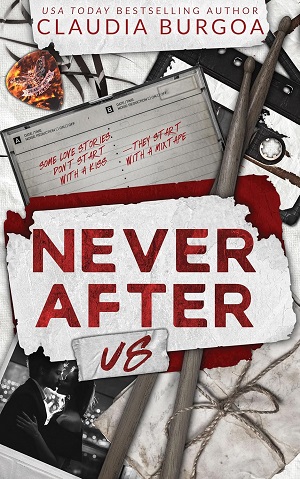
Never After Us (Heartbreak Mixtapes #4)
Prologue
Mara
Love is a four-letter word more powerful than the sun. At least that’s what everyone swears—poets, priests, the glossy pages of bridal magazines promising forever. Love can move mountains. Love can conquer everything.
That’s what they want us to believe.
No one prepares you for the part where love can ruin you.
The day he died, the world refused to pause for even a breath. That’s what stunned me the most—how normal everything stayed around me. The sky dragged along in its dull gray. The neighbors’ dog barked like it always did. A car door slammed somewhere down the street. Someone laughed. Someone lived.
And I stood there, realizing my life was splitting open . . . while the city carried on without the slightest tremor.
The call came just after I was cleaning dishes. He had missed dinner—again. They were looking for me, Mara Cavanagh-O’Shea. Then there were words like “Samuel,” “an accident,” and many more I couldn’t comprehend even when they repeated them twice or thrice. They were sorry—very sorry.
The voice was somber, calm. Somebody had trained them in the art of careful phrasing, to cushioning the impact while the person on the other side was having a life-changing moment. As if tone alone could keep everything from falling out of place.
My mind slowed, refusing to accept anything spoken on the other side of the line. If I didn’t move, maybe none of it would be real. Maybe the universe would rewind.
Maybe love—our forever love—would choose us a different script.
I dropped the dish towel in my hand. It hit the floor without a sound and stayed there for days, untouched, a forgotten offering to a life that no longer made sense. The house smelled faintly of citrus soap and rain—a scent that once eased my nerves.
That day, it felt like an impersonation of comfort, wearing a costume it could no longer pull off.
In the next room, Mila was playing. Her tiny voice drifted through the drywall, bright and unbroken, the last pure thing in our home.
She didn’t know. Not yet. And I remember standing still, listening, realizing her innocence was about to shatter in my hands.
One sentence from me, and her world would shift. Her sky. Her heartbeat. Her future.
How do you tell a three-year-old that Daddy won’t come home again?
People think grief is loud. They picture the screaming, the devastation, the heartbreak played out where everyone can see it.
But grief moves differently. It lives in the pause after you hang up the phone.
It settles in the air when someone’s laughter disappears forever.
It trails behind you through your home, pressing the walls closer, rearranging every memory so you no longer know where to place your feet.
He was supposed to walk through the door that night after .
. . we were supposed to have dinner, pretend to argue about how much salt he used (I barely sprinkle any while cooking), kiss, then forget the argument ever existed.
We were supposed to grow old, to watch Mila climb bleachers at her school concerts, to add inside jokes to the ones we already had. We were supposed to have more time.
But life doesn’t bargain for extra days.
It doesn’t keep score. It doesn’t wait for you to say goodbye.
Sometimes it just . . . stops. They told me it was quick—that he didn’t feel anything.
As if that detail could soothe something inside me.
As if the speed mattered when everything in me slowed so suddenly, I could barely breathe.
For weeks afterward, I swore I heard the sound of his key at the front door.
That soft scrape, that familiar shift of metal, the tiny anticipation of a moment before he stepped inside.
I’d turn toward the hallway without thinking, heart caught halfway between memory and hope, only to face stillness.
I’d set two plates on the table before realizing. I’d reach for his coffee mug, the one with the chipped handle he refused to throw away. I’d pause in the mornings, waiting for his laugh to break through the quiet the way it always had.
Grief clung to me in ways I didn’t recognize.
I thought if I stayed busy enough, if I kept moving, it couldn’t grip hold of the parts of me that still felt tender.
Maybe that’s why I’m leaving now—for a new job, a new adventure, a nervous attempt at a new beginning.
I tell myself I’m doing it for Mila, that it’s the practical choice, the right thing.
But deep down, I wonder if I’m searching for a place where memories won’t chase us from room to room.
Even now, I can’t decide what hurts more—that he’s gone, or that love didn’t save him. That every whispered promise, every silly argument, every tender moment meant nothing to a slick patch of road and a single sharp turn.
Love doesn’t rescue. It doesn’t lift you out of the fire or shield you from cruel timing. Sometimes it ends with a phone call. Sometimes it collapses while you’re still holding a dish towel, you’ll leave it on the floor because bending down feels like admitting your life just changed.
Love doesn’t conquer everything.
It simply reminds you how much there was to lose.
And when it’s gone, you’re left with the remnants of what you swore would last forever—proof that forever was never guaranteed in the first place.