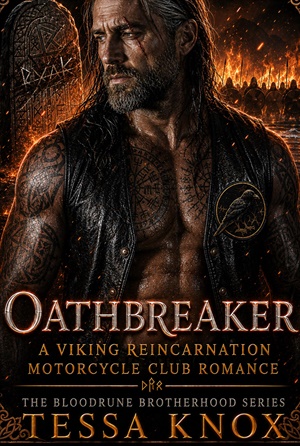
Oathbreaker (The Bloodrune Brotherhood #4)
Prologue
Ghost
My name is Kjell Amundsen and I have been alive for approximately a thousand and eleven years, in pieces, with gaps.
The dream always starts with the smell of wet rope.
That's the part nobody believes when I try to explain it, which is why I stopped trying somewhere around year nineteen of being alive. People expect blood. They expect screaming. They think a thousand-year-old memory ought to arrive like a war film.
Mine arrives like a rope left out in the rain.
We're standing on a gravel beach in the grey hour before proper light, and the fjord is so flat it looks like something you could walk on if you were stupid enough to try. Vestrfjord. I know the name the way you know your own name — I don't recall learning it, I just have it.
There are forty of us. I could tell you where each man stands. I've had a thousand years to memorize the seating chart.
Before the beach there's the night before the beach, and that's the part I'd give back first if anybody offered.
We're up above the water in a longhouse that isn't ours, borrowed from a man who owed Halvard something, and there's a fire and there's bad ale and there's a boy going around with a horn making sure every cup is full because that's the entire job they've given him and he is taking it extremely seriously.
And Halvard stands up and says the words.
That's what an oath was. People think it was ceremony.
It wasn't. It was administrative. It was forty men agreeing out loud, in front of each other, in a room with a fire in it, that tomorrow nobody moves.
That's the whole content. You can dress it in gods if you like — we did, we said the names — but underneath it's a labor agreement between men who are about to be very frightened.
I said the words.
I want to be precise about this, because the difference matters and it's the difference the whole rest of my life is built on.
I didn't say them quietly. I didn't say them looking at the floor.
I said them out loud with a cup in my hand and I meant them, in the marrow, the way you mean a thing at twenty-six with a fire on your face and forty men around you.
That's what makes it what it is.
If I'd been a frightened man who'd never promised anything, I'd just be a frightened man. There's no crime in it. Half the men on that beach were more scared than me and every one of them stayed.
I promised. In a room. In front of witnesses. And then in the morning my arm came down.
The boy with the horn is on the beach too, by the way. He's on the end past Tor. He's the one Tor is telling the bad joke to.
I don't know his name either.
Hal is left of center with his shield already up, and he's doing the thing he still does, the thing he does now in a parking lot in Ash Harbor when somebody's about to throw a punch — he rolls his neck twice, once each way, like he's settling into a chair.
Bear is three men down and he's already gone. Not scared. Gone. The eyes have emptied out and whatever's driving that body now isn't taking questions.
Tor is on the end where the line is thinnest, because Tor always takes the end where the line is thinnest, and he's talking to the boy beside him. Steady voice. Telling him a joke, probably. Tor's jokes were bad then too. Some things a curse can't fix.
And I'm second from the right, shoulder against a man whose name I've lost — that's the cruelty of it, I remember the smell of the rope but I lost his name — and my shield is against his shield, and my father's axe is in my hand.
It's a good axe. I want that on the record. It never failed. It was the only thing on that beach that didn't.
He gave it to me when I was fourteen and he said four words about it, which people who know me now would find funny if I could tell them. He said: Don't lend it out.
That's my inheritance. Four words and a piece of iron.
I've thought about that a lot, over the centuries — whether the not-talking came from him or whether it came from the beach, whether I was always going to be a man who says four words or whether I became one afterward because five words is enough to let something out.
I've never settled it. You'd think a thousand years would be sufficient time to work out where your own silence came from, and it turns out it isn't, it turns out you can carry a question that long and it just gets heavier and no clearer.
They come out of the treeline in silence, which is how you know they've done this before. Loud men are men who need to be brave. Quiet men are men who are working.
The wall holds.
That's what nobody says afterward, in any of the tellings, in any of the songs, in the stone with our nine names carved on it. The wall held. For eleven seconds we were forty men and one animal, and the animal had a spine, and the spine was iron.
Eleven seconds.
Then a man in front of me lifts his arm and I see the underside of his jaw and I know — with a clarity I have never once had while awake — I know that I am going to die here, on this gravel, in this cold, and that it will hurt for a while and then it won't.
And my arm drops.
Not knocked down. Nobody hits it. My own arm, my own hand, my own shield, and it comes down like something switched off inside my elbow, and the gap opens, and I step back through it.
One step. Then another one. Then I'm running.
The gravel is bad footing. I remember thinking that. Sprinting for a treeline at the age of twenty-six with my father's axe still in my fist and a shield-wall coming apart behind me, and what my mind offers up, the one thought it hands me, is: this gravel is bad footing.
I make the trees.
That's the part that ruins me. Not the running. I've made peace with the running — you can, eventually, the way you make peace with a scar. What I have never made peace with is what happens after I make the trees, which is:
Nothing.
Nobody comes after me.
No spear in my back. No shout. No hand on my collar.
I get twenty feet into the dark and I turn around and the fighting is going on exactly the way it was going on before, because the Fenrir men have closed the gap I made and the Ravensworn have closed it from the other side, and the whole thing has swallowed my absence like water swallowing a stone.
Not one man chased me.
Because not one man was watching for it. You don't watch the men beside you. That's the entire arrangement. That's the deal. The wall works because forty men agree to look forward, and I made the only move on that beach that nobody in the history of the world had thought to defend against.
They didn't chase me because it didn't occur to them that I'd go.
Twelve seconds, start to finish. Arm drops, step back, run, trees, turn.
I have replayed those twelve seconds for a thousand years and I have never once found the frame where I decided.
They all die. I want to be clear about that, because it's the arithmetic I do every morning of every life.
They die on that beach and I die in the trees three days later of a wound I don't even remember taking, and then the v?lva does what she does, and the nine of us come back and come back and come back, and every time, one of us comes back knowing he's the reason there's a back to come to.
I've tried to test it. That's the part I've never told anybody.
When I was nineteen I put myself in front of things on purpose.
Bar fights I had no business in. A house fire in Coos Bay where I went back through a doorway twice for a dog that turned out to already be outside.
A stretch of my twenties where I took every dangerous job on the board and volunteered for the rest.
None of it counts. That's what I found out. You can't test a thing like this by picking your own ground — every one of those was a door I chose to walk through, and a man who walks through a door he chose is not being asked the question.
The question is a line you didn't pick, at an hour you didn't pick, next to a man whose life is riding on your left arm.
You get asked that maybe once. I got asked once.
Only I don't know that. Not for certain. Not yet.
That's the mercy in it, if you can call it mercy. For most of this life I've had the twelve seconds without the context. Just a dream about a beach and an arm that stopped working. I've been able to tell myself it was somebody else's arm. A borrowed nightmare. Static from a signal not meant for me.
I've been telling myself that for thirty-four years.
Here's the arithmetic I do.
Thirty-nine men. Say each of them got another forty years, which is generous for the century, but say it. That's fifteen hundred and sixty years of living that ended on a gravel beach because a man on the right of the line found out about himself in public.
I've had thirty-four years this time. Forty-one the time before, and sixty-one before that — that one was a long one, that one was a punishment — and every single one of them I've spent moving, and the moving has never once made a dent in the number.
You can't pay it. That's the first thing you learn. There's no version of a life that's worth fifteen hundred and sixty years, and anybody who tells you otherwise has never sat down with the figures.
So you stop trying to pay it. You just keep the ledger open and you keep moving so nobody gets close enough to read it.
That's a life. It's not much of one, but it's a design, and it functioned for three centuries.
I wake up on a picnic bench at a rest stop off Highway 26, outside a town called Cold Fork, at ten past five in the morning.
My hands are shaking.
Not trembling. Shaking, properly, the way a washing machine shakes when the load's gone off-balance, and I have to put them flat on the concrete table and lean on them until they quit.
There's a mile marker across the road and a sign under it advertising a diner with a man's name on it, and below that, in smaller letters somebody added later and never repainted: OPEN.
There's a trucker asleep in a cab at the far end of the lot with his boots up on the dash.
There's a raccoon working the garbage can with real professionalism.
There's a laminated map of Oregon bolted to a post with a red dot on it that says YOU ARE HERE, and somebody has scratched out HERE and written, in ballpoint, LOST.
I stand in front of that map for longer than a sane man would.
I've been riding for eleven days. Ash Harbor to Boise, Boise to Elko, Elko to a motel in Winnemucca where I did not sleep, and then north again for no reason I could name to anybody including myself.
Hal had asked me to plan the fall run. That's my job.
That's the job I'm good at — I sit down with a map and I find the road that keeps forty men moving, and I have never in eleven years put the club on a bad road.
I got as far as opening the map.
Then I got on the bike at two in the morning without telling anybody, which I have done maybe nine times in this life, and every one of those nine times somebody eventually found me at a gas station four states away and never once asked why.
That's the thing about my brothers. They've built the whole club around a hole and never looked into it.
My bike is twenty feet away and it does not start.
I try it four times. On the fourth try I know exactly what's wrong with it — I've been a mechanic in three lives, my hands know engines better than they know people — and I know I could have it running in about an hour with what's in my saddlebag.
I sit back down on the bench instead.
I want to say I don't understand why. I understand why perfectly.
A running man needs a running machine. And I am so tired, so profoundly and cellularly tired, of being a man who can leave.
The sun comes up over Cold Fork, which takes about nine seconds, because there's nothing in the way.
A truck goes by. Then another one. Then nothing for eleven minutes, and I count them, because counting is what my hands do when they've got nothing.
Down the hill somebody turns a light on in a low building beside the highway. Then another light. Then a sign buzzes and drops a letter and gets it back.
Somebody down there is starting a day.
That's all it is. I want to be honest that that's all it is, because later on people will want a bigger reason and I won't have one.
A woman I've never met turned on a fryer at half past five in the morning in a town with nothing in it, and I sat on a picnic bench and watched it happen, and something in me that had been walking for a thousand years sat down.
I look at the sign with the dead man's name on it.
And for the first time in a thousand years, I stay put.