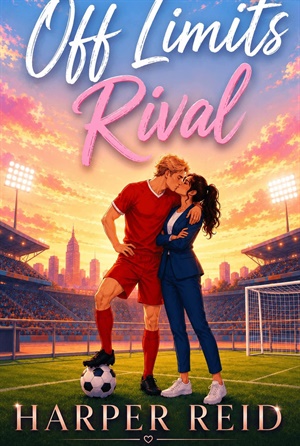
Off Limts Rival
Chapter 1
Sloane
“You’re in my shot, Reinhardt.”
“I’m aware.” Carter Reinhardt does not move out of my frame.
He leans further into it — all six feet of Atlanta’s golden boy folding one shoulder against the backstage wall like the league built this cramped little media corridor for him to be charming in.
“I figured if I stood here long enough, you’d have to look at me.
You’ve spent the whole junket treating me like furniture. ”
“You are furniture. Expensive, decorative, structurally unnecessary.” I don’t look up from my phone. “Move.”
He grins — the famous one, the one that’s sold more jerseys than his left foot — and aims it at me like it’s a certainty rather than a gamble. “She speaks. And insults my structural integrity. Best day of my season.”
“Lose to us Saturday and it’ll be the worst.”
“Brutal.” He doesn’t move. “Big morning for you, though.”
“Every morning is a big morning for me. That’s the job.”
He opens his mouth. Closes it. Something crosses his face that doesn’t match the rest of him, and I don’t have time to file it, because he finally steps aside — six inches, generous of him — so getting past means turning my shoulders and going through the gap rather than around it.
The corridor smells like hairspray and warm catering and eleven hours of other people’s ambition.
For the length of one step he’s close enough that I feel the heat coming off him, and I hold my breath without deciding to, and I clock — half a second, entirely against my will — that he is markedly better-looking in person than any man whose job is beating my team has the right to be.
I file the half-second under liabilities, mine. I have one iron rule, forged in the wreckage of the last time I let a charming athlete anywhere near my life: I do not work with men like Carter Reinhardt. I manage around them. I outlast them.
Behind me, he laughs — easy, delighted, like I’ve handed him something instead of walking off with the last word.
On the junket floor our third-choice keeper is at the last station, and Theo — nine weeks in, still ironing his shirts — has just let a reporter open with the manager’s contract.
I’m across the floor before the keeper’s mouth is all the way open.
“That’s the last one.” I’m smiling. I am always smiling on a floor. “My fault. He’s got a fitness test at two.”
The keeper goes. Theo turns the color of a receipt.
“I should have—”
“I put you on this station without briefing you. That’s mine.” It isn’t. I briefed him Tuesday, twice, with a handout. “Write the question down. You’ll see it again inside a week.”
He writes it down.
Nobody in this building becomes the story on my floor. That isn’t kindness. That’s the entire job.
Twenty minutes later my own boss asks me to fall in love with him.
***
“No.”
“You haven’t heard it.” Marcus doesn’t look up from his phone, which he carries the way other men carry a wedding ring — as a permanent explanation for where his attention is.
“I’ve heard enough of it to know the shape.
You want a face on something, and you’ve come to the person who builds the frames instead of standing in them.
” I stay on my feet. Sitting down in this office is a concession and he charges interest. “Ask Reyes in brand. She’s photogenic and she’d enjoy it. ”
“It’s a cross-rivalry romance campaign. Manufactured. Public. Through the tournament.” He sets a folder down on my desk like a gift. “You and Atlanta Forge’s winger.”
I look at it. Atlanta’s crest knotted into ours under a swag of tournament gold, and beneath that, in eleven-point type, the name I walked away from twenty minutes ago. Somebody in graphics spent a full day on this. Somebody in graphics has known longer than I have.
“Find someone else.”
“You’re the best operator in this league. And the only face the rival club will accept. The two are related.”
“You built the file on me yourself.” My voice drops, which is worse than the climb. “You know what it cost the last time my private life became someone else’s content. You know I’ve spent three years making myself unphotographable. And this is the campaign you walk into my office and hand me.”
“Through the tournament. Strategically.” As though strategically were a blanket he could throw over it. “It’s visibility, Sloane. Not a marriage.”
I slide the folder back across the desk with one finger. “No.”
“You misunderstand the meeting.” Marcus lowers the phone at last and settles into the chair across from my desk, crossing one ankle over his knee like we’re discussing quarterly projections.
“I didn’t bring you in for your consent.
It’s already signed — three names above yours.
I brought you in as a courtesy, because you of all people know what happens to a woman in this league who becomes the story by accident.
” The smile arrives, the warm one, the one to fear.
“This time you’d be holding the pen. I’d have thought you’d want it. ”
And there it is. The line that lands, because it’s true, and because he knew exactly where to set it down.
“The league is watching the rollout as the model for expansion optics,” he says, unhurried, into the space where my answer should be. “It lands, and you’re the youngest comms head in league history with a signature campaign on your record. Not a good year. A body of work.”
Here is the thing I would not say out loud in this building for money.
I want that.
I have wanted it since I was twenty-four and rebuilding from a crater, and I have wanted it in the particular airless way you want something you’ve decided you’re not allowed to admit to wanting, and Marcus has just set it on my desk in the same folder as the worst year of my life, because that is what he is for.
For one second I don’t have a sentence.
In this room, that’s the tell. I am the person who always has the sentence. Marcus watches the second cross my face with the mild interest of a man confirming a hypothesis. He doesn’t smile. He doesn’t need to. He’s already seen the one thing he came in here to see.
Outside my window a delivery truck is reversing into the loading bay, beeping, patient, indifferent to the fact that a career is being restructured four floors above it.
So I take the second back.
“If it’s signed,” I say, “you didn’t need my consent, and you knew that before you sat down.
Which means you’re not here for a yes. You’re here for a good one, because a hostile operator ruins the asset and you can’t buy another me by Friday.
” I pick the folder up. “So I’m not being asked, Marcus.
I’m being priced. Fine. Let’s price it.”
Something in his posture changes by about a degree. In four years it’s the most I’ve ever gotten out of him, and I’d like it noted somewhere that I enjoyed it.
“I have nine conditions.”
“Nine.”
“You’ll have all nine in writing by Friday. Three of them aren’t negotiable, and I’d rather you heard those in a room with a door than at a board table with eleven men and a caterer.”
“Go ahead.”
“One. Approval authority — mine, sole, final — over every asset with my face in it. Not consultation. Approval. If it goes out, it goes out because I released it.”
“Done.”
“Two. A documented exit. Any point, any reason, no cause stated, and it does not require your signature to activate.” I let that sit. “If I have to ask permission to stop, I don’t have an exit. I have a leash with paperwork.”
“Done.”
He hasn’t moved. He hasn’t reached for a pen, or a phone, or the appearance of having to think, and somewhere behind my sternum a very old alarm starts up quietly.
“Three.” This one I’ve been holding in my mouth like a coin.
“Nobody on this campaign goes near what happened three years ago. Not as background. Not as texture. Not as a redemption arc. If I see Lucas’s name in a single deck, I walk, and I take the twelve pages of documentation I’ll have built by then with me. ”
Marcus reaches into his jacket, takes out his phone, and turns it face-down on his knee.
“Done.”
The radiator ticks. Down in the bay, the truck stops beeping.
Three conditions. Three yeses. Not one of them cost him a breath.
“You came in here prepared to give me all of that,” I say.
“I came in here prepared to give you considerably more than that.” He stands, straightening his jacket, and the warmth is still on his face, which is the part I’ll be thinking about at two in the morning.
“You’d have asked for those three, in that order.
You’d have used the word leash. I’ve been reading your work for four years, Sloane.
It’s excellent.” He pauses at exactly the right distance from the door. “It’s also extremely consistent.”
I have spent three years building a version of myself that nothing gets through.
He’s just told me he keeps a copy in a drawer.
“Priya Anand at Atlanta Forge is your counterpart,” he says. “She’s downstairs. So is the talent.”
“The talent is in Atlanta.”
“The talent has been in this building since eight this morning.”
He leaves my door open when he goes.
***
I make it four steps into the corridor before I see him.
Carter Reinhardt is sitting on the vinyl bench outside my office with his elbows on his knees and a paper cup of our terrible lobby coffee going cold in his hands, and he has clearly been there long enough to have finished being amused about it.
He stands when he sees me. Too fast, like it wasn’t a decision.
And here’s the part I’ll be angry about later, when I have the energy to allocate: I don’t have my face on.
Twenty minutes ago I could have walked past this man through a wall of photographers.
Right now Marcus is still in my ears telling me he’s got me printed out somewhere, and whatever is happening on my face, Carter Reinhardt is watching it happen.
He doesn’t make a joke.