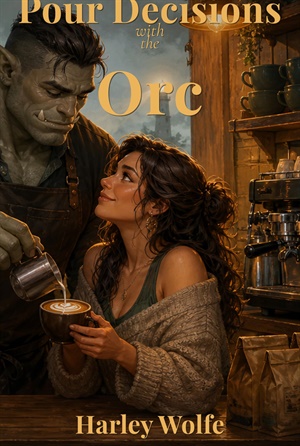
Pour Decisions with the Orc
Chapter 1
Maggie
The fog over the highway is thinning out, and inland the redwoods are going copper at the tips.
I haven’t been north of San Rafael in nine years, and I’d forgotten how loud it gets up here, the busy unbothered loud of a place that’s going on with or without me.
My hand goes to my fleece pocket, a habit I picked up behind a counter and packed without meaning to.
The pocket has nothing to show for itself but a binder clip, half a pencil, and a cinnamon receipt from somewhere I have no memory of being. I put them back. They’ll keep.
My phone lights up on the bench. It’s Gi.
“Hi,” I say.
“Where are you?”
“A rest stop, about forty minutes out. There’s a bench. It’s very scenic. A seagull has been staring at my coffee like it’s about to leave a one-star review.”
“It should,” she says. “Mom called me.”
“Of course she did. What’s the verdict from Sacramento?”
“She wants me to tell you she’s being very supportive.”
“God, the restraint that must be costing her. Tell her I felt it from here.”
“She also wants you to know she read the article again.”
I set the cup down on the bench. “Wonderful,” I say. “She’s getting her money’s worth out of that one. It’s twelve hundred words, Gi. People don’t reread their own wedding vows that many times, and those at least came with cake.”
“She says she’s concerned about your energy.”
“She used the word energy.”
“Her word. I want that on the record.”
“It’s on the record.”
“Mags.” Gianna stops, and the keyboard tapping behind her stops too, which is how I know the real thing is coming. “She said the whole phrase. She said you were redirecting your energy toward a more aligned vision. And she said it like she thought she was being nice.”
I don’t say anything for a second, and the second goes long. That’s my sentence. I wrote that sentence, for a candle company, for an obscene retainer, and now my mother keeps it in a drawer to take out on special occasions.
“Mags.”
“I heard you, Gi. I’m just enjoying the fact that I once charged a wellness client four hundred dollars an hour to be told I was redirecting my energy, and now I get it for free from a woman who still owns a fax machine.”
“I told her not to say it. I told her if she said it I was driving up there.”
“Please don’t drive up here.”
“I won’t.” She lets out a slow breath, the one she does when she’s deciding to let me have my way. “Are you going to be all right?”
“I’m going to be fine,” I say. “I have a plan, it has steps, and you don’t get to hear them because you’ll quote them back to me at Thanksgiving.”
“You really do have a plan with steps.”
“I’m a professional. Past tense, ask the article. I have to go.”
“Call me when you’ve looked at the place?”
“I’ll call you tonight,” I say, and I mean it, which surprises us both a little.
I hang up. The chipped silver ring on my middle finger has gone warm under my thumb, where I’ve been worrying at it for the whole call.
I carry the cup back to the rental in one hand and the phone in the other, and the air off the lot smells like salt and like a woodstove going somewhere up a hill I can’t see.
The cup goes in the cupholder where it can think about what it’s done, and I pull back onto Highway 1 north.
The Corolla rattles like a car that has been to a great many Hertz counters and back.
It has firm opinions about sitting at 63 instead of 65, and this morning, of all mornings, I’m willing to let something win an argument with me as long as it isn’t my mother.
The binder slides toward me on the left curves and back on the right ones.
Forty minutes, I tell it. That’s all you are.
The harbor comes up all at once over a rise, slate-colored water and three boats out at the far dock, and the road tips down into a town that has more shadow in it than the Wikipedia photo let on, because that photo was taken in summer and this is the middle of October.
Halfway down the right side of Main there’s a man in a reflective vest with a clipboard in one hand and a coffee in the other, and behind him a flatbed truck is angled to the curb while two men walk sheets of plywood off the bed and prop them against a storefront.
The plywood is painted a green and white I recognize in my body before my brain catches up, a very specific forest-adjacent green that I once stood in a conference room and helped a client decide was the color of authenticity.
There’s a logo in the corner of each sheet I can’t read at thirty miles an hour.
Some chain is putting a new face on an old building, and the part of me that files brand palettes like other people file grudges leans in to look.
That’s the part of me I drove a hundred and seventy-five miles to quiet.
I tell it to sit. I look back at the road.
I coast the last block into the gravel lot of the Sea Wisp Inn, leave the cold cup where it sits, and tuck the binder under my arm.
Then, instead of going in, I do the thing I promised a committee in February I’d do, and I walk the length of Main Street.
It turns out to be two and a half low blocks with the harbor at one end and a hill of houses at the other.
There’s a florist with galvanized buckets of dahlias out front, and a diner with a sandwich board offering TWO EGGS ANY WAY $3.
95, and a bookstore whose chalkboard reads WHALES MENTIONED INSIDE in the handwriting of someone who has never once worried about their handwriting in their life.
The first coffee shop on my list sits closest to the harbor, all industrial fixtures and a QR code in the window.
Great brand, no friends, says the file label, arriving before I can stop it.
The second turns out to be a kiosk wedged inside a hardware store, which my research had somehow neglected to mention, and which I would have charged a client extra to call a flagship.
The third one sits straight across the street from the flatbed and all that green and white plywood, and the third one is the shop I’ve been refusing to mention, even to myself.
Its sign is gold-leaf serif on a forest-green board, FINLEY’S, and underneath in smaller letters, EST. 1889.
Out front on an easel there’s a chalkboard lettered in tall block capitals by someone who plainly does not care that the letters ran too big for the board: TODAY: VANILLA CARDAMOM.
DECAF AVAILABLE. Taped to the inside of the lower right windowpane, the tape gone yellow at the edges, is a smaller piece of cardstock in that same unhurried block hand.
HELP WANTED. SEE INSIDE. I read it once.
Then I read it again. Not for me, I tell myself.
I’m only here to look. I keep walking, and I make it four whole steps before I turn around, because the case study can survive a flat white, and so can I.
The bell over the door is a small brass thing tuned a hair under the note it was meant for, and it rings once and clean when I push in.
The latch gives under the heel of my hand with a satisfying little click.
On the other side of the door the air is warm milk and fresh grind and a spice my Nonna used in a cake she made exactly twice a year.
Cardamom. I have the word in my mouth a full second before I have it in my head.
There’s a counter on the right with a chrome espresso machine planted in the middle of it, big and quiet as a small engine block, and two shelves of mugs in mismatched glazes, and a framed photograph angled wrong from where I’m standing to make out who’s in it.
Four little two-tops with chairs that don’t match each other. A window bar with three stools.
Behind the counter, at the machine, there’s a man who is easily the tallest person I’ve stood in a room with in a very long time.
His skin is gray, the slate gray of stone after rain, gone deeper at the knuckles of the hand resting on the portafilter.
He’s got short dark hair and a heavy brown canvas apron with a brass buckle and the modest tusks of an orc, his upper lip resting against them without comment.
He’s doing something at the machine that is pointedly not looking at me.
Off at the far corner two-top, as far from the door as a person can get, there’s a second orc, older, in a flannel that’s been worn soft by someone who understands flannel, with a black coffee in a thick green mug and a newspaper folded beside it.
He glances up when the bell rings and then goes back to his paper.
The espresso machine reaches the top of some cycle of its own and lets out a long pressurized exhale into the quiet, like it’s been holding that in.
“Good morning!” I say, the good morning coming out a touch too bright. “I’d love a flat white.”
He sets the portafilter down and turns, and the turn is one unhurried motion with his weight going evenly through both feet, quiet for something that big.
He has to be a foot and a half taller than I am.
I’m not a tall woman. The room rearranges itself around the size of him.
“Morning,” he says, in a deep register that promises me exactly nothing. “Whole milk or oat?”
“Oat, please.”