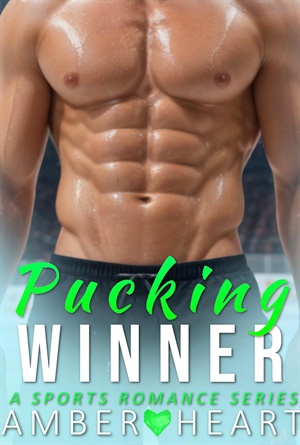
Pucking Winner (Secret Sports #11)
Chapter 1
Amara
The sound of a credit card being declined is a very specific frequency of humiliation. It’s quiet, almost imperceptible to the human ear—a soft, digital bip-bip from the terminal—but it vibrates through the skeleton like a jackhammer hitting concrete.
I stood in the center of Le Blanc, the only boutique in Blackwood, Vermont, that carried anything worth wearing, and stared at the little black machine as if it were a bomb that had just failed to detonate. Or maybe, one that had just gone off.
“I’m sorry, Miss Vane,” the sales associate said. Her voice was syrupy, laced with that fake, customer-service pity that made my skin itch. Her name tag said Jessica, and her eyes were darting to the line of people forming behind me. “It says ‘Issuer Rejected.’ Do you have another card?”
I didn’t blink. I couldn’t. If I blinked, the perfectly constructed porcelain mask I’d been wearing since I was sixteen years old might crack, and if it cracked, I would shatter right here on the polished marble floor.
“Try it again,” I said. My voice was steady.
Bored, even. That was the trick. You had to look like the inconvenience was yours, not theirs.
You had to look like a princess who was annoyed that the peasants’ technology was failing to keep up with her lifestyle.
“It’s a Black Card, Jessica. It doesn’t get declined.
It has a limit higher than the GDP of this town. ”
Jessica’s smile faltered, the corners twitching. “I understand, but—”
“Just. Swipe. It. Again.”
She sighed, a tiny huff of air through her nose, and slid the heavy metal card through the reader one more time.
Processing…
Processing…
Declined.
The red letters on the screen burned into my retinas.
My stomach dropped, a sickening freefall sensation that had nothing to do with gravity and everything to do with the text message currently vibrating in my clutch. I hadn’t looked at it yet. I knew who it was from. The specific buzzing pattern—two short, one long—was set exclusively for my father.
I snatched the card from her hand, my fingernails—painted a violent, glossy oxblood—clicking against the plastic.
“Fine,” I snapped, tossing my hair over my shoulder.
The platinum strands were perfectly waved, an armor of silk and chemicals.
“The chip is probably faulty. I’ll just have my assistant call the bank and have them fire whoever handles my account.
Keep the dress on hold. If you sell it to anyone else, I’ll have my father buy this building and turn it into a parking lot. ”
I didn’t wait for her response. I spun on the heel of my Louboutin boots and marched toward the glass doors, my heart hammering against my ribs like a trapped bird.
I pushed out into the biting cold of the Vermont afternoon, the wind instantly slapping my cheeks pink. It was snowing again. It was always snowing in Blackwood. The sky was a bruised shade of purple-grey, heavy and low, promising a storm that would bury us all.
I huddled into my white shearling coat, pulling the collar up to my ears, and finally, with trembling fingers, pulled my phone out.
From: Father
To: Amara
Time: 4:12 PM
The accounts are frozen. The cards are cancelled.
I warned you last semester, Amara. If you aren’t going to take your degree seriously, I’m not going to fund your little four-year vacation.
Design is a hobby, not a career. Come home, marry the Waldorf boy, and act like an adult. Until then, you’re on your own.
I stared at the screen until the snowflakes melting on the glass blurred the words.
On your own.
The air in my lungs turned to ice. It wasn’t just the money.
It was never just the money. It was the leash.
My father didn’t know how to love; he only knew how to own.
And when his property malfunctioned—when I refused to switch my major to Business, when I refused to be the silent, smiling trophy he wanted to auction off to the highest bidder in his social circle—he simply cut off the resources.
I checked my bank app.
Checking: $42.18.
Savings: $0.00.
Panic, hot and acidic, clawed at the back of my throat. My rent at the off-campus townhouse was due in two days. My meal plan was linked to my father’s account. My car lease was in his name.
I was twenty-one years old, dressed in three thousand dollars' worth of wool and leather, and I was destitute.
“Okay,” I whispered to the empty street, my breath pluming in a white cloud. “Okay, don’t panic. Fix it. You’re a Vane. We don’t panic; we strategize.”
I couldn't call my friends. Jules would offer me her couch, but Jules was on a scholarship. She ate ramen because she had to, not because it was ironic. If I told her I’d been cut off, the pity in her eyes would kill me faster than the hypothermia.
I couldn’t be the charity case. I was the Queen Bee.
I was the one who bought the rounds of drinks, the one who booked the tables.
Without that, who was I? Just a girl with a mean streak and a sketchbook full of dresses no one wanted to wear.
Leo.
My brother.
Leo Vane, the Golden God of Blackwood University hockey.
The only person my father actually respected, largely because Leo could stop a ninety-mile-per-hour puck with his body.
Leo would help me. He wouldn’t ask questions.
He’d just grunt, toss me a credit card, and tell me to stop crying because it was "annoying. "
But Leo was in North Dakota for an away game exhibition. He wouldn’t be back for three days.
I chewed on my lower lip, tasting iron. I couldn't stay at my place; the landlord was already texting me about the rent check. I needed somewhere to hide. Somewhere safe. Somewhere expensive enough that I wouldn't feel like my world was collapsing.
Leo’s new apartment.
He had just moved into The Sterling Heights, the ridiculously opulent glass tower overlooking the campus. He’d given me the keypad code weeks ago in case of emergencies, though he’d followed it up with, “Don’t use it unless someone is dying or you’re bringing me food.”
This counted as dying. My social standing was dying. My ego was dying.
I hailed a cab—my last forty dollars—and gave the driver the address.
By the time the taxi pulled up to the curb, the snow had turned into a full-blown blizzard. The wind howled through the streets, rattling the streetlamps. I tipped the driver my last two dollars, dragged my oversized Louis Vuitton tote bag out of the backseat, and ran for the lobby.
The doorman wasn't there. Weird. But the inner door was unlocked, so I slipped inside, shivering so hard my teeth clattered together.
The lobby of The Sterling Heights smelled like old money—sandalwood, polished teak, and silence. I bypassed the front desk, keeping my head down, and hurried to the elevator. I pressed the button for the Penthouse floor.
Leo had said he was on the top floor. “Only the best for the goalie who saves this school’s ass every weekend,” he’d bragged.
The elevator ride was smooth and silent, lifting me away from my problems on the ground floor.
I leaned my forehead against the cool mirrored wall, closing my eyes.
I just needed a hot shower, a bottle of Leo’s expensive whiskey, and three days to figure out how to sell my shoe collection on the black market without anyone finding out.
Ping.
The doors slid open.
There was no hallway. The elevator opened directly into a foyer.
It was dark. The only light came from the floor-to-ceiling windows on the far side of the massive living space, framing the swirling white chaos of the blizzard outside. The apartment was freezing—colder than the lobby. It felt sterile, like a museum or an operating theater.
“Leo?” I called out, stepping off the elevator. My heels clicked loudly on the black slate floor.
Silence.
“Leo, seriously, turn the heat on. It feels like a morgue in here.”
I dropped my bag near a sleek, black leather sofa that looked like it had never been sat on. I wandered further in, hugging my coat tighter around me. The place was immaculate. No hockey gear lying around. No pizza boxes. No half-empty Gatorade bottles.
Wait.
Leo was a slob. Leo lived in a perpetual state of organized filth. This place… this place was terrified of dust.
A prickle of unease slid down my spine. I stopped in the middle of the living room, looking around. The furniture was sharp, angular, modern. Chrome and black leather. There wasn’t a single personal item. No photos. No trophies.
Just a massive, sprawling silence.
And then, a sound.
Heavy, rhythmic footsteps coming from the hallway to my right.
“Leo?” I turned, a relief washing over me. “Thank God. I thought I broke into the wrong—”
The figure stepped out of the shadows, and the name died in my throat.
It wasn't Leo.
The man standing there was taller than Leo.
Broader. Where my brother was wiry tension and kinetic energy, this man was a fortress.
He was shirtless, wearing only a pair of grey sweatpants that hung low on his hips, the drawstrings dangling loose.
His torso was a landscape of hard, shifting muscle, corded and defined, dusted with dark hair that trailed down beneath the waistband.
He was drying his hair with a black towel, the motion slow, methodical.
He lowered the towel.
Ice-blue eyes locked onto mine. They were cold, intelligent, and devoid of any warmth. They were eyes that didn't just look at you; they dissected you to find the weak points.
Ezra Sterling.
The Captain. The Center. The heir to the Sterling empire.
And my brother’s arch-nemesis.
My heart didn't just stop; it plummeted through the floor and shattered in the lobby below.
Ezra didn't flinch. He didn't jump. He didn't look surprised to find a strange woman standing in his living room in the middle of a blizzard. He just stood there, motionless, radiating a terrifying kind of calm.
“You,” I breathed, the word coming out as a horrified whisper.