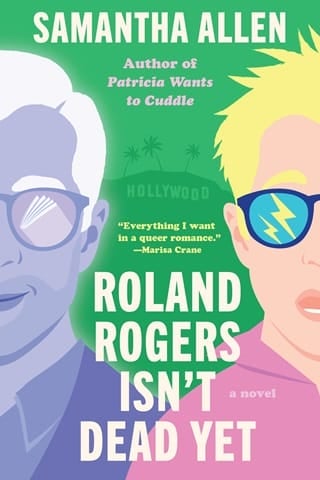
Roland Rogers Isn’t Dead Yet
Adam
ADAM
I ’ve knocked on a thousand doors before, but this one is different. This one belongs to the most famous man in America: Roland Rogers, an actor worth half a billion dollars, star of the biggest franchise of the last decade, and owner of Malibu’s biggest eyesore, a jutting trapezoid of glass and concrete clinging to the cliffside. The house is an affront to God—or at least to his insurance company.
“You know whose place this is, right?” my Uber driver asks, shooting me a sideways look as he removes my roller bag from the trunk and extends the handle.
I asked him to park on the shoulder of the coastal road, just shy of the gatehouse, certain that Roland’s security won’t want to admit anyone besides me. Even then, I’m half expecting to be turned away. Surely my name isn’t written on the clipboard. I don’t belong in a place like this. An A-lister summoning a decidedly midlist writer to his mansion out of the blue? Maybe my agent fell prey to an online scam and I’m about to suffer the worst humiliation of an already humbling life. Still, I try to muster confidence.
“Yeah, it’s Roland’s house,” I tell the driver, stupidly pretending to be on a first-name basis, trying to convince him I have legitimate business here. “He’s expecting me.”
“Sure, man,” he smirks, looking me up and down. I follow his gaze to my ratty clothes: a lint-ridden peacoat I still haven’t taken off from the plane ride, the undone buttons revealing a ratty band T-shirt clinging to my belly. I don’t look like someone Roland Rogers would be expecting, more like a celebrity stalker who’s about to get tased.
“Thanks for the ride,” I say, even though I thanked him earlier, nudging him to leave already. Instead, he stands there, seemingly waiting for me to come to my senses and get back in the car.
I take another stab: “I, uh, tipped on the app.”
He sighs. “Good luck, dude. Hope I don’t see your face on TMZ later.”
And then finally, he’s shutting his trunk and peeling away from the gate, leaving me standing there in the oppressive sunshine. The February I left behind in New Jersey is a lot colder than winter in California.
I remember the last time I was sweating through my shirt in a stranger’s driveway. The mission president in Las Vegas had a rule that we couldn’t remove our suit jackets unless the thermometer cracked ninety-five, and my stickler of a companion insisted we abide by it, even on my final sweltering day in the field.
That was almost twenty years ago now, but still, the old script runs through my head as I walk toward the gatehouse: “Hi, my name is Elder Gallagher, and this is Elder So-And-So. We’re missionaries for the Church of Jesus Christ of Latter-day Saints.” Mostly, people closed the door in our faces. That is, if they even opened it in the first place. Nevadans paid too much for air-conditioning to let any more desert seep inside.
Roland’s security detail is probably going to give me the same treatment. At least back then I looked respectable, with a military-grade haircut and shoes polished to a blinding glare. I was thirty pounds lighter from all the walking, even though every step felt weighed down by the secret I was carrying. It wasn’t the easiest time to be a closeted gay Mormon in 2004, not that there’s ever been one.
My anxiety gives way to confusion when I find the gatehouse vacant. Through the small sliding window that opens into the driveway, I spot a stool, a row of blank monitors, and an empty water cooler. What did my instructions from Paul say again? I fish around in my messenger bag, pull out my phone, and check the email. At the bottom, there’s a note I must have missed amid the bustle of last-minute packing: “Roland will meet you at the gate.”
That surprises me. Roland Rogers is hardly ever photographed in public. There aren’t any candid shots of him surfing or grabbing matcha or strolling the Santa Monica Pier. The paparazzi must hate him for being so reclusive. But he can afford to be. There are so few movie stars in the classic sense anymore. The actors I grew up watching are all doing Hello Fresh ads on podcasts, endlessly interviewing each other about films and TV shows they starred in a generation ago; Roland Rogers, on the other hand, is still a name that means something. He’s the last gasp of glamorous old Hollywood, which only makes it more disappointing that he has spent his peak years on the Crash Street movies, mindless action spectacles that risk erasing what he used to be: a damn good actor. Are all those extra zeroes really worth his integrity, I wonder? Does the money make the embarrassment of playing Crag Dynamite disappear? I guess those are the sorts of questions only someone with my bank account balance would ask. Men with Roland’s resources don’t need to bother with silly things like introspection anymore. And they certainly don’t greet their guests at the street.
To be sure, I glance over at the wrought-iron barrier, and there’s no one standing on the other side. To the left of the gate, though, I notice a speaker built into the post, and a small call button. Perhaps I need to summon him—or someone? A butler? Do the ultrarich even call them “butlers” anymore, or do they just have a Pokémon-esque collection of “personal assistants” running their households? Slipping my jacket off my shoulders and draping it over my arm only makes me clammier; in this heat, even minor exertion is taxing. But if I’m going to be stranded out here while my host luxuriates in his palace, I need to be wearing less. I hit the call button and hear a brief burst of a digital tone come through the speaker. That did something, I hope.
While I wait for someone to answer, I look at this blight on the landscape looming over me. Roland Rogers bought this monstrosity after filming Crash Street 4 , per my perusal of Wikipedia, and he expanded the primary suite after Leonardo DiCaprio bought an even bigger house nearby, according to an Us Weekly article I read on the plane. I’m not sure what I can offer to someone who lives in his own hermit kingdom, removed from the world, and yet he expressly asked for me, or so I’m told. As excited as I am to revive my dead career, I’m mystified by the choice. Out of all the authors in the world, he picked a gay ex-Mormon who had fifteen minutes of fame over a decade ago, and who has been languishing in obscurity ever since.
I mash the button again. This time, a short burst of static follows the tone, but no voice.
“Hello?” I say. “This is Adam Gallagher, here for Roland Rogers.”
In no universe did I ever expect those words to be on my tongue. I should be back in my tiny studio apartment in Millburn, cleaning out my cat’s litter box, which, incidentally, has a more pleasing design than the architectural atrocity in front of me.
I hit the button again. More static. But still no answer, which does nothing to disabuse me of my theory that this is all an elaborate practical joke. But the driver is long gone, and my phone battery is on three percent from all my in-flight reading.
That’d barely give me enough juice to hail another Uber.
Or call my agent and yell at him.
Two days ago, when Paul asked me to meet him at a Manhattan steakhouse for dinner, I was immediately suspicious of his motives. I had been checking in with him about my latest manuscript for months, so why the sudden urgency? Then I saw the $150 Wagyu on the menu, and I was concerned for his sanity. The last thing my agent expensed for me was an iced mocha.
The only explanation I could come up with was that he had finally mustered the courage to drop me as a client. He wanted to treat me to a farewell dinner at Delmonico’s, as if some nice port could help me stomach the news that my career, if you could call it that, had come to an end.
“This is nice,” I told him as we settled in, surveying our dimly lit surroundings, the candles casting warm splotches of yellow light onto preternaturally white tablecloths, the warm smell of varnished wood permeating the air. Usually, I would have hated being packed in among the dead-eyed finance guys, but their chattering provided a welcome distraction from an otherwise uneasy meal.
“Only the best for you!” Paul beamed, always managing to sound like he had just downed a shot of espresso twenty minutes before, no matter what time of day it was. Agents are made from different stuff than authors and thank Christ for that. The thought of sending a work email fills me with existential dread; Paul probably fired off a couple under the table while I consulted the entrée options.
I hadn’t seen very much of Paul and his permanent smile in the year before that dinner. There were obvious indications that I was sliding closer to the bottom of his list: his email replies had grown fewer and further between, his enthusiasm was more forced than usual. The last thing he said about the novel I sent him—“Are you sure you don’t want to do another memoir, Adam?”—was so deflating I wanted to quit on the spot. Hadn’t I spent enough time mining my trauma for Obama liberals? How many new angles could I possibly find on the same sad story? It was an excommunication, not the fucking Zapruder film.
To be honest, though, I understood why I fell out of Paul’s favor. I hadn’t earned out the advance for any of my books except Salt Lake City Sodomite , of course, and my latest didn’t even make it to paperback. The Lambda Literary Award nomination for Sodomite all the way back in 2010 was my crowning achievement, the quick follow-up I published two years later landing with a thud. It didn’t take long for the money from my debut to run out, forcing me to resort to an array of odd jobs—freelance copyediting, SAT tutoring, admissions-essay editing—to pay the bills. I barely managed to make the rent on my last apartment, even with my ex-boyfriend’s help. Paul went on to find flashier authors, the kind who get picked for Reese’s Book Club, who earned him kitchen-remodeling money instead of spare change. He kept selling my nonfiction books, mostly to microscopic indie presses for commissions that weren’t even worth his time. I couldn’t expect to be his charity case forever.
“I thought you and Jess were vegetarians now,” I told Paul, setting down my menu, my mind already made up. I had briefly considered the chicken, but if the agency was going to pay, I wanted the filet—on principle more than anything else. A last supper called for red meat.
“Oh, Jess stuck with it, but I gave that up during the pandemic,” Paul said, still grinning. “I know it’s better for me and the planet to eat like a rabbit, but by 2021, I was gagging at the sight of a portobello steak. Besides, tonight is an occasion .”
“It is?”
Instead of answering, Paul looked down at the wine menu. “How do we feel about the Bordeaux?”
I had noticed that one: it clocked in at $125 per bottle. I’ll say this about Mormonism’s ban on alcohol consumption: it certainly saves you money. But Paul was apparently more than willing to charge it, and that finally sent me over the edge.
“OK, Paul, what’s happening here?” I asked him. “Is this a goodbye dinner? Are you dropping me? Because if you are, I can take it, and we can just enjoy this meal together, but have the decency to tell me first.”
“ Dropping you?” he balked.
And then he laughed, only stopping when an aproned waiter appeared to take our drink orders. Paul went ahead and ordered the Bordeaux—the whole bottle—with the casualness of asking for ice water. The waiter vanished with a nod, treating us like visiting dignitaries, leaving me to wonder what motivation Paul could possibly have for taking me here. Even after we did The View for Sodomite , the most Paul ever splurged on was brunch at Sarabeth’s, although to be fair, he was a brand-new agent back then, stumbling onto his first bestseller almost by accident, signing me off a blind submission. That’s probably why he stuck with me all those years: he went on to bigger successes, but I was his first. Or was it something less than loyalty? Was it just pity?
“You’re spending about as much money on me tonight as I’ve earned in royalties in the last five years, so yeah,” I told Paul, lowering my voice to a whisper so none of the Wall Street types could hear me admit how poor I was. “Have you suffered a head injury or something? Do you have me confused with another client?”
At that, Paul leaned over the table conspiratorially, like he was about to let me in on the joke. But instead, he asked a seemingly irrelevant question. “Adam, do you know who Roland Rogers is?”
He might as well have asked me if I knew who the Pope was. Between billboards, Instagram posts, and Crash Street T-shirts on passersby, I had probably seen Roland Rogers’s face five times on the train ride into the city that afternoon. When I was growing up, he was in many of my favorite movies: rom-coms, legal thrillers, crime dramas. He could make almost anything watchable: even if a script was mediocre, or the direction subpar, he lifted the material through the sheer force of his presence. I couldn’t say whether his powers elevated the Crash franchise; I’d tried to ignore its existence as much as possible.
“Of course I know who Roland Rogers is,” I told Paul. “I don’t watch the Crash Street movies but I’m ex-Mormon, not Amish. Why? What’s going on?”
My agent leaned back, relishing my bewilderment.
“Paul, out with it,” I demanded, and finally he relented.
“Adam, Roland Rogers wants you to write his memoir.”
Suddenly, there was a splash of Bordeaux being poured in front of me, but I couldn’t hear the sound of the wine hitting the bottom of the glass. The waiter was hovering over me, prompting me to taste the sample, but I could only divine that from his body language, because the words coming out of his mouth were gobbledygook. If I heard right, Paul just told me one of the biggest stars on the planet wanted me, Adam Gallagher, to be his ghostwriter.
“Paul, seriously? Be real.”
Like any author, I had always wondered who really wrote celebrity memoirs. From what I understood, there was a whisper network of names the upper crust liked to draw from, the same way they all relied on a handful of discreet plastic surgeons. Roland Rogers wouldn’t pluck someone out of nowhere, would he? He’d want someone proven. Why me?
“Can you taste the wine already?” Paul prompted me.
I glanced up to find the waiter eyeing me expectantly. “Oh, right. Sorry.”
I hoisted the glass to my lips and quickly swallowed without tasting, setting it back down and vaguely gesturing at it. “Great, thanks,” I muttered.
Then my glass was being filled and Paul was still grinning, absolutely living for every moment of this torment. The waiter poured him a taste, too, and Paul, infuriatingly, took his sweet time approving it, swirling his glass, and making some asinine comment about how it was “tannic but not too tannic.” I wanted to murder him. He knew exactly what he was doing. He probably timed this whole schtick out.
But finally, when we were alone again, Paul set his wine to the side, placing his elbows on the table, his smile uncharacteristically absent.
“Adam, what I’m about to tell you has to stay between us. I got an email from Roland’s talent agent. I thought it must have been spam at first. But Roland apparently read—and loved — Salt Lake City Sodomite back in the day. And he wants you to write his book because”—Paul stopped to look side to side, ensuring no one nearby was eavesdropping, and then continued, even quieter—“because he’s gay. He’s ready to come out and he wants your help to do it.”
I had never guessed it myself, but Roland Rogers’s being gay immediately made sense the second Paul said it out loud. In my grand horseshoe theory of human sexuality, anyone that masculine immediately comes under suspicion. In the pre-creatine days, back when he had his first film roles, he was more baby-faced, but lately, he looked carved from stone, abs multiplying impossibly with each new Crash poster. He also dated that supermodel half his age—the one with no last name. Zoya. More shocking than his sexuality was the news that he read my book. I wish he would have tried to hire me back then; an extra infusion of cash in 2010 would have saved me years of toiling, watching my money drain and my dignity dwindle.
Paul watched me with those rakish eyes of his as I took a slow sip, finally allowing myself to truly taste the Bordeaux. Fuck if I knew what “tannic” meant, but it was as good as anything I’d ever had. Maybe it’s because I started drinking late in life, but every wine I tried after leaving the Church just tasted like Welch’s grape juice to me.
“You’re not surprised?” he whispered. “I was stunned.”
I tried to explain it to him as euphemistically as possible in case anyone could overhear. “I mean, it makes sense that Mr. Rogers would be … a friend of Dorothy. All those macho action movies? And his little girlfriend, too?”
“Do you think she was his mustache?” Paul said, a little too loudly, catching himself.
Even during Sodomite , Paul never bothered to learn much about gay culture.
“His beard, you mean,” I corrected him.
“Right. Sorry.”
Paul wanted me to echo his shock, but my mind was stuck on the money. The Delmonico’s invite was no longer a mystery. One of my agent’s least lucrative clients had become a potential cash fountain. I was the shiny object again. The figure had to be mind-blowing.
“Paul, how much?” I asked him.
“Well, if you want to do it, I think I can get his people up to … two hundred and fifty?”
“Two hundred and fifty thousand ?!”
Paul tried to shush me, but I couldn’t help myself.
In a flash, my life changed forever: I could buy my place instead of renting my way to an early grave. I could eat something other than frozen pizza for dinner. I could parlay the ghostwriting job into a career renaissance, writing books that actually attract the notice of reviewers. I could go back on tour again, soaking up all the petty little pleasures of a transient lifestyle: the travel-size soaps and lotions, the magic of walking into a hotel room and finding the sheets turned down. That’s the closest I’d ever gotten to feeling like a God, the universe bending to my whims. The very idea of $250,000 was almost unimaginable—more than all my book advances to date, combined .
“It’s a lot of money, Adam,” Paul said. “I’m thrilled for you, of course. For us. But the terms are a bit unusual.”
“How so?”
My fantasies came screeching to a halt. Of course there were strings attached. I set my Bordeaux down, sliding the glass away in protest. Paul could tell I was frustrated, but mercifully, he didn’t delay. He inhaled, and then launched into the spiel.
“They want an answer tomorrow. You won’t get paid anything upfront. You’d have to fly out to his home in Malibu immediately and stay for the duration of writing. The nondisclosure portion of the agreement, as you can imagine, is ironclad. They can basically execute you by firing squad if you tell anyone what you’re doing—”
Paul paused for breath. Out of nowhere, I remembered that Utah continued to allow death by firing squad after it was outlawed almost everywhere else—one of many weird facts I learned about the state growing up there.
“—and Roland wants the book done in a month. I tried to tell them that you can’t rush genius, blah blah blah, but his team was insistent on that point.”
“Is that all?”
“Not quite.”
So far, the deal wasn’t sounding that bad. A quarter-million dollars for a month’s worth of work in a Malibu mansion? Would I have to crunch? Sure. But I could do it. Back when I kept Salt Lake’s alt-weekly afloat basically by myself, I was churning out ten thousand words a week. And besides, how deep could Roland Rogers really be? Another closeted Hollywood hunk—how original.
“The really annoying thing, Adam,” Paul continued, “is that they want you to write the book on paper. You can’t bring your laptop with you and Roland doesn’t want you to record any of the interviews. Usually, these celebrity contracts have extensive privacy clauses, but this one is extreme.”
I was taken aback by this demand. “It’s not like I’m going to risk that much money by leaking anything. How am I supposed to write that much, that fast, manually ?”
The hand cramps alone would be hell, even if I used the last vestiges of shorthand still rattling around in my brain.
“They’re pretty strict on it,” Paul said, folding his napkin over his lap as our waiter returned with a basket of bread and butter.
I pondered being totally cut off from the world, with no one but an empty-headed celebrity to keep me company. What would we talk about when we weren’t working? Human growth hormone? Which of his cars was his favorite? The thought of that somehow sounded lonelier than being alone. I could write something soulless if I tried, but only as a well-paid mercenary, not as a memoirist.
“Doesn’t he have, like, hundreds of millions of dollars?” I asked Paul. “Can’t he buy me a burner laptop? They can disable the Wi-Fi if they want to.”
Paul shook his head.
“Believe me, I asked. They’re treating this like Fort Knox. Which checks out, I guess, if they’re trying to keep the whole”—Paul lowered his voice—“ gay thing under wraps until the book release.”
For someone less desperate, the conditions might be too extreme to accept. Then again, someone less desperate would have actual negotiating power. Paul was presenting the terms to me more like an executive fiat than an actual contract he could try to finesse. The only thing I could do was look for the logic behind the demands. If a tabloid somehow scooped the news, it could undercut book sales. And someone as image-obsessed as an actor probably wanted to control the narrative instead of letting the gossip rags run with it. He’d want a tight seal. It wouldn’t be fun, but it made sense.
I grabbed a piece of bread, and the stainless steel ramekin of butter, admiring the ripples in its whipped surface. Across the table, Paul measured my silence.
“So, what do you think, Adam?”
I considered how nice it would be to eat like this more often—slowly, luxuriously, not worrying about which credit card to put down on the table when the bill arrived—and then asked myself if I could really write a book in a month for an actor whose last decade of movies I’d mostly skipped.
The only Crash Street I had ever seen was the one Richie showed me, after persuading me it was worth it for the eye candy alone. It turned out to be so boring I fell asleep, despite the deafening volume. When I woke up midway through the third act, the heroes were launching a car out of a giant cannon onto the roof of the Pentagon. I asked Richie what was happening, and he said something like, “They’re breaking Anders out of General Firestorm’s secret military prison.” It sounded like the script was written by a twelve-year-old on a sugar high between rounds of laser tag. Still, we had a more pleasant night than usual, even if Richie ended up liking eye candy a bit too much. I saw the way Richie looked at Roland’s defined musculature, his hard jawline—the way my boyfriend melted at his easy smile—and wished he looked at me that way. Gay men with Roland’s physique haven’t made it easy out there for guys like me. The only thing I really had going for me was a full head of hair. That’d be enough if I were straight, given the quality level of heterosexual men, but in my world, it just made me a slightly more palatable ogre. Richie left a few months after that movie night—onto the thinner pastures he was grazing before he convinced himself to try a nerdy type for once. He took his sweet time figuring out what he really wanted. I guess I did, too.
But sitting there with Paul, pondering the prospect of $250,000, I couldn’t care less about having a boyfriend. I needed that money, not just to forestall my inevitable future as a middle-aged barista with student loans, but to finally get back in the game. The book wouldn’t be mine, technically. Writing it would be a rote exercise. None of that mattered, though, if the payout gave me the breathing room to produce something significant and get back in the Rolodexes of big publishers. If it worked, I could even taste that life of bourgeois affectation again, cramming my toiletry kit full of pilfered Molton Brown mini shampoos. Do they still make their black pepper collection, I wondered?
“I’ll do it,” I told Paul. “Just tell me where to sign.”
As I roast outside Roland Rogers’s gate, though, I don’t feel any closer to godhood. His team has my flight information; they know exactly when I’m supposed to arrive. And yet there’s still no response, even after pressing the intercom button three more times. I’m about to call Paul on my almost-dead phone, when finally, I hear a loud burst of static come through the intercom.
“Adam?”
The voice is a familiar one: mellifluous and smooth, with a touch of rasp. It’s the kind of voice that could sell cyanide. Cumulatively, I’ve probably heard it for hundreds of hours, listening to Roland’s characters profess their love, proclaim their courtroom objections, and cry over patients lost on the operating table. He lived all sorts of lives onscreen before his Crash Street era, starring in so many movies it’s impossible to imagine theaters even existing without him. On Fourth of July weekend, or Christmas Day, everybody went to see the “Roland Rogers movie.” No need to bother with titles when his name was on the poster. That all changed around the time I wrote Sodomite . He doubled his muscle mass to play Crag Dynamite while the smaller-scale fare I liked got exiled to arthouse cinemas. But no matter how jaded I’ve become with Hollywood’s recent output—and, I suppose, with most everything else—I’m still not immune to the charisma this man can pack into a simple word. There’s an undeniable thrill to hearing him address me.
“Roland?” I respond.
Momentarily starstruck though I am, I refuse to show him the deference of using his last name. He’s not a king. Still, he might expect some obsequiousness out of me. He’s a household name in a hundred countries, and I’m a rapidly aging author with no other prospects. I’ll try to carry myself with as much dignity as I can, hoping he doesn’t decide to test how badly I need this gig. There’s a whole decade’s worth of younger, buzzier, hotter authors he could replace me with in a heartbeat, so if he wants me to prostrate myself before him to get the payout, I might have to do it. I’ll tell him he’s brilliant and that his musings are deep, actually, and that there’s never been a book more important than this one. For now, though, he’s just going to be Roland.
The static returns but Roland’s voice crackles through it, growing fainter, as though he’s struggling to break through the noise. “Hello. Ad-am.”
The enunciation is strange. He sounds more like Keanu Reeves this time, pronouncing each word slowly and deliberately, as though he’s surprised to hear the English language coming out of his mouth.
“Can I please come in?” I ask him, masking my impatience. At this rate, I’m not going to get inside his house in the next month, let alone finish his book.
“Yes. Of. Course.” His voice gets louder again, and less fractured, as the static subsides. “I’m glad you’re here, Adam. Please. Come up.”
“Thanks.”
I wait for the gate to slide open, but nothing happens.
“Sorry,” Roland says. “Just a. Moment.”
Roland’s voice fades away, leaving me standing there, peering longingly through the gaps between the gate’s slats. A winding driveway leads through lush, almost overgrown landscaping up to the house. I wasn’t above looking at photos of the estate immediately after dinner with Paul; my childhood home could fit in Roland’s pool, and he has more bathrooms than I have fingers. I’d like to use one of them now.
But the gate remains motionless, and I can hear Roland muttering on the other end of the line, the unusual staccato rhythm returning: “Stupid. Thing. Sorry. Adam. Haven’t done this. Before.”
“You haven’t opened your gate before?” I ask, at the risk of sounding like I’m mocking him.
How pampered is this guy? Am I going to have to show him how to use his coffee maker, too? I wouldn’t be much help there. Another Mormon habit that stuck. The devil’s brew proved too bitter for a palate raised on 7UP.
“No. Not what I meant. Hang. On …”
Roland’s voice trails off again and I stand there, sweating through my socks. By the time I finally meet this guy, I’ll be a disgusting, sloppy mess. My first impression is going to be a damp one. But maybe he prefers it that way, forcing all his non-famous guests to show up bedraggled so that his immaculate visage awes them even more when they finally get to his door. Not that he needs the contrast to stick out. On the plane, I clicked through several of his photo shoots, including all three People ’s Sexiest Man Alive issues. By the last one, I have to admit I wasn’t doing it for research anymore. I’m not expecting him to be very smart, but Jesus Christ, is he gorgeous. Thank God he’s been in the closet all this time, because if he had been out for the last twenty years, he’d be the kind of gay guy who wouldn’t be caught dead standing next to a schlub like me. I’ll be lucky if he even invites me to the book launch.
“YES!” Roland exclaims at last, with frankly jarring enthusiasm, and then I hear the clacking of the gate as it slides open in its track.
This will be an interesting experience, to put it kindly, if my subject is this incompetent. But all Roland really has to do is talk, I remind myself, as I take loping strides up the driveway, rolling my luggage behind me, eager to empty my bladder somewhere besides his untrimmed bushes. At least he’ll be pleasant to look at, even if nothing he says is especially compelling. I’ve skimmed through the major magazine profiles and the features in the entertainment trades. Roland doesn’t give them much beyond a bog-standard “big break” narrative: He grew up in Georgia, moved to Los Angeles, and waited tables before landing a role on the TV hospital drama Life or Death . From there, it was a natural leap to the big screen. And now look at him! So handsome! So charming! The articles all devolve into celebrity worship by the end. There’s a reason his story plays well in the media: it’s the foundational myth of Hollywood, in so many bullet points.
Of course, he never told any journalist he was gay—as far as I know. But that stuff writes itself. We’ll follow the same convenient template as Sodomite did: the awkwardness of puberty, the shame of hiding, the liberation of the first encounter, blah blah blah. Coming-out memoirs are a dime a dozen by now; it’s cruel, almost, that I have to write another one to finally move past my own. With any luck, there will be an interesting twist I can throw in there to keep the work engaging. Maybe he’s got a secret boyfriend he hasn’t told anyone about. I wonder if Zoya knew. In any event, the public will gobble it up. If only they had the same appetite for life after coming out. But who wants to read about the pressure to keep your body fat percentage below twenty, or about feeling like you’re seventy years old at age thirty-nine? All that fluidity and freedom—that beautiful burst of energy—just gives way to cruel arithmetic in the end.
As I get farther from the street, the sounds of nature take over. I can hear birds chattering in the shrubbery lining the driveway, and the distant sound of waves crashing. However this goes, I’ll get to stay in one of the most luxurious homes in California rent-free, even if it looks like a single-story office park from the outside. Roland can cancel the contract, but he can’t retroactively lower the thread count of the sheets I’m going to sleep on tonight.
The end of the driveway funnels me onto a winding stone footpath that finally leads to the front door. Really, it’s just a panel in the glass with another call box beside it. The door is closed, and Roland is nowhere to be found.
On the other side of the glass, the place looks abandoned. No lights are on. A dead flower arrangement on the large marble entry table is surrounded by fallen petals. But above it hangs a stunningly large fire-red glass sculpture—a shockingly out-of-place décor moment, and quite an aggressive choice for a foyer. You might as well slap visitors with a wet towel as they enter.
Pressing the doorbell seems rude. Roland already knows I’m here. So instead, I knock. And the unforgiving feeling of knuckles on wood takes me back to another life. We’d like to share a brief message with you about the Restored Gospel. May we come in? How is it that bad memories can slice through time so easily while happiness evaporates the moment it’s experienced? The restless past is never content to stay put. The speaker in the call box crackles to life, rescuing me from the memories.
“Give me a second,” Roland says. “I can get this one open, too.”
It’s going to be a long month.