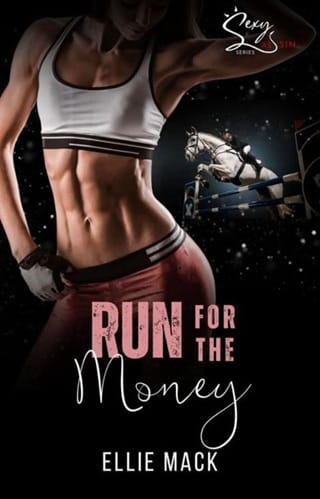
Run for the Money (Sexy as Sin)
1. Melanie
Chapter 1
Melanie
A bead of condensation rolls down the side of my plastic wine glass and onto my hand. I twist my wrist slightly so the water flows over my thumb and into my palm, rather than the back of my hand. Even one drop of water on the vintage silk dress I’m wearing tonight would be criminal negligence—at least according to my parents. The royal blue and ivory Gunne Sax gown was my mother’s prom dress. As beautiful and on-theme for tonight’s party as it is, I regret wearing it. Everywhere I turn, there’s a new threat to the integrity of the garment: finger foods, these cheap plastic wine glasses, tipsy old men who think their rump-grabbing attempts are subtle, and busy cater waiters.
One ruined dress pales in comparison to my other disgraces lately. If I return the dress with a greasy-fingered handprint on the hip or a water mark along the bodice, I doubt my parents’ disappointment will be any deeper than it already is. I’ve barely left the house over the past two months, too embarrassed by my recent failures to do much more than mope. Worst of all, I fumbled the biggest social achievement in Archer family history when Paul Walters left me last spring. According to my parents, I was supposed to become Mrs. Melanie Walters by the time I turned thirty to make up for my lack of a career. Two years shy of the deadline, I’m still Melanie Archer, and I’ve ruined all chances of reconciliation with Paul. It doesn’t matter to my parents that all of this has left me broken-hearted and confused; all they see is me falling short of their expectations.
“…such exciting use of color. Do you think your mother will want to feature her in a show?”
I tune back into Mirielle Cunningham’s monologue just in time to hear her question. She’s a friend of my mom’s and the chairperson for this gala. I was on the fence about coming tonight, then she called to invite me personally. So here I am. We’re in a downstairs gallery at the Museum of Contemporary Art in Denver, surrounded by multi-media sculptures by a new-to-me artist, Alice Jones-Tandy. Mom’s been talking about her work for months, but I’ve had trouble focusing lately. I don’t know anything about art, despite my parents’ best efforts. Growing up, all I cared about was horses. When that went catastrophically wrong, I threw all my attention at Paul, and now that Paul’s attention is fixed on someone else, I’ve found myself unmoored.
Quickly, I look around the exhibit so I can answer Mirielle. There certainly are a lot of colors; whether or not Jones-Tandy used them in an exciting way, I couldn’t say. But Mirielle is gazing at the bizarre statues with a look of wonder on her exquisitely maintained face.
If I were a bigger witch, I’d ask who does her Botox and filler. Her face still looks natural—fifteen years younger than she is, but all of her features still move around properly. Her eyes crinkle when she smiles and she can wink without it looking spooky. My mom’s eyebrows haven’t looked natural in ages because her forehead is so stiff. But if I say anything to Mirielle, she won’t realize I’m taking a dig at my mom, not her. All I would accomplish would be making a sweet woman feel bad about herself, which is the sort of behavior I’m trying to avoid lately.
“I think Mom’s been talking to her about it,” I say instead.
It’s a safe, neutral answer. Mom loves to scout artists from MCA, give them a show in her gallery, then pretend she discovered them. The museum tolerates it because of Dad’s lavish donations, but I see the way curators’ smiles tighten when they see my family. I notice how enthusiasm cools and the atmosphere changes when museum staff learn my name. The Archers fancy themselves the rulers of an art empire— fancy being the operative word. Though I suppose most empires are stolen, so perhaps it’s an empire after all.
“Wonderful! I think Alice could do something really impressive in the sculpture garden at your mom’s gallery,” Mirielle says. “I’ve heard rumors this exhibit is interactive.”
She gestures at the sculptures scattered throughout the massive gallery. To me, they all look immobile. I don’t see any signs from the museum about interacting with the art. Actually, I don’t see any signs at all.
“Interactive how?”
I take a closer look at the statue nearest us. It’s a woman—I think. A human figure, at any rate. The whole thing is made out of a violently orange substance—clay? Stone? I honestly can’t tell. The head is wrapped tightly in what looks like plastic wrap. Hands claw at the wrap, the grip eerily realistic. Near where the mouth ought to be, there’s a slight impression in the plastic wrap. I lean closer to see if that will give me any clues about what this thing is supposed to be or represent, then I swallow a scream. The plastic over the mouth is moving.
“Oh my God, Mirielle, it’s breathing ,” I say.
Mirielle leans in, too, then laughs, delighted.
“Oh, marvelous! Really marvelous! I wonder if they all breathe,” she says.
I see nothing marvelous about a statue that looks like it’s slowly suffocating. I’m uncomfortable, and ready to move to another gallery. Unfortunately, Jones-Tandy isn’t done messing with the people who dare consumer her art. Every brightly colored statue in the room rotates clockwise on its pedestal. The fire doors to the gallery slam shut, trapping the gala-goers who were unlucky enough to wander into the room.
“We are at capacity,” a smooth, robotic voice says.
It’s emanating from everywhere—from the statues, from the PA system, almost from the air itself. Mirielle is having the time of her life. She grips my free hand with both of hers and laughs like this is fun instead of extremely off-putting.
“The planet is at capacity,” the robot voice repeats.
“Oh boy,” I mutter.
I have a sinking feeling this is only the beginning of the nightmare. My chest already feels too tight, and it’s only been a few seconds. All around the room, people are reacting like Mirielle. We’re packed in here with at least two dozen other people, but no one seems as uncomfortable as I am. There’s a hum of excitement that only makes me feel worse. I scan the room for an exit—surely one has to be open, for fire safety?—and my eyes land on the last thing I need to see: Paul Walters and his new girlfriend, only a few yards away.
Since this is rapidly becoming the worst night of my year, she obviously looks gorgeous. Her sleek, brown hair is curled and cascading over her shoulders like a freaking shampoo commercial, while the glimmering silver dress she has on fits her so perfectly it must be made to measure. He looks even better. His tux is perfect—and perfectly filled out. His warm, hazel eyes are perfect. Even his stupid jawline is perfect. Perfectly, stupidly perfect. They’re smiling at each other, his arm around her waist and her eyes glued to his unfairly handsome face, totally oblivious to the rest of the room. I’m not sure they realize we’re locked in here with a dozen suffocating statues and a doomsday robot.
The lights shut off, and this time I don’t manage to swallow my scream. I’m not the only person startled, though. Gasps and yelps fill the room until they’re drowned out by pulsing electronic music. Red, green, and blue neon lights flash in the gallery, and then all four walls are flooded in bright white light, the shadows of the statues stark against the blank walls.
“Capacity, cap-cap-cap-capacity,” the robot voice stutters.
“Thrilling!” Mirielle whisper-shouts beside me.
Video projection clicks on. A bony, oddly muscular foot slides down each wall, larger than life. The camera pulls back until the whole person is in frame: a dancer clad in a stark white dress, twirling through what looks like a bombed-out tenement building. The music and the robot voice get louder and louder as the video plays. I’ve never wanted to leave a museum more.
I’m sure there’s a message here, some deep, powerful meaning that’s flying over my head. It’s probably brilliant, subversive, and revolutionary and all the other qualities people like Mirielle spout at art shows. But I don’t care. I can’t focus on a broader global truth when I’m locked in a room with my ex-boyfriend and the real love of his life, when up until six months ago, I thought the love of his life was me . While neither of them strikes me as the kind of person who would use this opportunity to publicly humiliate me, their presence is enough to wreck my composure. I can’t look at either of them without remembering how thoroughly I embarrassed myself in front of them this past summer.
In hindsight, it’s obvious where I went wrong. Grand gestures were never the way to Paul’s heart, so presenting myself to him on a literal bed of roses was a long shot. If he’d been the one to discover me, naked and lying in wait in a cabin on his brother’s property, his first move would probably have been handing me his jacket to cover up. Unfortunately for all parties involved, his new girlfriend was the person who found me.
She ran away without saying a single word, which for some reason felt worse than if she’d screamed. I’d never felt so invisible. Then I stepped outside the cabin and heard Paul shout at his brother about how it had been months since he’d loved me, and he was “deeply and irreversibly” in love with this new woman. That catapulted me from “invisible” to “atomized.” I tried to be the bigger person, to let Paul go gracefully instead of making a scene, but every second I spent in front of him on that mountain carved me into smaller and smaller pieces.
It’s been almost two months since the Naked Cabin Incident, and this is the first time I’ve seen Paul or the new woman since then. I can’t think of a worse scenario to run into them than this one. Trapped in an art gallery, surrounded by an overwhelming amount of lights, sound, and color, my hand still clutched between Mirielle’s, is the definition of a worst-case scenario. The petite brunette on Paul’s arm isn’t just my beautiful replacement— she also happens to work for Mirielle’s daughter. If Mirielle spots them, there’s no way I can avoid a conversation. I have nothing to say to them, only things to shout hysterically while flipping them off. Not the right vibe for the evening, even with the cacophony around us.
The statues rotate faster and faster in time with the music. I can only hope this crescendo means the artistic nightmare is about to be over. My eyes are on the doors, because the second they open I’m bolting. I might drag Mirielle with me, because her grip is so tight I’ve lost feeling in my hand, but so be it. I threw out the last of my dignity with the Naked Cabin Incident, so why not drag Mirielle Cunningham through a fundraising gala like a wild woman?
The video and music stop as suddenly as they began, and the regular lights come back on. There’s a metallic clunk and the doors swing wide. The flight instinct drains out of me, leaving behind the etiquette my parents have drilled into me since I was born twenty-eight years ago. I can’t run out of the room; that’s undignified. The polite thing to do is to make conversation with the other guests at the gala, regardless of my personal history with them.
“What an exhibit! Such a fresh take on the climate crisis. Oh, Paul Walters and Alicia Hanratty are here! Mel, honey, did you see?” Mirielle asks.
Only Mirielle Cunningham would string those sentences together so casually.
“I did see, yes, but there was rather a lot going on,” I hedge, unsure if she’s somehow forgotten Paul and I were together for four years.
“Paul, Alicia, hello!” Mirielle calls, waving at the couple.
She still has a hold of my hand, and the window for a graceful exit has passed. I toss back the last of my wine and brace myself for devastation because Paul and Alicia are headed directly for us. If they feel as uncomfortable as I do, though, they’re a lot better at hiding it.
“Evening, Mirielle. How are you?” Paul says with a warm smile.
Mirielle leans forward to kiss his cheek, and she finally releases my arm. She pulls Alicia into a motherly hug, and then it’s my turn to go through the gauntlet. Paul turns to me, and has the decency to look guilty. I wonder if he regrets the way our last conversation went, or if he’s merely embarrassed I overheard his outburst. He’s not usually big on outbursts. I certainly never inspired enough passion in him to raise his voice, even when we argued—yet another way I pale in comparison to the magnificent Alicia.
“Melanie, you look well,” he says gently .
What a sweet, affable liar.
“Good to see you. You, too, Alicia,” I say as calmly as I can, despite how badly I want to drop to the floor and scream.
Realization—quickly followed by panic—sweeps over Mirielle’s face at her faux-pas. I’m sorely tempted to address it. For a moment, it would be satisfying to say, Thank you so much for forcing me into a conversation with my ex and the woman he left me for! It’s the cherry on top of an unbearable twenty minutes! I hope you lose sleep over this for the next ten years . But the satisfaction would be fleeting, and the embarrassment would be eternal.
“I love your dress,” Alicia says through an overly cheerful smile that’s finally showing the cracks in her composure. “It’s ‘70s Gunne Sax, yeah?”
I nod. “It was my mother’s when she was younger.”
“Gorgeous,” Alicia says.
And then, all conversation grinds to a halt. No one wants to address the history between me, Paul, and Alicia, and apparently the awkwardness has eroded all ability to make small talk. Between the sensory overload of the art and the social distress, I’m too hot. If I don’t get out of this exhibit hall in the next five minutes, I’m going to sweat through all this vintage silk. Or puke. Maybe both.
“Excuse me,” I say. “It was lovely to see you all.”
I don’t wait for anyone to respond. It’s rude, but I don’t care. I need air. I head for the stairs to the rooftop bar, even though it’s cold out tonight. I’ll brave late October in Denver to escape this situation. Coming here was a mistake. I should have turned down Mirielle’s invitation and stayed home. It would have disappointed my mother, not to mention hurt Mirielle’s feelings, but I’ve managed to do both anyway.
I burst onto the roof and suck in a noisy lungful of air. My breath fogs slightly as I exhale, but it’s not cold enough out here to send me running inside. It’s dark and it’s deserted—exactly what I want. Grateful for the respite from the crowd downstairs, I head toward the edge of the roof to look out over the city.
Movement catches my eye, and I glance to the right to find a man already here—way too close to me. I can’t believe I didn’t see him when I charged over here, but now I’m directly in front of him. He’s facing the doors, his elbows propped on the railing and his legs extended slightly in front of his body, less than a foot away from my own feet. The way he’s got one ankle crossed over the other makes it clear he’s wearing cowboy boots under his tux pants—real ones, too. There’s dirt caked in the stitching. It’s not the strangest fashion choice I’ve seen tonight, but it’s up there. He’s probably looking for the same break from the event as me, so I offer a polite smile then side-step him to face the railing, giving him some semblance of privacy.
“You certainly took your goddamn time.”
My spine stiffens. There’s no one else out here, which means the stranger’s talking to me. Aggressively.
“That’s awfully rough language for this venue,” I scold, not loving how much I sound like my mother. But I’m not loving his demeanor, either.
“Well, pardon my fucking French, Miss Manners,” he says.
I squint at him through the darkness. I’m closer to the door than he is, so if I run for it, I could probably make it inside before him. We’re only one flight of stairs above the highest level of the gala festivities, so I could reach security quickly if necessary.
Then again, he’s got a significant height and weight advantage over me. Even leaning against the railing like he is, he’s a good six inches taller than me. The tux jacket he’s got on doesn’t disguise the breadth of his shoulders, either. If he lunges at me, I might not make it to the door ahead of him. I doubt anyone would hear me scream, either.
“Don’t even think about trying anything,” I say with the fiercest tone I can muster. “My boyfriend is meeting me up here in a minute.”
“You’re a terrible liar,” he says cooly. “But you can relax. I’m not going to jump you or shove you over the edge. And even if I were interested in what you’ve got under that skirt—which I’m not—I wouldn’t take anything you’re not offering.”
“Excuse me?” I splutter. “Who do you think you are, talking to me like that?”
He extends a hand to me. “Nicholas Korbel. You can call me Nick.”
“No thank you,” I say, ignoring the hand.
“ I’m Melanie Archer, pleased to meet you ,” he says in a falsetto voice, shaking his own hand. “ What brings you to this stuffy, unpleasant function, Nick? I can’t imagine what would be so important that you’d hang out for an hour in the cold waiting for me! ”
I take a step back. Him knowing my name does nothing to help me relax.
“Glad you asked, Melanie,” he says in his regular voice. “I’m here to meet you, because I think we could help each other out with a mutually beneficial situation.”
“Are you stalking me?” I whisper.
“Hardly. You are extremely easy to find on the internet. But since you’ve been ignoring all my attempts to contact you, I’ve had to resort to more extreme measures. A quick call to the foundation chair confirmed you were on the guest list for tonight, and here we are. Keep up, Melanie. You’re going to have to be quick on your feet if we’re going to pull this off.”
I don’t believe for a second that Mirielle—the foundation chair—is in on this, whatever it is. Despite her misstep with Paul, she’s not actually dead-set on distressing me.
“We’re not pulling anything off,” I say. “I’m leaving. Whatever you want from me, I’m afraid you’ll have to keep wanting.”
“I have an Arabian Thoroughbred, Grand Theft Equine. I call him GT for short. Eight years old. Stallion. Surprisingly even temperament.”
If I’d had a thousand guesses to figure out what he wants from me, sharing horse stats wouldn’t have made the list.
“Congratulations?” I say. “I don’t see what that has to do with me.”
“You’re going to compete him in the next Olympics.”
I laugh, and the high, clear sound is too loud on the near-deserted rooftop. It’s barely a laugh; the noise is closer to a hysterical scream. Now I know this is a prank. Nick glares at me, as though I’m the one behaving poorly.
“I’m not in the mood for jokes tonight,” I say once I manage to collect myself. “This conversation is already pushing the limit for me. Have a good night.”
I head for the door, because I don’t need to be involved in this man’s delusions.
“You’re telling me the three-time North American Junior Show Jumping Champion is afraid of a challenge?”
His words stop me in my tracks.
“Two-time,” I correct quietly.
“Would have been three-time if you’d completed your final run,” he rebuts.
“But I didn’t,” I say through gritted teeth.
There’s no need to clarify which competition he’s talking about. There was only one competition in my entire career when I didn’t finish the final run. After that, I stopped competing altogether. Nick obviously knows more about me than I know about him. He’s poking at a sore spot, trying to get a reaction out of me. I should know better than to give him one—especially when he’s making preposterous offers about the Olympics.
“If Diana Walters had completed both of her runs that day, she would have beaten me,” I add, unable to stop myself.
“How do you know?” he challenges.
It’s something I’ve thought about over and over again, for more than a decade, so my answer is ready to go the moment I turn to face him.
“I was sloppy that day. She was ahead of me in the qualifying round by two points. A clean run on the final course would have given her the title, easily, even if I’d been faster,” I say. “The turns were tighter than I was comfortable with, and my horse had been tired all week. The likelihood of us tapping a pole or getting a time penalty was huge. The only way I would have won was if—”
I stop short, guilt swallowing up my temper.
“If Diana fell off her horse?” Nick prompts.
I glare daggers at him and clamp my mouth shut. I knew better than to answer him the first time, but I did it anyway. It’s concerning how easily I walked into his trap. I won’t be doing it again.
“Diana Walters was a powerful rider,” he says, impervious to my glare. “She had speed and strength on her side, and the emotional momentum of a stellar qualifying round. But the final course didn’t play to her strengths. She always rode like she had nothing to lose, and more often than not, it cost her. You’ve always been the more calculating rider, better able to adjust to problems on the course.”
“You mean I’m a scheming…witch,” I snap, stumbling a little over the last word because it’s not the one I think a man like him would use.
“No. I mean you’re analytical in your approach to show jumping,” he says. His eyes hold mine a moment, a hint of humor glinting in them. “And I’d never call a woman a witch—or a bitch, for that matter. That sort of language is too rough for a place like this.”
He’s definitely trying to goad me into something—an argument? Cursing to prove I’m no better than him just because I don’t like to swear? It’s hard to say. There’s something odd about the way he’s watching me, like he’s hit a button and he’s waiting for a machine to roar to life. But I’m ready for the trap this time. The less I engage, the better.
“Whatever I am, I’m going home. Nice to meet you, Nicholas. Have a great evening,” I say coldly.
I turn to the door again, but he grabs my arm. My whole body goes stiff at the unexpected touch, and he lets go instantly.
“Here, take this,” he says.
I stay exactly as I am, facing the door. There’s a rustling beside me, and then he presses a crumpled business card against my palm. It must’ve been in his pants pocket rather than his wallet, because the corners are worn away. Printed on the front is his name and email address, and on the back is a physical address .
“That’s my ranch. You’re a good rider, and I don’t think you’ve approached the limits of what you can do. There are more trophies for you to win, if you’ll try.”
A chill totally unrelated to the weather rips up my spine. It’s not exactly glowing praise, but it’s not an insult, either. A quiet, often-ignored voice at the back of my head tells me to wait a moment, to hear this guy out. I’m torn between listening to the voice and squashing it down until it suffocates.
“I’ll see you in the stables tomorrow morning, Miss Manners,” Nick says. “Don’t keep me waiting. We’ve only got five qualifiers to make it to nationals, and if we miss nationals, we can kiss the next Olympics goodbye.”
He brushes past me to go back inside. I stand shivering on the rooftop for another five minutes, trying to get my bearings. I don’t know who Nicholas Korbel thinks he is, but he’s dead wrong about who I am and what I can do. The Olympics aren’t a real goal anymore, not for me. Those days are done. There’s not a snowball’s chance in hell that I’m going to his ranch tomorrow—or ever.