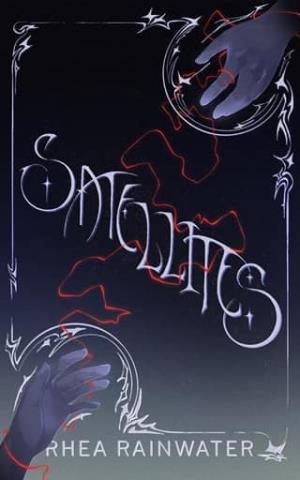
Satellites
Scraped Knees
Solace
Ididn’t know that my life would be weighed in near-misses. Linguistically, it barely made sense. How can you nearly miss something? The phrase has been used to describe dodged aircraft crashes, bombs that didn’t land, and accidents that never bore fruition.
That’s the thing about near-misses—they live in that sliver of space where collision introduces itself, only to diverge at the last second and find a different path. Leaving nothing but a small what if.
My life was full of them. What if I hadn’t left my window open that night? What if I had gotten the nerve to tell people how I felt? What if I hadn’t gotten so drunk? What if I’d gone to the music conservatory instead of the four-year college my mom insisted on? What if…
The first near-miss was small, barely a scrape on my knee, and yet it left a mark I still carry.
It was first grade, and I’d been shoved to the ground at recess, gravel biting through my pants, by a boy with a mop of sable curls and gray eyes. He reminded me of a wolf, with his straight nose, and the stern line of his mouth. I shouted at him, scrambling to my hands when we locked eyes.
Jude Ransom.
The boy who came crashing into my life, only to barely escape catastrophe.
His brows were furrowed, a hand half-raised as if he wasn’t sure whether to step closer or run away. “I didn’t mean to, Solace.”
Turns out, I hadn’t been paying attention, and was nearly nailed by a flying tetherball.
Which wasn’t all that surprising—I wasn’t the most attentive child.
Jude had shoved me out of the way, but did not intend to send me crashing to the asphalt.
He gave me his hand and helped me up, muttering another apology with a crooked smile.
Not all of them appeared that way though. Some near-misses didn’t break skin, they broke hearts, and those were the worst. There was nothing to bandage, and nowhere to place the blame.
The next came in third grade, under the wide arms of the oak behind the school. We’d been inventing kingdoms, arguing over who would rule, and laughing until our stomachs ached. Jude sat across from me, hands fidgeting with the hem of his shirt.
“Solace,” he said, hesitant. “Will you be my girlfriend?”
My stomach flipped, and I blinked, caught between disbelief and panic. At nine, the idea was absurd. Funny, even. His girlfriend? “No.”
He nodded, pressing a smile into his face that didn’t quite reach his eyes. When we were young, Jude was inquisitive and gentle. His heart was often louder than his voice. “Why not?” he asked, standing to brush the dirt from his knees.
“We aren’t old enough.” At least, that’s what my mother told me. No boyfriends until you’re thirty, Solace.
He reached a hand out, and I gripped it. “One day we will be though.”
Jude pulled me to my feet, and I brushed the dirt from my pants. “When we’re bigger, yeah.”
“I’ll ask you again.”
“Okay,” I replied with a shrug. And that was it. When you’re nine, boyfriends and girlfriends are just a pact made between friends.
We’d grown up in the same town and went to the same school and had the same friends, but our lives never quite collided the way I’d always thought our souls had.
If you’d asked Jude, he’d tell you it started in third grade when I told him I wouldn’t be his girlfriend.
It was that ‘no’ that set off all the others. All our near-misses.
From there, it turned into birthday party invites.
Co-partners on school science projects. Band concerts and basketball games.
Volunteer hours. Movies with friends. Yet, somehow, our lives never quite converged.
By ninth grade, it seemed as if we were destined for the friend zone regardless of how either of us may have felt.
It was early fall, we were assigned the same English class, and to both of our delight we’d been seated beside one another.
“Long time no see,” Jude said, bumping his shoulder lightly against mine. His hair had grown longer over the summer, curling enough to fall in front of his eyes. For once, he was taller than me, a fact he refused to point out, though I could tell he appeared smug about it.
I stole glances at him while digging my notebook out of my backpack. “Did you have a good summer?”
“Good enough.” He rubbed the back of his neck and smiled. “After space camp, we went on a cruise. What about you?”
I glanced down at my paper, the scribbles forming little spirals that didn’t mean anything.
I didn’t want to tell him my summer had been one long stretch of hospital appointments, waiting rooms, and whispered fears.
That my mom had cancer, and I hadn’t been allowed the things I wanted most—not the midnight premiere of the movie I’d planned for, not the lazy afternoons with friends.
And that for even considering my own disappointment I had deemed myself selfish.
Embarrassed.
“I… um, it was fine,” I replied with a forced smile.
He folded his arms. “Anything new?”
“Not really,” I lied. It wasn’t that I was ashamed, or worried about pity or anything like that. It was just that—I don’t know… I didn’t want to bother him. I didn’t like bothering anyone.
We started talking about the small things: books we’d read, movies we’d seen, the new cafeteria lunch menu. Stealing glances out of the corner of my eye, I couldn’t help but notice there was something different about him, and it wasn’t the two inches he’d grown over the summer.
“See you at lunch?” he asked as the bell rang.
“Yep.”
For three weeks, we sat together in the cafeteria, side by side. A couple of other friends joined sometimes, but mostly we sat alone, trading fries and whispered jokes.
“Are you thinking about going to the dance?”
I wasn’t, but Jude held an expression that made my stomach tighten. “I’m not sure yet.”
He chewed on his lip. “Yeah, same. Nobody has asked me.”
“And you can’t go unless someone asks you?” It was a stupid question. Of course he’d go. Unlike me, Jude’s friend group had only grown. He’d even tried out for the football team, and as much as I hated to admit it, our lunches were beginning to grow far and few between.
Scoffing, he plucked a french fry from my plate. “I’m going. I was only hoping someone would ask me.” His eyes narrowed slightly when our elbows touched. I adjusted my sleeve, careful not to look at him.
The event in question was a Sadie Hawkins dance, which meant that girls were supposed to ask boys.
I thought it was kind of dumb—I couldn’t yet drive, I wasn’t dating, and if I was being honest, I wasn’t really ready to.
The dance was all in good fun, but I was struggling to have fun at all these days.
Jude gave me a goofy smile, bumping his shoulder into mine in that way he always did. “You should ask someone.”
Like you? I almost joked, but then Matthew dropped his heavy backpack on the table, tipping Jude’s water bottle over, where it managed to spill across his science homework. All the churning thoughts of asking him to the dance melted with the puddle soaking my sleeve.
It shouldn’t have been such a big deal—we were best friends after all. Except that lately, I’d regarded him with a sense of foreignness. I couldn’t figure out why, but it didn’t keep me from tugging on that line of thought until it was all I could think about.
I should ask him to the dance. Why not? We’re best friends.
It didn’t take long until I decided I was going to suck it up and ask him.
From that moment, I counted the days, rehearsing the question in my head: Do you want to go to the dance with me? By Friday, I had my words perfectly lined up after having practiced them on my little brother, my dog, my bedroom door, and the cutout of Edward Cullen I kept in the corner.
My stomach was in a riot that morning as I walked into English class and took my seat.
The dance was next Friday, and even though my mom was set to have another surgery that morning, my dad made sure to fill in my grandparents and arrange a ride to and from the school.
My mom, even feeling sick, planned to drive me to the mall this weekend to buy a dress and my first pair of heels that weren’t solely for a piano recital.
Jude walked in and I thought I was going to puke. My palms were slick with sweat as he slid into the seat beside me. “Morning, Sol.”
This was the moment. I was going to ask.
I swallowed thickly. “Morning.”
“How’s it going?”
“Good.” I nodded—almost too enthusiastically. I opened my mouth to ask him next, to speak the words… and nothing. My mind blanked. Absolutely nothing. Instead, like a fool, I stammered, “Good… yeah it’s good. Homework was a little rough.”
“You’re telling me. If I don’t get my grade up my mom won’t let me tour NASA on winter break.”
I laughed, popping my binder open. “I highly doubt you’ll have trouble with that.”
Ransom smiled back at me, and the question I’d meant to ask him died a terrible death in my weak throat as Ms. Bates began our morning lesson.
I was a loser.
It wasn’t as if I hadn’t tried. I really did. Twice more, actually. Once at lunch, and then again that night, thumb hovering over a lame text. I was just that pathetic.
It was the following week sitting there in English class that my world came crashing down.
“Look what I got.” Jude held up a bear, with soft red ears and stitched paws. “Heather gave it to me. She asked me to the dance.”
The words hit me like cold water and my carefully constructed courage drained away in an instant. I stared at the bear, then at him, and at the empty space where my rehearsed question hung between us for an entire week.
“Oh,” I said. The room grew louder, or maybe it was the roaring in my ears as I gripped the edge of my desk so hard it was sure to leave an impression. I forced a note of joy into my voice. “That’s cool. You’ll have fun.”
Jude grinned, oblivious to my deflation, swinging the bear gently. “She said she’s been wanting to ask me for a few weeks. Crazy, right?”