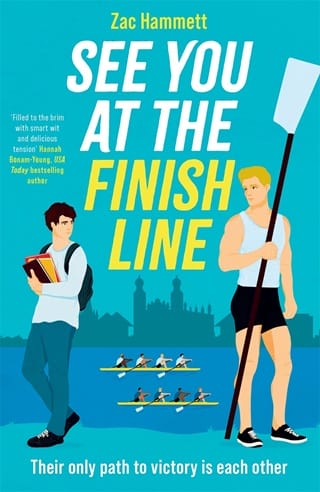
See You at the Finish Line
Chapter One
Lucas
Don’t look outside the boat. That’s all I can think right now. Don’t look outside the boat. It’s a shame, since I must have the best view in the house. To the left of me, the Oxford crew are poised in menacing silence. Behind them, a small flotilla of boats containing the umpire, TV crew and various VIPs. On the banks of the Thames, a crowd of people ten or twelve deep. At least, I assume there is. I can’t look, but I can hear them, chanting out rival slogans as they sip on their plastic pint glasses and shuffle impatiently in the crisp March air. It still feels crazy to me that a student rowing race can attract this much attention. But I mustn’t start thinking like that. If I don’t look, none of it’s real. Don’t look outside the boat. Don’t look. Don’t look. Don’t look.
There’s only one problem with not looking outside the boat. I’m the Cambridge cox, which means I sit in front of our eight rowers, shouting orders and steering with my rudder. Directly opposite me is George, our all-American boat club president, setting the pace in what’s known as the stroke seat. I once read that if you look someone in the eye for four minutes straight, you risk falling in love with them. George and I have conclusively disproved that theory. It’s mad to think how many hours the two of us have spent sitting opposite each other in the boat like this over the past year. I know every inch of George’s face; the sweep of his neat blond side parting that melts mothers’ hearts, the masculine brow and perfectly proportioned cheekbones that remain tanned year-round, the stoic expression behind his grey-blue eyes. He looks like a model – mainly because he is one. In his underpants no less, plastered on billboards around the world. You’d think that would make him arrogant beyond belief, but it’s much worse: George is a people pleaser, desperate to be liked by everyone he meets.
‘Starting positions,’ booms the umpire over his megaphone.
Shit. George and the rest of the team slide forward on their seats and grip their oars. The crowd falls quiet. This is it. I look down the length of the boat to check that it’s straight. The current is pulling us dangerously off course. I raise my hand.
‘Waiting on Cambridge,’ the umpire announces.
George glances up and checks our position.
‘We’re good,’ he whispers.
What’s his problem? Steering is my job. I look back down the line. ‘No we’re not.’
Every single person lining the course or watching on TV is waiting for me to get on with it. But we need to start perfectly straight or we’ll risk crashing into Oxford.
‘We’re good,’ George says again.
‘Wait,’ I insist.
I look down the boat one more time, but now I’m doubting myself. Are we straight or not? Why doesn’t George trust me?
‘When you’re ready, Cambridge,’ the umpire says pointedly.
‘Trust me, we’re good,’ says George, giving the umpire a big goofy thumbs up.
I stare at him. ‘What the hell are you doing?’
‘Just letting him know we’re all good.’
‘But we’re not! What’s wrong with you?’
George glances fretfully back at the umpire. I don’t believe it. He doesn’t want to annoy him.
‘He’s not going to give us extra points for starting on time, George. He’s not going to pat you on the back.’
‘Lucas—’
‘Let me get the boat straight.’
‘It is straight.’
‘No it’s not.’
‘Yes it is!’ George flashes me a kilowatt smile. ‘You got this.’
I’m going to explode if he doesn’t shut up. Now is not the time for a pep talk. Before I know what I’m doing, I lower my hand. Just like that, the umpire sounds his starting klaxon. The rowers pull on their oars, the crowd cheers like mad, and commands come tumbling out of my mouth. What I’m saying, I have no idea. I’m having some kind of out-of-body experience.
‘Back off, Cambridge!’ the umpire screams.
I snap out of it and glance to my left. The boat is off-course. It’s heading straight towards Oxford. I yank hard on my rudder.
‘Fucking hell, George. I told you!’
George pulls on his oar and says nothing. Once the race gets going, the rowers are like pistons in a machine, sliding backwards and forwards with mechanical precision, not an ounce of energy to spare, let alone brain power. It’s me who has to do the thinking. I glance over at Oxford. They’re already half a boat length ahead. How is this happening? How is this the race we’ve prepared all year for? I have to act fast. The course is four miles long, but the advantage switches hands depending on who’s closest to the fastest river current at any given point. I’ve memorised the course’s fluctuations. If we aren’t ahead by the halfway point at Hammersmith, we never will be. And Oxford’s lead is increasing.
‘We need to do a push,’ I say to George. ‘Ready?’
A push means cranking up the stroke rate so high that the rowers might not have anything left for the rest of the race. As George slides forwards on his seat, I can see the beads of sweat on his forehead, the capillaries bursting in the whites of his eyes.
‘It’s too early,’ he splutters.
I stare back at him, rage pulsing through my veins. What’s he worried about now? Upsetting our coach by deviating from the race plan? I’m not an idiot. Doing a push this early is a hell of a risk. But it’s now or never.
‘It’s not too early,’ I scream. ‘Now push! Push! Push!’
I hear a ripple of excitement pass through the crowd as the boat speeds past Thames Rowing Club. A lot of the real fans gather here, on the first half of the course, not at the finish line, by which point the race has almost always been won or lost.
As I shout at the rowers to crank up the stroke rate, I feel the boat begin to glide through the water. We’re edging closer to Oxford. Is this the moment the tables turn? I glance to my side. Oxford have hit back with a push of their own. They’ve re-established their lead without a struggle. If anything, it’s bigger than before.
I can already feel our rowers tiring. I can see it on George’s face. I bring the crew back down to their regular stroke rate and glance at the Oxford boat. There’s clear water between us. My gamble failed. Worse, our spirit has been broken.
Nothing is more demotivating than a bad push.
I try to rally the team, knowing there are still nearly ten minutes left of this torture. But I can see the Hammersmith Bridge approaching, the point at which we conclusively lose our advantage.
The race is over, and everyone knows it.
I close my eyes and feel the water hit me. The shower is too hot, painfully hot, but that suits my mood. I’ve been warned many times how bad it feels to lose the Boat Race, but it’s done nothing to prepare me for the sheer sense of waste. All that training, all that anticipation, for nothing. At the end of the race, the rowers were physically spent to the point of collapse. I felt equally depleted, but I knew it was my job to get the team away from the cameras and back into the boathouse. I couldn’t bear to look George in the eye as we rowed over to the shore. Neither of us said a word. Arriving at the boathouse, we received a pitying round of applause from our friends and family, which only made the humiliation worse. Compared to that, this shower is heaven, and I feel like everything will be all right if I can just stay underneath it forever.
‘Guys,’ says George, ‘gather round.’
I open my eyes and scowl. George is standing in the middle of the changing room, a towel around his waist. We move towards him in various states of undress. When I first started rowing, I was self-conscious about all the casual nudity. But now I know these guys so well that I barely notice who’s fully dressed and who’s butt naked.
‘Before we do the press conference,’ says George, ‘we need a team talk.’
Everyone trades glances. Waiting for us upstairs is an annoyingly large number of journalists. Evidently, George wants to get our story straight before anyone goes off message.
‘Firstly,’ he says, ‘A for effort.’
The rest of the team ignore him. We’re all still too raw for a positive take.
‘Listen, we gave everything, and you can’t ask for more. At the end of the day, there can only be one winner. It’s as simple as that.’
The crew nod vaguely. Wait, don’t start agreeing with him. I might be the one who shouts orders, but George is the president, and people tend to follow his lead. I can feel the anger brewing inside me. Are we really not going to talk about what went wrong out there?
‘So don’t be too hard on yourselves,’ says George. ‘In fact, give yourselves a pat on the back. Next year, we can come back stronger—’
‘Let’s hope not,’ I snap.
Sometimes I just can’t help myself. Everyone turns in my direction.
‘What’s that?’ says George, his genial expression buckling.
‘Let’s hope we’re not all back next year. Not if you’re planning to fuck up the start again.’
George blinks as if he literally can’t comprehend that someone’s criticising him.
‘You told me we were straight when we weren’t,’ I insist.
‘Come on, Lucas,’ says Johannes, ‘what’s done is done.’
Johannes is a six foot seven Swiss guy who does his country proud by remaining steadfastly neutral whenever there’s a conflict.
‘I gave my opinion,’ George says calmly. ‘That’s all.’
‘I’m the cox. It’s my call.’
‘You were freaking out! I was trying to help.’
‘No you weren’t. You were desperate to start because the umpire was getting impatient, and nothing is worse to you than the idea of pissing someone off.’
George is momentarily winded.
‘He’s right,’ says a glacially posh voice.
I look over at Tristan Barnes, who has turned from his usual pasty white to a bright shade of red. Tristan is a politician’s son with a thick neck and beady eyes who inspires no love in any of the crew, but he’s the only one who shares my dislike of our president.
‘You don’t question the cox, George. Not at the start of a race.’
George can’t handle being attacked from two sides.
‘Look, Tristan, you’re entitled to your opinion—’
Without warning, Tristan flings a shoe across the room and lets out a grunt of rage. We’re all familiar with Tristan’s mood swings, but George looks concerned to see that his strategy isn’t working. I need to go in for the kill.
‘Maybe your judgement was off,’ I say. ‘You got in pretty late last night.’
George is wrong-footed but recovers quickly. ‘There were a lot of people at that dinner. I have responsibilities as president.’
‘Do they include that girl you left with?’
The rest of the crew breathe in sharply. Now the gloves are really off. But George remains calm.
‘She asked me to walk her home.’
‘And shag her when you got there?’
‘She’d had a long day.’
‘Oh, so now your shags are a charitable service?’
George glances down at the contents of his towel then smiles at me breezily. ‘Don’t knock it till you’ve tried it.’
The rest of the crew ooh in delight. George has them in the palm of his hand.
I look him in the eye without flinching. ‘I’d rather kill myself.’
I’m not sure that’s strictly true. The first time I ever saw George, I had the same thoughts most people do when they meet him. I’m only human. But then we started working together, and believe me, those thoughts are in the past.
‘Seriously,’ says George, ‘what’s the big deal? If you were getting some, I’d be congratulating you.’
That’s a low blow and he knows it. My love life is a barren desert. As I glare back at him, I feel a surge of humiliation. Only now we’re not in the middle of a race. Now there are no cameras. I look at George, take a deep breath, and charge straight at him.
Ten minutes later, we emerge for the press conference in our boat club blazers, cheeks flushed, hair wet but combed. George makes us wait until everyone is dressed so we can go upstairs as a united front, conscious as ever of the image he’s presenting. It didn’t take much effort for the team to stop me from beating George to a pulp. In fact, it was embarrassingly easy. That’s the problem when you’re almost a foot shorter than most of your teammates. Since coxes are technically dead weight, we tend not to be giants. As I stand sulking, Johannes tidies my hair and I want to cry. I’m trying not to look at George, but every time I do, I’m convinced he looks pleased. Me losing my shit appears to confirm the narrative that the race was all my fault. Presumably, George’s only disappointment is that I haven’t given him a black eye he can parade to the media.
The press conference is being held in the club room of the boathouse where our squad has been based for the past week. As London is sixty miles from Cambridge, we’re renting our boathouse from King’s College Wimbledon, one of London’s most exclusive private schools. It still blows my mind that teenagers can have an entire facility like this on the banks of the Thames. At my school, we shared a football pitch with the local donkey.
The club room is a large, wood-panelled room whose walls are mounted with oars commemorating various famous victories, and numerous team photos commemorating the art of manspreading. As we step into the room, a dozen cameras flash. Our coach, Dame Deborah Hobbs, gives us a wooden nod. Despite the occasion, Deb looks the same as she always does – regulation tracksuit, hair sitting halfway between a mullet and a bob, and ruddy chapped skin that has never known the sweet caress of moisturiser. A quadruple Olympic gold medallist, Deb made waves in the rowing world when she was appointed coach of the Cambridge men’s team. The pressure on her to succeed is immense, and she must be finding this just as painful as we are. Unfortunately for the assembled media, she’s unlikely to elaborate on those feelings. As evidenced by her infamous acceptance speech at the ironically titled Sports Personality of the Year , Deb tends towards the monosyllabic.
A table has been set up in front of the rows of reporters with a cluster of microphones and only two chairs. Deb takes one of the seats reluctantly, while George dives in next to her. The rest of us line up behind them, our main function to stand there and look dignified in defeat. In charge of proceedings is an officious-looking moderator with a clipboard and a poorly executed comb-over. As he opens the floor to questions, an eager woman on the front row shoots her hand up.
‘Deb – Helen Wheeler from the Daily Telegraph . Tough result for you today.’
‘Yes,’ says Deb.
Helen Wheeler stares at her. ‘Sorry, do you want to—’
‘Only one question allowed,’ the moderator says briskly.
‘But I didn’t ask a question!’
The moderator is unbothered. This is a guy who lives for the rule book. He gestures at the next reporter.
‘Neil Ronaldson from The Times . Can you tell us what the race strategy was today?’
Deb looks at him blankly. ‘No.’
There’s a murmur among the reporters. This is ridiculous even by Deb’s standards. She must really be hurting. The next reporter thinks long and hard before asking his question.
‘Deb, what do you think Cambridge could have done differently?’
Deb pauses for an equally long time before answering.
‘Lots.’
The reporters are on the verge of mutiny.
‘If I may,’ George says.
The reporters turn their attention towards George. As the cameras flash in his direction, he blossoms like a flower.
‘We don’t comment on specific tactics,’ says George, ‘but I can say that we prepared for every eventuality and executed our strategy to the best of our ability.’
The reporters nod gratefully, which gives George the approval he’s craving.
‘George, can you tell us what was going on at the start of the race there?’ asks the next reporter. ‘Looked like there was some disagreement between you and your cox.’
It’s taking everything in me not to pipe up and make some headlines.
‘No disagreement,’ says George. ‘We were making sure the boat was straight.’
‘But it wasn’t,’ says the reporter. ‘We could see that. Was that the cox’s fault?’
Everyone holds their breath. Not even the moderator is objecting to the follow-up question. I brace myself. If George had any dignity, he’d admit to his mistake. Instead, he’s about to throw me under the bus and end my rowing career.
‘Absolutely not,’ says George. ‘Lucas had a flawless race. The start wasn’t the issue. Oxford beat us because they had more power than us. It’s as simple as that.’
Our friends and family are still gathered on the terrace they watched the race from – a large, first floor balcony that has been decorated with sponsors’ banners and balloons in Cambridge’s official shade of light blue. The boat club struggled so hard to find a sponsor who wasn’t tangentially complicit in global warming or arms dealing that we’ve ended up being sponsored by a brand of toothpaste. As we appear at the terrace, the guests stop their chatter and offer another half-hearted round of applause. There’s only one thing that’s going to make any of this remotely bearable, and it’s the free bar. As I head towards it, I feel a tap on my shoulder and spin around.
‘Hi, Lucas – Helen Wheeler from the Daily Telegraph .’
‘What are you doing here? Press conference is over.’
‘I didn’t get a chance to get your comments on the race. Could I just—’
‘No. No comment.’
I push past Helen Wheeler and look out across the crowd. It’s events like this which remind me that rowing is not a sport for people who grew up like I did. It’s for people who’ve been competing at regattas since boarding school. People whose fathers and grandfathers rowed for Cambridge. People who actively enjoy wearing blazers. I can see several former Cambridge rowers, or Old Blues, as they’re so brutally called. One bloated man in his fifties is sounding off to some poor woman about the famous dead heat of 1877, while another appears to be demonstrating his rowing technique to a trio of baffled undergraduates by squatting on the floor. I can’t decide what’s more tragic – if these men in their ill-fitting blazers are former winners or losers.
Beyond them, there’s Tristan and his father, a government minister who was sacked after an unfortunate hot mic incident involving a breastfeeding journalist. He looks positively delighted that it’s his son who bears the stench of failure today. Tristan’s father is much shorter than him, while his mother is a slim little apology of a woman, which suggests that Tristan is either a genetic abnormality or the result of an affair. Tristan is venting while his mother and girlfriend Eleanor work overtime to placate him and assure him that everything would have gone differently if he’d been in George’s place.
As my gaze reaches the far side of the terrace, I see a familiar pair of big brown eyes and long dark eyelashes and my heart almost stops. Amir.
Amir is a boy in my year at Cambridge who’s been my crush for as long as I can remember. Look at him, standing there in an immaculately ironed shirt and chinos that perfectly frame his slender figure. He’s always so elegant and flawless, like he’s been groomed by a whole team of people. I’m not surprised to see him here – I’ve stalked Amir’s social media extensively enough to know that he’s come to support Wilbur, his old school friend who rows for our reserve crew.
I wonder if Amir’s noticed me. I’m too nervous to catch his eye. Maybe if I drink approximately forty-five cocktails, I’ll have the courage to go over and—
‘Lucas!’
I turn to see my mum waving at me. She’s wearing the purple dress she reserves for special occasions. Next to her is my younger sister Casey, who’s also in a dress and heels, looking like she’s ready to follow through on her threat to audition for the next season of Love Island . I don’t have a clue about women’s fashion, but even I can tell they’ve both got it slightly wrong. The other women in the room are much more casually dressed, in crew-neck sweaters and jeans. They look at home in a way my mum and Casey never could. My heart breaks for them, but I’m also embarrassed. I feel bad, but now I’m actively hoping Amir hasn’t noticed me as I cross over and greet my family. There’s no chance I’m going to mention their faux pas. We might be common, but we’re still British.
‘I’m sorry, Lukey,’ says my mum. ‘I know how hard you worked for this.’
I nod and bite my tongue. Damn all these posh people and their stiff upper lips.
‘Thanks,’ I say. ‘Bet you wish you hadn’t bothered.’
I’m secretly touched that my mum paid for a Travelodge for her and my sister that she really can’t afford. After all that effort, the least I could have done was win.
‘Of course we don’t,’ says my mum. ‘It was very exciting.’
‘What happened?’ asks Casey.
I cast around the room and see George talking to the Telegraph journalist. He’s answering every single one of her questions without letting his smile slip once.
‘He did,’ I say, pointing. ‘He screwed up big time.’
‘Ooh,’ says Casey. ‘Is that the underwear model?’
I’m about to launch into a rant for the ages when George glances across and catches us looking at him. To my horror, he excuses himself and walks straight over.
‘You must be Lucas’s family,’ George says with a smile.
My mum thrusts out a hand for George to shake and ward off any chance of him being a hugger.
‘Just had a chat with that reporter,’ George says to me with a wink. ‘Making sure she’s got her story straight.’
I raise an eyebrow at him.
‘I’m sure you had her falling at your feet.’
George turns to my mum and sister. ‘How proud are you of this guy?’
‘They’re giving me two out of ten,’ I say.
‘Don’t be silly,’ says my mum.
‘Yeah,’ says George, ‘you did so well.’
I look at him drily. ‘George, we lost.’
‘We almost won.’
‘No we didn’t. We came dead last.’
‘We actually came second, if you think about it.’
‘What, like Harold came second in 1066?’
George pauses to process that one.
‘You should still be proud of yourself,’ he insists.
‘Of course he should,’ says my mum. ‘We all are.’
‘Cool, how about you all be proud of me and I’ll blow my head off?’
My mum rolls her eyes at me.
‘Don’t worry,’ she says to George, ‘we’re used to this. Do you have family here?’
George betrays a flicker of sadness. ‘No. We’re a long way from Wisconsin.’
‘Oh well,’ says my mum. ‘Maybe they can come see you win next year.’
‘For those of us who are selected,’ I say pointedly.
George looks uncomfortable and glances across the room. ‘I should keep doing the rounds. Excuse me, ladies. It was so great to meet you.’
As George walks away, my mum looks like she’s had an audience with the Pope. ‘What a lovely young man.’
‘Join the queue, Mum. His reputation is legendary.’
My mum tuts. ‘It must be hard, not having your family here to support you.’
‘Seriously, Mum, don’t get sucked in by George. He’s the worst.’
‘Why? What did he do?’
‘He’s acting like he’s doing me a massive favour by getting the press not to focus on the start of the race. When actually, he’s doing that because he knows that if they do, they’ll realise he fucked up. He’s getting away with it, like he always does. He’s not even a proper Cambridge student.’
Casey frowns. ‘What do you mean?’
‘He’d never have got his place if he couldn’t row. They bring in these athletes who literally can’t pass their exams.’
My mum looks shocked. ‘That can’t be allowed.’
‘It’s not. Not officially. But both sides do it.’
‘Then .?.?. what’s the problem? Surely you want the best rowers.’
‘Yeah, you’d think, but it’s not that simple. You need to do more than sit in a boat and pull your oar. You need to be smart, and George isn’t smart. He’s not smart enough to know we weren’t straight at the start. He’s not smart enough to know when to do the push. He’s not smart enough not to have sex the night before the race. And the worst part is, he’s convinced he’s right every time. Like idiots always are. Until we get people like him off the team, we’re never winning.’
My mum nods and pats my arm. She knows that all I want is to be heard. Casey glances behind me and her eyes widen. I turn to see what she’s looking at. It’s Helen Wheeler from the Daily Telegraph , standing right there, recording on her Dictaphone.