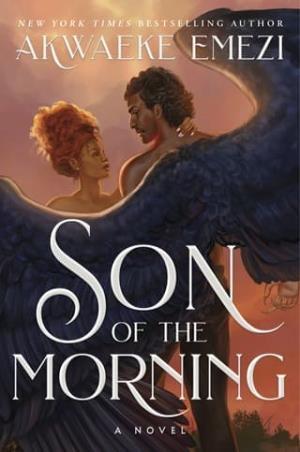
Son of the Morning
Prologue
Galilee Kincaid was born with an ache inside her.
She’d felt it for as long as she could remember, continuous and insistent, a thousand small stings that never let up. Sometimes
it swelled into a wanting with no direction, just an explosion of volume and intensity—sharp wings that tore her apart over
and over again. She learned to breathe through it, to accept the stings even as the ache cost her sleepless nights staring
at her ceiling while cicadas shrieked outside her window.
Galilee had grown up in the deep country, many miles outside the nearby city of Salvation. The water whispered that far out
in the land; it sang and bubbled and held all kinds of secrets in large, scaled bodies and powerful jaws. It carried whispers
over moss-covered rocks, spilling in small waterfalls as black birds flew in circles against a lurid sky. In the forest, dark,
gangling figures snapped through the underbrush, and the white-tailed deer screamed as they fled on their delicate, panicked
limbs. The Kincaid women had lived on that land since before they took the name, and it had been many decades since they built
the monstrously large house in which Galilee was raised, surrounded by aged oak trees and weeping willows. A winding road
led to the sprawling porch, and every tree lining that road was adorned with a storm of blue bottles, the glass spinning in
the sunlight.
The Kincaids were led by their matriarch, Darling Kincaid, and the house was filled with generations of women—Darling’s nieces and her daughters, all their daughters in turn. When the girls came of age, they often stayed in the big house, but sometimes they left for towns and
cities nearby: St. Paradise, Lucille, Cypress. No matter where they ended up, Kincaid women kept no men and bore no sons.
Those who remained on the land were a little wilder than the others—fishing in the endless creeks, hunting for meat and for
things that did not belong on this side of the veil, blood on their hands and ease in their throats. Every single one of them
watched Galilee closely, because they knew she was something, though no one could say exactly what. The child smelled of bones under dead leaves, and sometimes, when she played in the
gardens, the bees covered her arms and chest in a thick blanket while her white teeth laughed through the swarm, certain that
none of her tiny buzzing companions would ever sting her. The Kincaids were careful not to speak to Galilee about her strangeness,
only to each other when the child was safely out of the way, when she couldn’t hear anything that might make her feel different
or like she didn’t belong. No matter how strange she was, the Kincaids knew she belonged, because they had decided the moment the newborn Galilee had been placed in her mother Collette’s arms.
In their bright kitchen, Collette Kincaid worked a round of piecrust dough under her rolling pin and felt it exhale beneath
her hands. Her cousins and sisters and nieces were talking about her daughter again, the little strange girl with inky eyes
and copper hair, with freckles and dark honeycomb skin. Collette was tired of hearing it.
“Let her be a child,” she snapped. “Don’t ask her for more.”
“Just a laying of hands,” one of the cousins argued. “Shirley swears her knee hasn’t been hurting since Gali helped her rub
it down with ointment last week. It won’t take her but a minute to help Peony.”
“Celestial made that ointment,” Shirley countered. Collette shot a grateful look at her sister for trying to deflect.
“Exactly,” another cousin chimed in. “It’s got nothing to do with Gali.”
“Can’t hurt to try!”
“Jesmyn, why don’t you tell Peony to use the damn garden stool we got her and maybe her back won’t hurt so much!”
“You cold as a snake, Eunice. My wife is hurting—”
“Enough.” The entire kitchen fell into a respectful hush as Darling Kincaid looked up from her tumbler of whiskey. “That girl is anointed.”
Her voice was both a rasp and a blade, and her descendants cringed. Darling Kincaid was the last of her generation after her
sisters had passed. Her hair was long and coarse and silver, braided into small plaits that hung around her shoulders. “That
girl is also too damn young for y’all to be hanging your hearts on her like this. Whatever God gave her? It ain’t no tool to be
picked up like a damn wrench.”
When Galilee was born, something had bruised Darling’s spirit terribly. She never spoke of it, but her daughters felt the
difference—a millstone of grief swinging from their mother’s neck, a wild sorrow that hung in the back of her gaze and cut
her smiles short. Still, Darling was Galilee’s fiercest protector, no matter what the child had cost her.
Jesmyn lowered her gaze, a little shamed in the wake of her pleading for Galilee to lay hands on her wife. “Not a tool, Nana
Darling. A gift.”
Darling’s voice took on even more of an edge. “A gift she will use in her own time, when she feels good and ready.”
There was silence again, then a cousin who was boiling berries on the stove spoke up. “Now we on the subject . . .” Everyone
swiveled their heads to look at her, and a flush crept up the cousin’s neck. “I know no one likes to say this about Gali,
but we’ve all noticed, I know we have. She smells different—”
A muted but collective gasp went around, and Collette stepped back, flour falling off her hands. It was dangerous to say things
like that out loud, even as well warded as the Kincaid house was.
“Hush, child,” Eunice warned in a hoarse whisper. “You don’t know what you’re talking about.”
Collette glanced as the sky began to darken outside.
Goddammit, she thought. It was as if the world was always waiting for some things to be said about Galilee, constantly eavesdropping.
The sunlight that had been filtering into the kitchen was fading, but the cousin hardened her jaw and put down her red-stained wooden spoon.
“I know the smell of wrong worlds and misplaced creatures,” she hissed, then gestured widely toward the fields and swampy
forest that surrounded their home. “We don’t live out here for nothing!”
Her words brought in more darkness as a thunderous cloud rolled over the house. Collette lunged across the kitchen to clap
a hand over her cousin’s mouth.
“Be quiet, Sage!” she hissed. “You know better!”
Sage’s eyes filled with hurt, and she pushed down Collette’s hand. “I just wanna know when you’re gonna tell us what she is.”
“She’s my daughter,” Collette snarled.
“You know what I mean.”
Collette flinched, but Sage grabbed her wrist tightly.
“Why are we hiding her?”
“Quiet!” Darling’s voice cracked cowhide slick through the room as she stood up, her dark eyes brutal. “When anyone asks what
that child is, what do we answer?” She raked her gaze across her family, and they lowered their eyes.
“Ours,” they replied together. “She is ours.”
It was a spoken ritual, this claiming, and every Kincaid woman knew what it meant. Sage had remained silent, but even she
cowered as Galilee’s grandmother walked up to her. Collette slipped out of the way.
“Blood and dirt,” Darling said, reproach heavy in her mouth. “The Kincaids have made bargains in the belly of the creeks before
our bloodline even had this name.”
The air looked like dusk now, even though it had been midafternoon just minutes ago. Collette stared out the window, worried.
“It’s getting darker,” she said.
Darling didn’t look at her, still fixed on the cousin trembling next to the stove. “The deal is struck and Gali is ours,” she said, and iron clanged in her words. “The girl’s a Kincaid. You a Kincaid. Never question if she belongs here again. We ain’t nothing if we not loyal.”
Sage sniffled, her shoulders folding in on themselves. “I’m afraid, Nana Darling,” she whispered. “She holding too much light.
Should be burning, but it’s so cold.” Her voice dropped even lower, soft with terror, her eyes glazing over. “What happens
when she gets too bright? When she’s discovered?”
Collette glanced away from the window, frowning at Sage. “Is she having a vision?” she asked the rest of the women.
Sage was a seer, but her gift was never as clear as the family would have liked. The other women put down their work and gathered
around.
“Fragments,” Shirley decided, after leaning in. “Glimpses of the future, but they’re all colored by fear.”
Darling turned away. “Fear is useless.”
She went to stand by Collette at the window, her silver plaits brushing against her shoulders. In the darkening outdoors,
a young Galilee was staring up at the sky. She was eleven then, her hair in twists, barefoot and wearing a hand-me-down pinafore
from her favorite cousin, Celestial, who was napping in the grass. A paperback was sprawled out next to Galilee, its pages
dog-eared and well loved, and a handful of bees circled lazily above her like a halo. Her cousins Zélie and Leah were playing
tag around her, shrieking with all the delight of youth. As the women watched, Galilee waved an impatient hand at the roiling
clouds.
“Go away,” she scolded, her voice as sweet and high as a bell. “I was still reading.”
The sky paused, then the clouds rolled back and splintered into nothing, exposing the blue sky. Sunshine broke over the Kincaid
house, and just like that, the world was reset.
Collette exhaled sharply, her fingers biting into the windowsill. “She’s never going to be safe, Nana Darling.”
Darling placed a wrinkled hand on her shoulder. “We’ll make her safe. You just remember to call her in for dinner.”
Outside, Galilee curled back up with her book. She could hear the land humming under her body and feel the pull of roots winding
deep in the dark earth, but the ache in her chest was loud. All the stings seemed to echo under her ribs, like part of her
was as hollow as a dead tree, waiting to be resurrected. Galilee didn’t talk much about it to her family. They would want
to fix her, and they wouldn’t rest until they figured it out. It would be exhausting. She would wait instead, and if it didn’t
go away when she was older, maybe she would say something then.
And so the years passed. No one spoke to Galilee about deals cut on creek beds or the many small and uncanny things she could
do. All the Kincaids were favored, one way or another, but no one talked to her about how some anointings are different from
others, or how some little girls come not just from their mother’s bodies but from bloody bargains sealed in dirt and fleeing
water. So Galilee continued carrying her stinging ache, and no one told her anything.
Given what she turned out to be, perhaps they should have tried.
I could have intervened at any point.
The girl was bright and sharp, but she was missing something, just enough for that missing to grow into something hungry—a chasm clamoring to be fed.
I watched her from the dappled shadows of the drifting willows, this child who was strange enough to feel othered within her own family, even as peculiar as they all were.
I watched her play with her cousins: the near-feral Celestial, sweet Zélie, and quiet Leah.
I heard her soft snuffling breaths as she slept sprawled among them as the night breeze billowed out the curtains in their room.
I smelled the salt of her tears each time Sage hurt her feelings.
The halfway seer never got over her suspicion of the girl, and it spilled out in pieces—she gave Galilee the dirtiest chores, whispered gossip to the other aunts about her, just enough for some of them to start treating Galilee a little different too.
It added up to a hundred small slights that cut deep into the child’s heart.
It was cruel, most likely, but it was necessary.
This is what you do with power. You cannot let it fade away or adapt to something lesser than itself just for the sake of mere comfort. It would
be a terrible waste, and I had no intention of squandering Galilee Kincaid.
I had such plans for her.