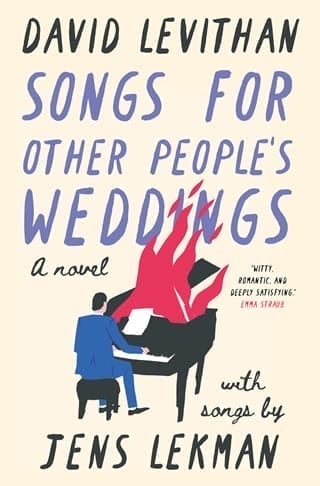
Songs for Other People’s Weddings
The First Wedding
Let’s start at the urinal.
Two men are standing unnaturally close to one another, which would ordinarily be a significant breach of urinary etiquette, especially when the dividers are as ineffective as they are here.
But in this instance, the breach is entirely pardonable, because these two men, Jun and Arthur, have just gotten married.
Also, they are wearing a gigantic tuxedo that’s been tailored for two people to share.
The white shirts underneath are sewn together with a big bowtie on the top.
The pants are appropriate for both a formal occasion and a three-legged race. The fly has been inconveniently placed.
Behind them, the wedding singer waits his turn.
In all the time Jun and Arthur spent planning for this big day, it hadn’t occurred to either of them to think about peeing.
In order to approach the fly at the proper angle, Arthur has found it necessary to fold himself into Jun, one arm bracing for stability, the other trying to guide the trajectory.
The endeavor plays out the way most weddings do, as a messy process with unexpected challenges that test the bounds of teamwork.
But in the end, there’s a certain sense of relief.
Jun and Arthur are both in their early forties, and as with most gay men of their generation, their gay identities formed first as a matter of revelation and survival, next as a matter of pleasure and defiance, and finally as a matter of community and pride.
When they were sixteen years old, ten years away from meeting each other, getting legally married wasn’t something they could imagine.
And if they had, it would have felt like a Technicolor dream sequence.
Their love formed when marriage was still out of bounds, and when the bounds changed with astonishing speed, it took them a while to decide the step finally being offered was a step worth taking.
The only way they could do it was in their own fashion.
Some couples have a favorite song. Jun and Arthur have a favorite state of being, and that is song.
Neither of them sings particularly well or plays an instrument with any proficiency.
Instead they believe in the ever-present soundtrack, the perpetual playlist. Sometimes they control the dials, manipulating their sonic surroundings to enhance or alter their moods.
Other times, they leave it to chance—not just by shuffling toward randomness, but often by wandering around Gothenburg and waiting for a song to come to them, lilting from an open window or roaring out of a bar.
The life they share and the songs they share are inseparable.
So when they planned their wedding they knew they wanted:
1) A theme-songed wedding
2) A song-themed wedding
The second of these desires leads to the first explanation of their costume.
Just as each of their guests has come dressed as a favorite song, Jun and Arthur are dressed as a tune that fits the occasion far better than a large tuxedo fits two men of different heights: the Spice Girls’ mathematically simplistic yet philosophically rich ballad “2 Become 1.”
As for the desire to have a theme-songed wedding...well, that is where J, the man waiting patiently behind them, comes in.
J is a somewhat successful Swedish singer-songwriter.
If you live outside of Sweden, it’s unlikely you’ve heard any of his songs on the radio.
..unless you are one of the bookish, folkish sort who listen to bookish, folkish stations that play bookish, folkish ditties. Then you might know exactly who J is.
The reason he’s here tonight is not a longstanding friendship with Jun and Arthur.
Until they emailed him out of the blue, J had never met them.
This may seem like a strange thing to do, but for J, it is not that strange, because on his debut album there is a song called “If You Ever Need a Stranger (to Sing at Your Wedding).” It goes like this:
If you ever need a stranger
To sing at your wedding
A last-minute choice, then I am your man
I know every song, you name it
By Bacharach or David
Every stupid love song that’s ever touched your heart
Every power ballad that’s ever climbed the charts
You think it’s funny
My obsession with the holy matrimony
But I’m just so amazed to witness true love
And true love can be measured
Through these simple pleasures
They are waiting there for you to be discovered
I would cut off my right arm to be someone’s lover
Maybe I’ll meet her there tonight at the wedding buffet
I walk up to her when she’s caught the bouquet
Songs are not, by nature, self-fulfilling prophecies. It’s safe to say that Bing Crosby experienced many snowless Christmases, Michael Jackson notably did not heal the world, and Florence Welch had no idea what 2020 was going to be like when she proclaimed the dog days to be over in 2010.
Over the years, many devotees of J’s music have gotten in touch with him when their weddings are in the larval stage, asking if he’s available to put some musical colors onto the ceremony’s wings.
Wedding singer gigs are usually more lucrative than busking, but J does not charge much for these efforts if (like Jun and Arthur) the couples are of modest means.
Undoubtedly if you asked J as he waits for the urinal why he is here, he would answer, “Because of my song ‘If You Ever Need a Stranger (to Sing at Your Wedding).’ They were strangers. I am singing at their wedding.”
Still, there’s more to it than that. J just doesn’t see it yet.
Instead he sees Arthur adjusting himself back into his underwear and Jun angling to take his own turn at the urinal.
“J!” Arthur calls out. “We’re so glad you’re here! We’d shake your hand, but I think it would be best if we washed off first. It’s really hard to piss in this tuxedo!”
“It’s wonderful to be here,” J says, maneuvering around the pair to get to a stall that has freed up. “It’s quite a crowd.”
Jun and Arthur finish their effluent business by the time J finishes his own.
They wait as he washes his hands, then wrap him in a two-armed, three-legged hug.
When they step back, they take a look at what J’s wearing: a deep-red beret and a wine-dark shirt covered in balloons, a number of which have already been popped.
“Oh, dear,” Jun murmurs sympathetically.
In keeping with the wedding’s theme, J had planned to be dressed as Nena’s eighties classic “99 Luftballons,” even though (a) only about sixteen luftballons fit on his shirt and (b) the song in its original German is about a group of fighter jets that open fire on balloons they’ve mistaken for UFOs, starting a ruinous military spiral that leads to a world where “ 99 Jahre Krieg lieBen keinen Platz für Sieger ”—“99 years of wars have left no place for winners.”
“What happened?” Arthur asks, assessing the red rubber carnage.
“Your nephews,” J answers. (The nephews are aged ten, six, and five, and collectively dressed as Kung Fu Fighting; the balloons didn’t stand a chance.)
Worried that his truthfulness has brought down the mood as only, say, the last lines of “99 Luftballons” can, J adds, “But it’s okay! I can be ‘Raspberry Beret’ instead.” (“Raspberry Beret” ends in a world where “I think I love her.” Better.)
“A Prince and two queens!” Jun exclaims.
Arthur groans, but there is affection in his protest.
J smiles at the sight of them in their absurd tuxedo. It is not the kind of smile that needs any thought behind it. His heart has grown so full that his mouth must lift.
The word for what he feels is tenderness .
That is the true reason he’s here.
There are a few standard questions J asks couples when trying to write their wedding song.
But mostly, he improvises. He can measure immediately whether both people in the couple want him to be there, or whether only one of them is a fan and the other is merely humoring.
If both are into it, the process begins.
J always starts with a simple question: “How did you meet?” (For Jun and Arthur, at a museum installation; Jun was the artist, and Arthur was doing the installing.) Then he might progress to “What did your friends first think of the two of you together?” or “What was your favorite date, from early on?” After that: free swim.
“What’s the stupidest fight you’ve ever had?
” or “What’s your favorite piece of his clothing?
” or “What habit of hers went away after she met you?” Jun and Arthur talked a lot about the challenges of queer romance, how in their youth it felt antisocial to not be hedonistic, and how settling down now feels like a betrayal of youth, to some degree.
“So what does this wedding mean to you?” J asked.
“Well, it all comes down to Plato’s Symposium, ” Arthur replied.
“Not to be confused with Plato’s Retreat,” Jun added, snickering.
Arthur pressed on. “Correct. Symposium . I’m sure you heard about it in school and thought it was boring beyond words, but it’s actually amazing, in a funny and touching way. It’s a bunch of Greek guys who come together, get absolutely wasted, and talk about love.”
Jun picked up the thread. “Aristophanes, a comedy writer who’s probably the drunkest of them all, recovers from his hiccups long enough to tell this story of how humans used to have doubled bodies.
There were three different kinds: the double males who were from the Sun, the double females who were from Earth, and the androgynous who were half man and half woman and lived on the Moon. ”
“The double humans started to mess with the gods, and Zeus got angry and decided to split them all in half—”
“—You probably know this part from Hedwig— ”
“Can I finish? So, yes, Zeus split them up. But he did nothing to erase their memories. Our memories. So each of us walks around the earth looking for our other half.”
“And now I’ve found mine.”
“And I, mine.”